


Best IWB Holster for Light Bearing: 2026 Guide
Table of Contents
- Why a Standard Holster Won't Work for a Light-Bearing Pistol
- IWB vs OWB Holsters for Light-Bearing Pistols
- Kydex vs Leather for IWB Light-Bearing Holsters
- What to Look for in an IWB Holster for Light Bearing
- Holster for Glock With Light: Fitment and Compatibility
- How to Adjust Holster Retention for a Light-Bearing Setup
- Top IWB Light-Bearing Holsters From Lindahl Holsters
- Conclusion
Last Updated: August 29, 2026
A standard holster will fail you the moment you mount a weapon-mounted light. This guide covers everything you need to know to choose the right IWB holster for light bearing, from material selection and retention systems to fitment compatibility and heat dissipation.
Quick Picks:
- Best Overall IWB Light-Bearing Holster: Lindahl Holsters custom Kydex, precision-molded to your exact pistol and WML combination
- Best for Appendix Carry: Lindahl Holsters AIWB configuration with concealment claw and adjustable cant
- Best for Duty Use: Lindahl Holsters Level 2 active retention holster with WML compatibility
Why a Standard Holster Won't Work for a Light-Bearing Pistol
A standard holster is molded to the pistol alone. When you attach a rail-mounted light, the firearm's geometry changes dramatically below the trigger guard. The holster shell no longer captures the correct retention points, the muzzle end won't close around the light body, and the trigger guard is left partially uncovered.
An IWB holster for light bearing requires a shell molded specifically to the combined footprint of the pistol and mounted WML, with trigger guard coverage extended to account for the new geometry. Without that precision molding, the pistol either rattles inside a shell that's too loose or won't seat at all.
A poorly fitting holster on a light-bearing pistol can allow trigger contact during holstering, especially when the WML's extra bulk shifts the draw stroke. According to ATF safety guidelines for holster carry, the holster must fully cover the trigger guard to meet basic safe carry standards. A dedicated light-bearing holster shell is the only reliable way to achieve this.
IWB vs OWB Holsters for Light-Bearing Pistols
Outside-the-waistband holsters are simpler to fit for light-bearing setups because the WML sits outboard of the belt. Inside-the-waistband carry is harder to execute but is the right choice for most concealed carriers and entirely achievable with correct holster design.
Concealment and Profile When Carrying IWB
The biggest challenge with an IWB holster for light bearing is bulk. A well-designed light-bearing IWB holster addresses this with a concealment claw that presses against the belt to rotate the grip inward and a low-profile belt clip that minimizes the waistline footprint.
Ride height matters too. Setting the holster higher tucks the light body deeper into the waistband, reducing visible print along the muzzle. Most quality Kydex IWB holsters for light-bearing pistols offer adjustable ride height via slotted hardware.
Appendix Carry With a Weapon-Mounted Light
Appendix carry with a WML demands specific holster geometry. The light body sits forward of the hip, pointed downward between your body and waistband. The holster must angle the muzzle away from the body, and the sweat guard must be tall enough to protect the slide without interfering with the draw stroke.
For AIWB with a WML, a neutral to slight forward cant typically works better than a steep angle, keeping the grip accessible while managing the light body's position.
Kydex vs Leather for IWB Light-Bearing Holsters
Kydex wins this comparison for light-bearing setups.
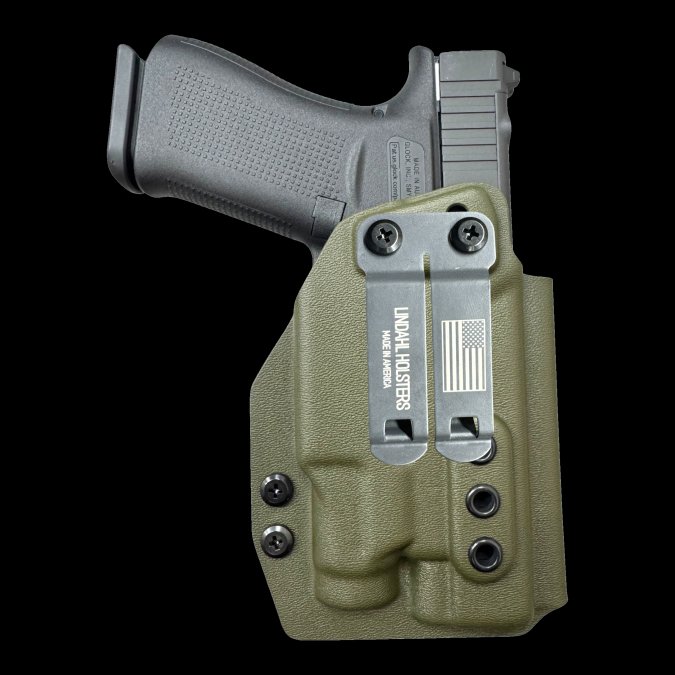
Close-up of a precision-molded Kydex IWB holster with a pistol and rail-mounted light inserted, laid on a wooden surface with a belt clip visible
Leather holsters are molded over time by the pistol's shape through repeated use. A WML changes this equation. The leather must conform to the combined shape of the pistol and light body, and it tends to do so inconsistently, leading to soft spots around the trigger guard and unpredictable retention as the leather breaks in.
Kydex is thermoformed directly over a mold of the specific pistol and WML combination. The result is a holster shell with consistent retention from the first draw onward. Trigger guard coverage is rigid and precise. Retention is set by the snap of the pistol into the shell, not by leather tension that varies with temperature and humidity.
Leather also absorbs sweat, which accelerates corrosion on the slide finish and internal components. A Kydex shell is non-porous, easy to wipe clean, and won't degrade with daily carry the way leather does.
Hybrid holsters offer a middle ground in comfort against the body, but for light-bearing setups, the Kydex shell component must still be precision-molded to the pistol and WML combination. The leather backer adds bulk, which can work against concealment for larger light-bearing pistols.
What to Look for in an IWB Holster for Light Bearing
These specifications matter when evaluating light-bearing IWB holsters.
Retention Systems: Passive vs Active
Passive retention is the snap or click you feel when the pistol seats fully in the holster shell. It's created by the holster shell flexing slightly around the pistol's widest points. Most civilian concealed carry holsters use passive retention exclusively.
Active retention adds a mechanical device, usually a thumb-activated lever, that must be deliberately disengaged before the pistol can be drawn. Active retention is standard on duty holsters used by law enforcement.
For an IWB holster for light bearing in a concealed carry context, passive retention is typically sufficient if it's adjustable. As the holster shell wears over time, you need to tighten it via hardware adjustment rather than replacing the holster.
For law enforcement or security professionals using a light-bearing setup in a duty context, active retention at Level 2 is the minimum standard.
Optics-Ready Configurations and Sweat Guard Design
If your pistol has a red dot optic mounted in addition to a WML, the holster must be cut to clear the optic body. An optics-ready configuration typically means the holster shell has an open top or cutout that allows the optic to seat without interference.
The sweat guard protects the slide from direct contact with sweat and prevents the belt or clothing from interfering with the draw stroke. For light-bearing setups, a full-height sweat guard is generally preferable, keeping the rear of the slide indexed consistently on every draw.
Ambidextrous Options and Adjustable Cant
Most precision-molded Kydex holsters are handed, meaning they're built specifically for right- or left-hand draw. Truly ambidextrous designs involve compromises in shell geometry that can affect retention consistency. If you carry on the non-dominant side, specify that when ordering rather than buying an an ambidextrous model.
Adjustable cant allows you to change the angle at which the pistol sits relative to vertical. A neutral cant positions the grip straight up and down. A forward cant angles the grip forward, which many carriers find more natural for a strong-side hip draw. For appendix carry, a slight negative cant is common. Quality Kydex IWB holsters allow cant adjustment in the field via hex key.
Holster for Glock With Light: Fitment and Compatibility
The holster for Glock with light is one of the most searched configurations in the IWB holster category. Glock pistols are widely carried and their MIL-STD-1913 Picatinny-compatible rail accepts a broad range of WMLs including the SureFire X300, Streamlight TLR-1, and TLR-7A.
The critical point is that the holster must be molded to the specific Glock model and the specific light. A holster molded for a Glock 19 with a TLR-7A will not correctly fit a Glock 19 with a TLR-1. The two lights have different body dimensions and retention geometry.
Universal vs Dedicated Holster Shells: Compatibility Matrix
Universal light-bearing holsters claim to fit multiple pistol and light combinations by using adjustable retention screws and a loose shell profile. In practice, that looseness compromises trigger guard coverage and retention consistency.
Configuration |
Dedicated Shell |
Universal Shell |
|---|---|---|
Trigger guard coverage |
Full, precision-molded |
Partial or inconsistent |
Retention consistency |
Adjustable, reliable |
Variable by combination |
Concealment profile |
Optimized for pistol/light |
Bulkier due to loose fit |
Optics compatibility |
Specifiable at order |
Rarely accommodated |
Recommended for duty use |
Yes |
No |
Recommended for AIWB |
Yes |
No |
Dedicated shells win on every functional criterion. The only advantage of a universal holster is cost, a poor trade when the function in question is safely retaining a firearm.
WML Heat Dissipation and Holster Safety
Weapon-mounted lights, particularly high-output LED units, generate meaningful heat at the light body (peer-reviewed research). When the pistol is holstered, that heat transfers into the holster shell and against your body.
Kydex has relatively low thermal conductivity, but prolonged contact with a hot WML body can cause localized softening of the holster shell over time (peer-reviewed research). The practical mitigation is straightforward: allow the WML to cool for a few minutes after extended use before holstering. For duty carriers who may not have that option, a holster shell made from higher-temperature-rated Boltaron offers better long-term resistance to heat-related deformation.
How to Adjust Holster Retention for a Light-Bearing Setup
Retention adjustment is one of the most misunderstood aspects of Kydex holster ownership. The goal is a holster that holds the pistol securely during normal movement but releases cleanly on a deliberate draw stroke.
Hands using a hex key to adjust retention screws on a Kydex holster shell, with the holster secured to a gun belt on a workbench, under bright workshop lighting
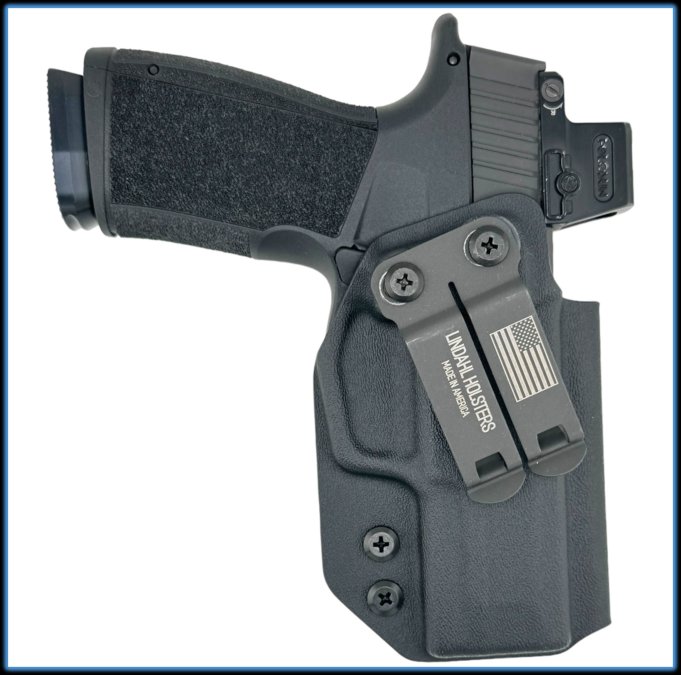
Most Kydex IWB holsters use one or two retention screws that compress the holster shell around the pistol. Tightening the screws increases passive retention; loosening them reduces it. For a light-bearing setup, the retention geometry differs from a bare pistol holster because the WML body creates additional contact points.
Start with all retention screws at the manufacturer's baseline setting. Seat the pistol fully until you hear or feel the retention click. Attempt to remove the pistol with a deliberate draw stroke. The pistol should release cleanly with intentional force but not rattle with normal movement.
Troubleshooting Common Fitment Issues
The pistol won't seat fully. This usually means the holster shell is too tight around the WML body. First, check that the WML is the exact model the holster was designed for. If the light is correct, try cycling the draw and reholster motion 20-30 times to allow the shell to break in slightly.
The pistol seats but retention is too loose. Tighten the retention screws in quarter-turn increments, testing after each adjustment. If tightening doesn't restore retention, the shell may have worn beyond its adjustment range and needs replacement.
The holster prints more than expected. Adjust the ride height upward to tuck the WML body deeper into the waistband. If the holster has a concealment claw, verify it's positioned to press against the inside of the belt.
The draw stroke feels inconsistent. Check the cant setting. Small cant adjustments have an outsized effect on draw stroke consistency, especially for appendix carry.
Top IWB Light-Bearing Holsters From Lindahl Holsters
Lindahl Holsters builds every IWB holster for light bearing as a dedicated, precision-molded Kydex shell. Every holster is made to the specific pistol model and WML combination you specify, ensuring complete trigger guard coverage, calibrated retention, and optimized concealment profile.
What sets Lindahl Holsters apart for light-bearing carry:
- Precision-molded Kydex construction to your exact pistol and WML combination, including optics-ready configurations
- Adjustable passive retention via hardware screws, with the option to specify active retention for duty-grade Level 2 setups
- Concealment claw standard on AIWB configurations to minimize printing
- Adjustable cant and ride height via slotted hardware on all IWB models
- 1-3 business day lead time
- 15% discount for military, law enforcement, and first responders
- Free shipping on orders over $125
Use the FIND YOUR GUN MODEL tool on the Lindahl Holsters website to confirm compatibility for your exact setup before ordering.
For law enforcement officers who need a duty-rated light-bearing holster: Lindahl Holsters offers Level 2 active retention configurations built to the same Kydex standards as the civilian lineup.
Feature |
Lindahl Holsters IWB Light-Bearing |
|---|---|
Shell material |
Precision Kydex / Boltaron |
Retention type |
Passive (adjustable) or Level 2 active |
Optics-ready option |
Yes, specifiable at order |
Concealment claw |
Standard on AIWB |
Cant adjustment |
Yes, hardware-adjustable |
Lead time |
1-3 business days |
LE/MIL discount |
15% |
Visit Lindahl Holsters and use the FIND YOUR GUN MODEL tool to configure your holster for your specific pistol and WML combination. For questions about duty-rated configurations or rush orders, contact the team directly.
Choosing the wrong holster for a light-bearing pistol isn't just inconvenient, it's a safety issue. A holster that doesn't fully cover the trigger guard or can't hold consistent retention on a WML-equipped firearm creates real risk on every draw and reholster. Lindahl Holsters solves this with dedicated, precision-molded Kydex IWB holsters built to your exact pistol and light combination, with adjustable retention, optics-ready configurations, and a 1-3 business day lead time. Get started with Lindahl Holsters and carry with confidence from day one.
===
Frequently Asked Questions
Q: How does a light-bearing holster differ from a standard holster?
A: A standard holster is molded to the firearm's frame and trigger guard only. A light-bearing holster extends the holster shell forward and downward to wrap around the weapon-mounted light attached to the rail. This dedicated molding is what creates the retention and trigger guard coverage the setup requires. Dropping a light-equipped pistol into a standard holster leaves the trigger exposed and the firearm unsecured — a serious safety hazard.
Q: Is there a universal IWB holster for pistols with a light?
A: Universal or 'one-size-fits-most' light-bearing holsters exist, but they come with real trade-offs. Because every weapon-mounted light has a different body shape and length, a universal shell rarely delivers the precise trigger guard coverage or retention that a precision-molded, dedicated holster provides. For daily carry or duty use, a holster molded specifically to your firearm and light model — such as a TLR-7A on a Glock 19 — is the safer and more reliable choice.
Q: Should I carry a weapon-mounted light for everyday carry?
A: A weapon-mounted light gives you positive target identification in low-light conditions, which is the majority of defensive encounters. The trade-off is added bulk on the pistol's rail, which requires a dedicated IWB holster for light bearing. If you commit to the WML, commit to the right holster for it. Carrying a light-equipped pistol in a non-compatible holster defeats the purpose and creates safety risks around trigger guard coverage and secure retention.
Q: Do I need a specific holster for every light model?
A: Yes. Different weapon-mounted lights — even compact ones like the TLR-7A, TLR-1, or SureFire X300 — have distinct body dimensions and mounting profiles. A holster shell molded for one light will not retain another correctly, even if both mount to the same pistol rail. Always specify your exact firearm model and light model when ordering a holster. Kydex holsters built to a specific combination deliver consistent retention and a clean draw stroke every time.
Q: How do I know if my holster retention is set correctly for a light-bearing setup?
A: The draw should require a deliberate pull — the pistol should not fall out when you tip the holster upside down, but it should release smoothly without excessive force. For a light-bearing IWB holster, check that the retention screw adjustment accounts for the added mass of the WML. Re-test after any hardware adjustment by performing several practice draws. If the pistol cams or binds on the light body during the draw stroke, the ride height or cant may also need adjustment.

