


Best Holster for Glock 19: 2026 Buyer's Guide
Table of Contents
- What Makes a Glock 19 Holster Worth Carrying Every Day
- IWB vs OWB Holster for Glock 19: Which Carry Style Fits You
- Kydex vs. Hybrid: Choosing Your Holster Material
- Optic-Ready and Light-Bearing Holster Compatibility
- Concealed Carry Holster Comfort Tips for All-Day Wear
- How to Adjust Holster Retention for a Secure, Smooth Draw
- Long-Term Wear and Holster Training Considerations
- Conclusion
Last Updated: August 29, 2026
The Glock 19 is the most carried pistol in the country, and finding the best holster for Glock 19 setups determines whether your EDC works or collects dust. At Lindahl Holsters, we build custom Kydex holsters specifically for this pistol. The wrong holster creates printing problems, retention failures, and draw strokes that cost you time when it matters.
Quick Picks:
- Best Overall: Custom Kydex IWB with adjustable cant and claw attachment for most concealed carriers
- Best for Duty/LE: Level 2 OWB with active retention for law enforcement and first responders
- Best for Light-Equipped Setups: Light-bearing Kydex OWB or IWB molded to your specific WML model
What Makes a Glock 19 Holster Worth Carrying Every Day
A holster worth carrying every day does three things without compromise: it covers the trigger guard completely, it retains the firearm under stress, and it stays comfortable across an eight-hour carry window. The Glock 19's compact frame sits between a full-size duty pistol and a subcompact, making it versatile for IWB concealment or OWB duty use.
Holster Feature |
Why It Matters |
What to Look For |
|---|---|---|
Trigger guard coverage |
Prevents accidental discharge |
Full enclosure, no gaps |
Retention type |
Keeps firearm secure during movement |
Passive or active, adjustable tension |
Cant adjustability |
Optimizes draw stroke angle |
0-15 degree range minimum |
Ride height |
Controls printing and comfort |
Multiple height positions |
Material |
Affects durability and sweat resistance |
Kydex for hard shell, hybrid for comfort |
Optic/light compatibility |
Accommodates mounted accessories |
Specific model cutouts required |
Trigger Guard Coverage and Firearm Safety
Trigger guard coverage is the single most critical safety feature in any holster. A holster shell that fully encases the trigger guard prevents external objects from contacting the trigger during holstering or carry. According to NSSF firearm safety guidelines, the majority of negligent discharges involving holstered firearms trace back to inadequate trigger guard protection or soft, collapsible holster materials.
Kydex is the correct answer. It holds its shape under pressure, heat, and repeated draw cycles. Soft leather or nylon holsters can collapse inward at the trigger guard, creating a hazard on re-holster. A rigid Kydex shell eliminates that failure mode entirely.
Passive vs. Active Retention Explained
Passive retention is friction-based. The holster shell is molded tightly enough to the firearm's contours that the gun stays put through normal movement without mechanical locking. Adjustable tension screws let you dial in exactly how much resistance you want on the draw stroke.
Active retention adds a mechanical locking mechanism, typically a thumb-activated hood or button, that must be deliberately disengaged before the firearm can be drawn. Active retention is standard for duty carry, where the risk of a gun grab is real. Civilian EDC carriers often prefer passive retention for faster draw, but law enforcement and first responders should default to Level 2 active retention as a minimum.
IWB vs OWB Holster for Glock 19: Which Carry Style Fits You
The IWB vs OWB decision shapes everything downstream: your clothing choices, draw speed, and all-day comfort. Neither is universally better; the right answer depends on your carry context.
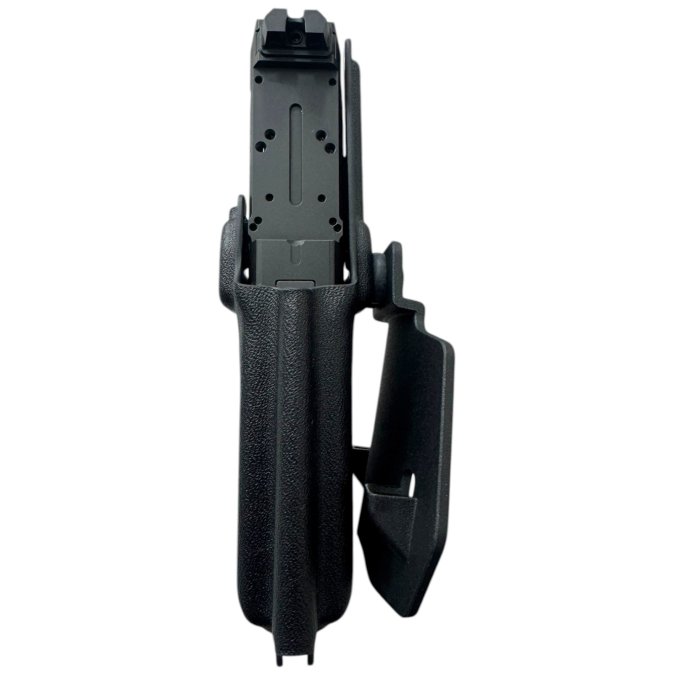
Close-up of a Glock 19 seated in a black Kydex IWB holster clipped to a belt at the 4 o'clock position on a leather gun belt, worn over dark tactical pants, showing the belt clip and holster shell detail against the waistband
IWB: Concealment, Printing, and Waistband Position
IWB holsters position the firearm inside the waistband, between your body and pants. This dramatically reduces the holster's profile and minimizes printing. For most civilian concealed carriers, IWB is the default carry style.
IWB carry requires pants with one to two inches of extra waist room. A full-height sweat guard protects your firearm from moisture and prevents the slide from digging into your side. Strong-side hip carry at the 3-4 o'clock position works well for most body types. Appendix carry at the 1-2 o'clock position is increasingly popular for its draw speed and concealment advantages.
OWB: Draw Stroke Speed and Duty Use
OWB holsters mount outside the waistband on a belt or duty rig. The firearm sits further from the body, allowing a faster draw stroke and significantly more comfort during extended wear. OWB is the standard for duty carry, range use, and open carry.
An OWB holster requires a cover garment to avoid printing. For law enforcement and first responders carrying openly, this is irrelevant. For civilian concealed carriers, OWB is viable in cooler months but challenging in summer. Cant and ride height adjustability matter more on OWB holsters because the firearm's position directly affects your draw stroke mechanics.
Kydex vs. Hybrid: Choosing Your Holster Material
Kydex wins on nearly every metric that matters for daily carry. It's a thermoplastic that can be molded precisely to a specific firearm model, holds its shape permanently, resists moisture and sweat, and provides consistent passive retention across thousands of draw cycles. Kydex is easier to clean, which matters for anyone carrying in warm weather or physically demanding environments. As documented in American Handgunner's holster material guide, Kydex has become the dominant material for EDC holsters because of its dimensional stability.
Hybrid holsters combine a Kydex shell with a leather or neoprene backer. Leather backers absorb sweat and eventually warp, affecting retention and holster shape. Neoprene backers perform better but add bulk. The one genuine advantage of hybrid holsters is the larger footprint against the body, which some carriers find distributes pressure more comfortably during IWB carry, particularly for appendix carry.
Optic-Ready and Light-Bearing Holster Compatibility
Optic-ready and light-bearing holster compatibility is not optional if you run a weapon-mounted light or a red dot sight. A standard holster shell molded to a bare Glock 19 will not accept the pistol with a WML or optic attached.
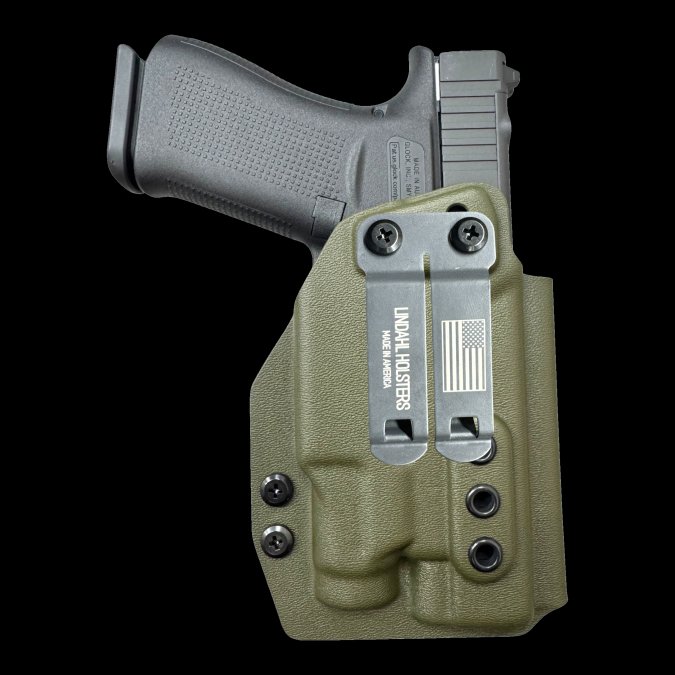
A Glock 19 with a compact weapon-mounted light attached to the rail, holstered in a light-bearing Kydex OWB holster, resting on a weathered wooden surface with a spare magazine and tactical belt in the background, natural daylight
When selecting a light-bearing holster, confirm the following:
- The holster is molded for your specific WML model, not just "rail-mounted lights" generically
- Muzzle coverage extends to the end of the light, not just the barrel
- Retention is set at the light body, not just the trigger guard
- The draw stroke clears the light without snagging
Red dot sights require a cutout in the holster shell that accommodates the optic body without affecting retention or draw. The cutout must be sized for your specific optic, whether that's an RMR, SRO, or Shield RMS footprint. According to USCCA's guide to weapon-mounted lights and holsters, the number of carriers running WMLs has increased substantially in recent years, making light-bearing holster compatibility one of the most common selection criteria.
Concealed Carry Holster Comfort Tips for All-Day Wear
All-day concealed carry comfort is achievable when you get three variables right: cant, ride height, and accessories that manage pressure distribution. Most carriers who report discomfort are dealing with a fixable fit problem, not an inherent limitation of IWB carry.
Cant, Ride Height, and Body Type Adjustments
Cant is the forward or rearward tilt of the holster relative to vertical. A forward cant, typically 10-15 degrees, tilts the grip rearward, aiding concealment and producing a more natural draw stroke for most people.
Body type significantly affects which cant works best. Carriers with a shorter torso or wider hips often need a more aggressive forward cant to prevent the grip from printing above the beltline. Taller carriers with longer torsos generally have more flexibility. Start at 10 degrees forward cant and adjust based on where the grip sits relative to your cover garment.
Ride height controls how high or low the firearm sits in the waistband. A higher ride height makes the grip more accessible for a faster draw but increases printing risk. A lower ride height improves concealment but can make the draw stroke more difficult. For appendix carry, the holster needs to sit high enough that the muzzle doesn't dig into the thigh when seated, but low enough that the grip stays below the beltline when standing.
Appendix Carry: Claw and Wedge Accessories
Appendix carry positions the holster at the 1-2 o'clock position, inside the waistband at the front of the hip. It offers fast draw access, excellent concealment for the slide, and the ability to monitor the holster visually.
Two accessories transform appendix carry comfort:
The claw (also called a wing) is a small attachment that hooks onto the belt or waistband. As the belt applies inward pressure, it rotates the grip closer to the body, reducing printing under a t-shirt. The claw is arguably the single highest-impact accessory for appendix carry concealment.
The wedge is a foam or rubber wedge that attaches to the back of the holster. It tilts the muzzle end away from the body, rotating the grip inward and improving both comfort and concealment. A wedge is particularly effective for carriers who find the muzzle digging into the lower abdomen or thigh when seated.
How to Adjust Holster Retention for a Secure, Smooth Draw
Holster retention adjustment is one of the most misunderstood aspects of EDC setup. The goal is not maximum tightness but consistent, repeatable resistance that secures the firearm during vigorous movement while allowing a clean, single-motion draw.
Most Kydex holsters use one or two tension screws to control passive retention. Here's a practical adjustment process:
- Start with the tension screw backed out to minimum resistance. Draw the firearm several times to establish a baseline feel.
- Tighten the screw in quarter-turn increments. Draw after each adjustment. You're looking for the point where the firearm requires deliberate intent to draw but doesn't require a two-handed pull.
- Test retention: With the firearm holstered, hold the holster inverted over a soft surface. The gun should not fall free under its own weight.
- Test draw stroke speed: If retention slows your draw stroke by more than half a second compared to your baseline, back off slightly.
- Re-test after temperature changes. Kydex can tighten slightly in cold weather.
Active retention systems require a different approach. The locking mechanism should engage with an audible click when the firearm is holstered. Practice the release motion until it's automatic.
Long-Term Wear and Holster Training Considerations
Holsters that end up in drawers share a common history: the carrier never built a consistent training habit around them. A holster is not a passive accessory but a system that requires practice to use correctly.
Long-term wear testing reveals fit problems early. A holster that feels fine during a 20-minute range session may create pressure points after four hours of office carry. The belt clip may shift during activities like driving or climbing stairs. These are fit variables that require adjustment, not defects.
Wear the holster for a full work day before drawing from it in a training context. Identify any pressure points and address them with ride height or cant adjustments. Dry fire practice with the holstered firearm builds draw stroke consistency faster than live fire alone. Re-evaluate retention after the first 30 days of carry, as Kydex can loosen slightly during break-in.
Draw stroke mechanics deserve specific attention. The most common mistake is gripping the firearm before it clears the holster, which causes the gun to torque against retention and produces an inconsistent draw. The correct sequence is: establish a full firing grip while the gun is still in the holster, drive the gun straight up until it clears the muzzle, then rotate toward the target. As noted in NRA's defensive pistol training resources, consistent draw stroke mechanics are built through repetition at slow speed before speed is added.
A holster that fits correctly for your body type, carry position, and firearm configuration makes every rep of that practice more effective. The Lindahl Holsters approach, custom Kydex molded to your specific firearm and accessory configuration with a 1-3 business day lead time, means you're not waiting weeks to start building that consistency.
Frequently Asked Questions
Q: What is the most comfortable Glock 19 holster for everyday carry?
A: Comfort depends on your carry position and body type. For appendix IWB carry, a Kydex holster with a claw attachment and adjustable wedge reduces printing and hot spots against the abdomen. For strong-side carry, a hybrid holster with a backing panel can distribute weight more evenly. Adjustable cant and ride height let you fine-tune fit regardless of carry position. The best Glock 19 holster for EDC is one you can wear all day without shifting or removing it.
Q: Is a Glock 19 too big to conceal carry?
A: No. The Glock 19 is one of the most commonly carried concealed pistols precisely because it balances capacity with a manageable footprint. At roughly 7.36 inches long and 1.26 inches wide, it conceals well in an IWB holster with proper cant and a fitted cover garment. Printing is more often a function of holster design and clothing choice than the firearm itself. A holster with a built-in claw and correct ride height keeps the grip tight to the body.
Q: What is the difference between IWB and OWB holsters for the Glock 19?
A: An IWB holster sits inside the waistband, positioning the firearm between your body and your pants for maximum concealment. An OWB holster mounts outside the waistband on the belt, offering a faster draw stroke and greater comfort for extended wear but requiring a cover garment for concealment. For plain-clothes EDC, IWB is the standard choice. Law enforcement and open-carry users typically prefer OWB or duty holsters with active retention levels.
Q: Will my Glock 19 holster fit if I add a weapon-mounted light or red dot?
A: Standard holsters are molded to the bare pistol and will not fit a light-bearing or optic-equipped Glock 19. You need a holster specifically designed for your light model, such as a TLR-7A or SureFire X300, and one that accommodates your optic footprint if the slide is milled. Always confirm holster compatibility with your exact light and optic combination before ordering. Custom Kydex holsters can be molded to your specific configuration.
Q: How do I adjust the retention on my Kydex holster?
A: Most Kydex holsters use one or two retention screws on the holster shell near the trigger guard area. Tightening the screw increases friction on the firearm, raising retention. Loosening it allows a faster draw. Adjust in small quarter-turn increments, then test the draw stroke each time. The goal is a holster that holds the firearm securely when inverted but releases cleanly with a deliberate draw. Never loosen retention to the point where the firearm shifts during movement.

