


5 Best Retention Holsters for Duty Use
Table of Contents
- What Makes a Retention Holster Suitable for Duty
- Duty Holster Retention Levels Explained
- Quick Comparison Table
- OWB Paddle Holsters for Glock: Versatile Duty Options
- Light-Bearing Duty Holster Compatibility
- OWB Paddle Holsters for SIG Sauer M18
- Duty Holster Belt Mount Options and Setup
- Training and Draw Practice with Retention Holsters
- Frequently Asked Questions
Last Updated: October 6, 2026
What Makes a Retention Holster Suitable for Duty
A duty holster isn't just a place to carry your firearm, it's critical equipment that determines whether you can access your weapon reliably under stress. The 5 best retention holsters for duty use balance three competing demands: security against weapon grabs, speed of draw, and all-day wearability.
Retention holsters use mechanical locking systems to prevent unauthorized access while allowing the authorized user to draw quickly, unlike simple friction-fit designs. A proper duty holster keeps your firearm secure whether you're running, bending, or in physical contact with a suspect.
The right choice depends on your role, firearm model, mounted lights or optics, and agency policies. This guide covers the 5 best retention holsters for duty use, key considerations, and Lindahl Holsters' lineup of OWB paddle holsters for duty carry.

Duty Holster Retention Levels Explained
Retention levels describe how many distinct, deliberate actions are required to defeat the holster and remove the firearm. The number matters less than the mechanism behind it, because two holsters can both claim "Level II" while offering very different security and draw strokes.
Level I retention relies on passive friction and holster geometry alone. The molded shell grips the trigger guard and slide through shape and material tension, with no active lock. Draw is fastest, but a determined attacker who gets a hand on the grip can often strip the weapon. Most agencies do not approve Level I for uniformed duty carry.
Level II retention adds one active locking device, usually one of a few well-known mechanisms:
- A thumb-activated internal lock that engages the ejection port or frame, released by a natural downward sweep of the thumb as the hand establishes the grip.
- A rotating hood or "SLS"-style cover over the rear of the slide, released by a thumb tab that rotates the hood forward.
- A trigger-guard-covering hood or strap released by a single motion.
The key characteristic of Level II is that the release motion can be built into the draw itself, so a trained shooter can defeat the lock and clear the holster in one continuous stroke. A well-practiced Level II draw lands in the 1.0 to 1.5 second range from holster to first shot.
Level III retention requires two separate active actions, typically an internal lock plus a rotating hood, or a hood plus a secondary strap, performed in sequence as the hand grips and draws. This is the configuration most often specified for high-risk assignments: tactical teams, custody and transport, corrections, and any role where a weapon-retention struggle is realistic. Draw times typically run 1.5 to 2.0 seconds with solid training.
Level IV adds yet another independent action, but it is uncommon in general patrol use because the draw penalty and training burden grow faster than the marginal security gain.
The trade-off is not "higher is better"
It is tempting to assume Level III is always right because it is most secure, but the calculus is more nuanced:
- Security vs. access. Every additional lock adds a step that must be executed correctly under stress. An officer who has not trained the sequence to automaticity can fumble a Level III release during a deadly-force encounter, a worse outcome than a slightly less secure holster drawn cleanly.
- Training demand. Level II can often be learned to a reliable standard in a few focused sessions. Level III generally requires more repetitions and periodic refresher training, especially when the officer also carries a backup or off-duty rig with a different mechanism.
- Policy and liability. Many agencies specify a minimum retention level for uniformed duty and test it during annual qualification. Choosing a level below your agency's minimum can be a qualification and liability problem.
- Assignment. A plainclothes or investigative assignment may have different retention requirements than a marked patrol unit, and a tactical or custody assignment may require more.
A simple evaluation protocol you can repeat
Because retention claims are easy to make and hard to verify, test any holster against a consistent set of checks before you trust it on duty:
- Static retention test. With the firearm unloaded and the holster on a proper belt, have a partner attempt to pull the firearm straight out while you resist, using controlled force. Note whether the lock holds and whether the holster shifts on the belt.
- Release-under-load test. Establish your normal grip and confirm the release mechanism disengages with the same pressure and travel every time.
- Draw consistency test. Perform 20 slow, deliberate draws and note whether the firearm seats and releases identically each time. Inconsistency usually points to a loose or over-tight retention screw.
- Reholster test. Confirm the firearm seats fully and the lock re-engages with an audible or tactile confirmation.
- Movement test. Jog, bend, and simulate a ground struggle with the unloaded firearm holstered. Check for holster shift, belt roll, and any change in retention feel.
Run the same five checks on every holster you consider so you compare measured behavior rather than marketing language. Lindahl Holsters OWB paddle holsters use adjustable retention so you can tune the feel as your technique develops.
| Retention Level | Typical Mechanism | Realistic Draw-to-First-Shot | Common Duty Use | Relative Security |
|---|---|---|---|---|
| Level I | Passive friction only | Under 1 second | Range and training | Minimal |
| Level II | One active lock (thumb lock, rotating hood, or strap) | 1.0-1.5 seconds | Standard patrol and uniformed duty | Moderate |
| Level III | Two active locks (e.g., internal lock plus hood) | 1.5-2.0 seconds | Tactical, custody, transport, high-risk | High |
| Level IV | Three or more active locks | 2.0 seconds and up | Specialized roles only | Maximum |
Quick Comparison Table
| Holster Model | Firearm Fit | Light Compatibility | Mount Type | Price | Best For |
|---|---|---|---|---|---|
| Glock 17 OWB Paddle | Glock 17 | None | Paddle | $79.99 | Training, range, open carry |
| Glock 17 w/ TLR-7/7A/7X | Glock 17 | Streamlight TLR-7/7A/7X | Paddle | $79.99 | Duty carry with weapon light |
| Glock 19/19X OWB Paddle | Glock 19, 19X | None | Paddle | $79.99 | Compact duty platforms |
| SIG Sauer M18 OWB Paddle | SIG M18 | None | Paddle | $79.99 | Military/agency M18 users |
| SIG Sauer M18 w/ TLR-7 | SIG M18 | Streamlight TLR-7 | Paddle | $79.99 | Light-bearing M18 duty |
OWB Paddle Holsters for Glock: Versatile Duty Options
The Glock platform dominates duty carry across North American law enforcement, and Lindahl Holsters offers precision-fit OWB paddle holsters for multiple Glock models.
The OWB Paddle Holster for Glock 17 is built for the full-size duty platform. Custom-molded Kydex construction ensures a consistent, reliable draw, and the adjustable retention system lets you fine-tune security. The OWB paddle attachment goes on and off without unthreading your belt, easing transitions between duty and off-duty carry.
For agencies running the compact Glock 19 or Glock 19X, the OWB Paddle Holster for Glock 19/Glock 19X delivers the same precision fit and adjustable retention in a smaller profile. Ride height keeps the firearm close to the body, and the open-muzzle design accommodates threaded barrels.
What separates these from generic holsters is the precision molding. A loose holster creates inconsistency in your draw stroke, while one that's too tight can slow reholstering under stress.
Light-Bearing Duty Holster Compatibility
Modern duty firearms increasingly come equipped with weapon-mounted lights. The Streamlight TLR-7 and its variants (TLR-7A, TLR-7X) are industry standards on thousands of duty Glocks, but a light changes everything about holster fit.
A light-bearing holster can't use traditional slide-compression retention; instead, retention is engineered around the light housing itself. This is more reliable in duty scenarios because the light is a rigid, fixed reference point.
The Glock 17 with TLR-7/7A/7X OWB Paddle Holster is precision-molded for this configuration, providing clearance for the light housing while maintaining full trigger guard coverage. Retention is adjusted around the light for consistent security in daylight or darkness.
For SIG Sauer agencies, the SIG Sauer M18 with Streamlight TLR-7 OWB Paddle Holster follows the same principle, combining precision molding around the M18's profile with light-housing retention engineering.
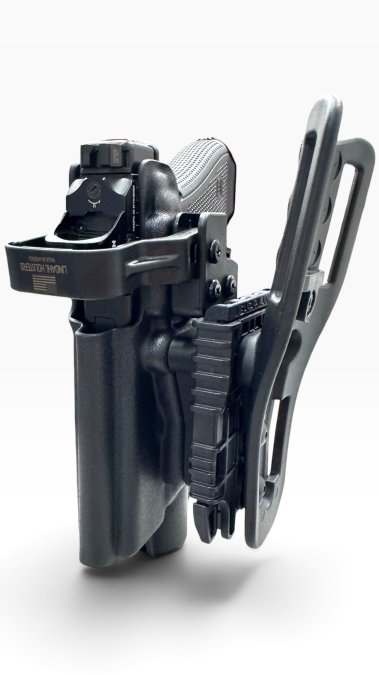
The critical point: don't try to use a non-light holster with a mounted light, and don't use a light-bearing holster with a bare slide. The retention won't work as designed, and you've compromised both security and draw speed.
OWB Paddle Holsters for SIG Sauer M18
The SIG Sauer M18 is the military's official sidearm and increasingly adopted by civilian law enforcement agencies. It demands a holster engineered specifically for its profile, the M18 is slightly shorter than the M17, and the grip angle differs from traditional duty pistols.
The OWB Paddle Holster for SIG Sauer M18 provides precision fit for agencies transitioning to the M18 platform. Custom molding ensures consistent draw and reholstering, and the paddle attachment offers quick on/off without belt manipulation.
OWB Paddle Holster for Glock 19 / Glock 19X →
M18 users often run the Streamlight TLR-7, making the light-bearing variant the more practical choice for duty carry, with full trigger guard coverage and light-housing retention engineering.
The M18's P320 platform is modular, which creates a compatibility consideration: Lindahl Holsters' M18 holsters are engineered specifically for the M18 profile. Other P320 variants (M17, compact models, or heavily customized slides) may not fit properly. Verify your exact firearm model before ordering.
Duty Holster Belt Mount Options and Setup
How a holster attaches to your belt determines how consistently it sits relative to your hand, and that consistency is what makes a draw repeatable. Mount choice also interacts with your agency's uniform and equipment standards.
Mounting platforms compared
- Paddle mounts grip the belt from the inside with a curved paddle that distributes pressure across a wider area than a belt loop. They are the most common OWB duty attachment because they go on and off without threading the belt, which matters when you transition between a duty belt and a plainclothes or off-duty belt. The trade-off is that a paddle depends on belt tension and paddle geometry to stay put; on a thin or worn belt it can shift during a struggle.
- Belt-loop and slot mounts thread the belt through fixed loops or slots. They are the most stable option and resist shifting better than a paddle under lateral force, but they require unthreading the belt to remove the holster.
- Drop-leg and thigh rigs lower the holster below the belt line. They can improve access when wearing body armor or a heavy load-bearing vest, but they add bulk, can swing during movement, and are subject to agency approval in many departments.
- MOLLE and vest-mounted options attach the holster to a tactical vest or plate carrier. These are common in tactical and specialty assignments but are generally not approved for standard uniformed patrol.
For most uniformed duty, a paddle or belt-loop OWB holster on a rigid duty belt is the practical default. Lindahl Holsters OWB paddle holsters are built around the paddle platform because it balances quick on/off with stable carry on a proper belt.
Belt selection and fit
Belt quality affects retention holster performance more than most officers expect. A thin, flexible belt lets the holster move independently of your body, changing your draw stroke from one rep to the next. A rigid duty belt, typically 1.75 inches wide and reinforced with nylon or stiff leather, holds the holster in a fixed position relative to your torso. Paddle holsters generally work on belts from about 1.5 to 1.75 inches wide; verify your belt dimensions before ordering, because a paddle sized for a 1.5-inch belt will feel loose on a 1.75-inch duty belt and a paddle sized for 1.75 inches may not seat on a thinner off-duty belt.
Ride height and cant
Ride height is how high the holster sits on the belt. OWB duty holsters typically ride higher than inside-the-waistband designs, positioning the grip closer to your hand and reducing draw time, and a higher ride makes reholstering easier because you can see the holster mouth. Cant is the angle of the holster relative to vertical. A slight forward cant can improve draw ergonomics for some shooters, while a neutral cant often works better for reholstering under stress because the holster mouth stays aligned with the natural path of the firearm. If your holster allows cant adjustment, test both settings during dry practice.
Setup checks before you carry on duty
- Confirm the holster does not shift on your duty belt during a jog, a bend, and a simulated ground struggle with the firearm unloaded.
- Confirm the retention release engages and disengages with the same feel every time, and that the firearm seats fully with a positive lock.
- Confirm ride height and cant let you establish a full firing grip without adjusting your hand position after the draw.
- Confirm the holster clears your other equipment, including your radio, magazine pouches, and any vest or armor.
Agency policy, qualification, and procurement
Professional buyers often have constraints that consumer roundups ignore, and they are worth planning around before you order a fleet.
- Approved equipment lists. Many departments maintain a list of approved holsters and retention levels for uniformed duty. Confirm your chosen model and retention level are on that list before purchase; a holster that meets your personal preference but not the approved list cannot be carried on duty.
- Qualification requirements. Some agencies test the duty draw during annual qualification, sometimes with a timed standard. Knowing whether your department times the draw, and at what retention level, tells you what to train for.
- Fleet standardization. Agencies that standardize on one holster model simplify training, spare-parts stocking, and armorer support. Standardizing on a single platform and retention level reduces the number of distinct release sequences officers must learn.
- Replacement parts and serviceability. Retention mechanisms wear. Ask whether the manufacturer stocks replacement retention screws, hoods, and paddle components, and how long those parts remain available, because a holster you cannot service is a holster you will eventually replace.
- Documentation. Keep the holster's model and retention level on file with your equipment record so it can be verified during inspection or qualification.
Long-term durability and maintenance
A duty holster lives in a harsh environment: sweat, rain, dust, and repeated draw-and-reholster cycles. A few maintenance habits keep retention reliable.
- Inspect wear points regularly. Check the retention screw, the release mechanism, and the paddle or belt attachment for looseness or cracking. Re-torque retention screws to your preferred setting and confirm the release still functions.
- Keep the holster clean and dry. Wipe out dust and grit that can migrate into the locking mechanism, and dry the holster after exposure to rain or heavy sweat. Debris in a lock is a common cause of a release that suddenly feels gritty or stiff.
- Check the firearm fit after any change. Swapping slides, sights, or a weapon light can change how the firearm seats. Re-run your setup checks after any equipment change.
- Replace worn components rather than forcing them. A retention mechanism that no longer holds its setting, or a paddle that has lost its grip, should be serviced or replaced rather than compensated for with a tighter screw.
A holster inspected and maintained on a schedule behaves the same on day 500 as it did on day one, and that consistency is what duty carry requires.
Training and Draw Practice with Retention Holsters
Retention holsters demand proper training. The mechanical release mechanism, whether a thumb lever, hood, or combination, must become automatic. A draw that works on the range but breaks down under stress is worse than no training at all.
Start with dry-fire practice (unloaded firearm, no ammunition in the room). Focus on the release mechanism first. If your holster uses a thumb-activated lever, practice the motion until you can release it without looking. The lever should disengage smoothly without requiring excessive force. If it's stiff, adjust the retention screw slightly. If it's loose, tighten it.
Once the release is automatic, add the draw motion. Your thumb should naturally contact the release as your hand enters the holster. The draw stroke should be one fluid motion: hand on grip, thumb releases the lock, firearm clears the holster, sight picture acquired. Practice at slow speed (5-10 seconds per rep) until it's unconscious.
Only after drilling the dry-fire sequence should you move to live-fire training. Start at close distance (3-5 yards) and focus on speed with accuracy. Most duty shooters train for 1-1.5 second draw-to-first-shot times with a Level II holster; Level III systems run 1.5-2 seconds.
Agency qualifications often test retention holster draws, and some departments mandate timed draws as part of annual qualifications. Verify your agency's specific requirements before selecting a retention level so you train to the right target.
Common mistakes in retention holster training include: practicing the release motion in isolation (it needs to be part of the draw), changing your hand position to accommodate the release (your grip should be consistent), and skipping the reholstering drill (reholstering under stress is harder than drawing, and mistakes here create safety issues).
Lindahl Holsters designs all paddle holsters with adjustable retention to support this training progression: start tight, dial it back as your technique improves, then adjust back up once your muscle memory is solid.
Selecting the right duty holster comes down to matching your firearm, your agency's retention requirements, and your training commitment. Lindahl Holsters OWB paddle holsters deliver the precision fit and adjustable retention that professional duty carry demands. Whether you're running a Glock 17 with a mounted light or transitioning to the SIG M18, we offer purpose-built solutions engineered for law enforcement and first responders. The National Law Enforcement Officers Memorial Fund publishes guidance on duty equipment standards that emphasizes retention holster importance for officer safety. Get started with Lindahl Holsters and find your gun model to see the complete lineup of duty-grade options built right here in the USA.
Frequently Asked Questions
What level of retention is best for a duty holster?
Level II retention is standard for active duty law enforcement. It combines a thumb-release mechanism with passive retention, preventing accidental draws while allowing quick access under stress. Level III adds a third retention device for high-risk environments. The choice depends on your agency policy, threat level, and training. Most duty officers find Level II balances security and accessibility effectively.
How do you choose a duty holster compatible with your specific firearm and light?
Start by identifying your exact firearm model and any mounted accessories like weapon lights. Verify the holster is precision-molded for your setup, a Glock 17 with TLR-7 requires different retention than a bare Glock 17. Check the product specifications for light compatibility. Lindahl Holsters offers models for common duty platforms including Glock 17, 19, 22 with and without TLR-7/7A/7X, and SIG Sauer M18 configurations.
Can a duty holster be mounted to different belt systems?
OWB paddle holsters mount directly to your belt without threading, making them quick to don and remove. They work with standard duty belts and tactical rigs. The paddle provides stability without requiring a dedicated belt slot. This flexibility is why paddle mounts are popular for training, range work, and duty environments where you may change gear throughout the day.
What is the difference between Level II and Level III retention?
Level II uses two retention mechanisms: passive retention (friction fit) and an active thumb release. Level III adds a third barrier, typically a hood or secondary lock, requiring additional deliberate steps to draw. Level III is slower to access but offers maximum security against weapon grabs in high-threat scenarios. Law enforcement agencies choose based on their operational environment and training protocols.
How should you practice drawing from a retention holster?
Start with dry fire practice at home using an unloaded firearm and appropriate safety protocols. Focus on consistent hand placement on the thumb release and smooth draw stroke. Progress to range training with live fire under supervision. Practice reholstering equally, retention holsters require deliberate reinsertion. Regular training builds muscle memory so the release mechanism becomes automatic under stress, critical for duty performance.

