


Comfortable Concealed Carry Holster Review: Top Picks
Table of Contents
- Comfortable Concealed Carry Holster Review: What Actually Matters
- Best IWB Holster for Everyday Carry: Top Picks Compared
- Concealed Carry Holster Positions: Finding Your Comfort Zone
- How to Adjust Holster Retention for a Smooth Draw
- Holster Wedge and Claw Integration: The Key to Concealment
- Belt Selection Guide: The Foundation of Comfortable Carry
- Physical Conditioning and Core Strength for Daily Carry
- Long-Term Skin Irritation Management and Sweat Guards
- Conclusion: Building Your Ideal Concealed Carry Setup
- Frequently Asked Questions
Last Updated: October 2, 2026
Comfortable Concealed Carry Holster Review: What Actually Matters
A comfortable concealed carry holster is the difference between a firearm you carry every day and one that stays in the safe.
Comfort is not a luxury feature. It is the single variable that determines whether you actually carry.
Most holster reviews rank leather versus Kydex or list features without explaining why one setup digs into your hip while another disappears.
Best IWB Holster for Everyday Carry: Top Picks Compared
The best IWB holster for everyday carry is one molded to your exact firearm, with adjustable retention and a sweat guard that keeps Kydex off bare skin.
| Holster | Fits | Price | Best For |
|---|---|---|---|
| SIG SAUER P365 ROSE | P365 ROSE | $84.99 | Subcompact daily carry |
| Glock 19 | Glock 19 | $62.99 | All-around EDC |
| Springfield Hellcat OSP | Hellcat OSP | $62.99 | Micro-compact deep concealment |
| FN 509 | 509, Tactical, MRD | $62.99 | Full-size with optic |
| S&W Equalizer | Equalizer | $62.99 | Easy-rack carry |
| H&K VP9 | VP9, VP9 OR | $62.99 | Full-size optic-ready |
| Springfield Echelon | Echelon | $62.99 | Modular chassis pistols |
SIG SAUER P365 ROSE IWB Holster
The standout pick for subcompact carry. This holster is molded specifically for the P365 ROSE, with a distinctive rose gold finish and adjustable retention and cant. The slim Kydex profile keeps a small pistol genuinely invisible under a t-shirt.

Pros: Precision fit, low-print profile, adjustable cant, made in the USA. Cons: The finish is a style choice, so plain-black buyers may prefer another model.
Glock 19 IWB Holster
The Glock 19 is the most-carried pistol in the country, and this holster is built around it. Two mounting positions let you tune cant, and the protective sweat guard shields the slide from body contact.
Pros: Adjustable retention and cant, full trigger coverage, lifetime warranty. Cons: Designed for standard G19 configurations, so verify your generation and optic at checkout.
Springfield Hellcat OSP IWB Holster
For the micro-compact crowd, this closed-end holster keeps debris out of the barrel and runs a full sweatshield up the slide. It fits the standard Hellcat too, but not the Hellcat Pro.
Pros: Full sweatshield, closed muzzle, enclosed trigger guard. Cons: Does not fit Hellcat Pro or light-equipped Hellcats.
FN 509 IWB Holster
Built from .08-inch American-made Kydex, this one fits the 509, 509 Tactical, and 509 MRD, with an open-ended muzzle that clears threaded barrels. Optic-ready out of the box.
Pros: Fits three 509 variants, accommodates red dots, stainless hardware. Cons: Not compatible with the 509 LS Edge or FNX series.
Smith & Wesson Equalizer IWB Holster
The Equalizer's easy-rack slide makes it popular with newer shooters, and this holster matches its geometry with a mid-rise sweat guard and closed muzzle.
Pros: Mid-rise sweat guard, closed-end muzzle, slim profile. Cons: Will not fit Shield EZ or Shield Plus models.
H&K VP9 IWB Holster
A full-size pistol needs a holster that locks up tight. This VP9 holster is vacuum-formed for zero rattle, with optic clearance for red dots and tall sights.
Pros: Optic-ready, adjustable retention, fully enclosed trigger guard. Cons: Not compatible with the VP9L or VP9SK.
Springfield Echelon IWB Holster
Molded around the Echelon's modular chassis, this holster delivers repeatable lockup and a full sweatshield. It is a strong pick for appendix or strong-side carry.
Pros: Precise lockup, full sweatshield, slim profile. Cons: No fitment for light-equipped or threaded-barrel Echelons.
Concealed Carry Holster Positions: Finding Your Comfort Zone
Concealed carry holster positions fall into three main categories: appendix (11 to 1 o'clock), strong-side hip (3 to 4 o'clock), and kidney carry (4 to 5 o'clock). Each changes how the grip sits against your body, and that determines both comfort and concealment.
Position is personal. Body geometry decides more than any review can.
- Appendix carry: best concealment, fast draw, but requires a claw or wedge to stop the grip from tipping out.
- Strong-side hip: most comfortable for long days, easy draw stroke, slightly harder to hide under a fitted shirt.
- Kidney carry: a rearward hip position that hides well when standing, but digs in when you sit.
A common mistake is choosing a position from a forum post instead of testing it. Wear each position for a full day around the house before committing.
How to Adjust Holster Retention for a Smooth Draw
How to adjust holster retention: tighten or loosen the retention screw in small quarter turns until the firearm stays put when inverted but draws without a hard yank. Test the setting with the holster empty first, then loaded, and re-check it after the first week of carry.
Kydex retention is set by screw tension. Too loose and the gun shifts; too tight and your draw stroke stutters under stress.
- Unload the firearm and clear the chamber.
- Insert the pistol fully into the holster.
- Turn the retention screw a quarter turn clockwise.
- Invert the holster and shake gently. The gun should not fall out.
- Draw the pistol. It should release with firm, consistent resistance.
- Repeat until the feel is right, then re-check after a week of carry.
The NRA guidance on safe firearm handling and storage is worth reviewing before any retention testing, and always confirm proper retention before you carry.
Holster Wedge and Claw Integration: The Key to Concealment
A holster wedge and claw work together to rotate the grip of the gun into your body, which is what actually reduces printing. The claw pushes the grip inward at the belt line; the wedge tilts the muzzle outward to tuck the grip closer to your torso.

The Lindahl Holsters ModWing concealment claw kit is a standalone piece of concealment hardware that lets your belt apply use and rotate the grip toward your body. Interchangeable inserts let you choose a strong or mild rotation based on what you're wearing, and it is ambidextrous for right- or left-hand carry.
If you carry appendix and still see the grip poke through a t-shirt, the fix is usually a claw, not a new holster.
Belt Selection Guide: The Foundation of Comfortable Carry
A stiff gun belt matters more than most carriers admit. The belt carries the weight, holds the holster against your body, and stops the whole rig from sagging.
Most holster reviews treat the belt as an afterthought. It is not. The belt is the load-bearing member of the system, and the holster is just the interface between the belt and the gun.
What Actually Makes a Gun Belt Different
A dedicated gun belt is not just a thick leather belt. It is a composite structure, and the layers matter:
ModWing™ Concealment Wing (Claw) Kit →
- Outer layer: full-grain leather or a laminated synthetic. This is what you see and what the clip grips.
- Reinforced core: a stiffener insert, commonly spring steel, HDPE (high-density polyethylene), or a composite polymer, sandwiched between the leather layers. This is what stops the belt from rolling forward under the holster's weight.
- Inner layer: often a softer leather or suede that grips your waistband and resists vertical shift.
- Stitching: double-row stitching at the stress points. Single-row stitching on a heavy belt is a failure point.
A standard department-store leather belt has none of this. It is a single strip of leather with a buckle, and it will fold like a taco the first time you hang a loaded pistol from it.
Matching Belt Width to Your Clips
This is the most common mismatch in concealed carry, and it causes more shifting than any holster defect.
- 1.5-inch belts are the standard for IWB carry. Most polymer and steel IWB clips are cut for 1.5-inch belts.
- 1.75-inch belts are common for outside-the-waistband and duty-style carry. They are stiffer and distribute weight better, but many IWB clips will not fit them.
- 1.25-inch belts are a compromise for deep concealment under dress clothes. They are less stiff, so they work best with lightweight subcompacts.
If your clip is cut for 1.5 inches and your belt is 1.75 inches, the clip will not seat fully. The holster will ride high on one side and shift under draw. Measure your belt at the point where the clip sits, not at the buckle.
Clip Type Changes What You Need From a Belt
Different clips load the belt differently, and that changes which belt construction works best:
- Polymer clips are lightweight and low-profile but flex under stress. They need a belt with a firm outer surface so the clip does not skate.
- Steel clips like the Lindahl Holsters DCC Monoblock IWB belt clip bite harder and resist lift during the draw. They distribute load across two mounting slots, which reduces the point pressure that causes hot spots. Steel clips also tolerate a slightly thicker belt than polymer clips of the same nominal width.
- Tuckable clips sit lower on the belt and are designed to hide behind a shirt hem. They need a belt that is stiff enough to hold the holster upright without the shirt pulling it out of position.
- J-clips and C-clips hook behind the belt rather than over it. They are less visible but rely almost entirely on belt stiffness to stay put.
Position-Specific Belt Considerations
- Appendix carry: a belt with a stiff core keeps the holster from tipping outward at the top. A belt that flexes too much at the front lets the grip rotate away from your body, which is the printing problem a claw is meant to solve.
- Strong-side hip: the belt needs to resist rolling at the 3 to 4 o'clock position, where the holster's weight pulls the belt edge downward. A reinforced core is non-negotiable here.
- Kidney carry: the belt has to stay flat across the small of your back. A belt that is too stiff will bridge across your lumbar curve and dig in when you sit.
Rigid but Not Stiff
There is a real upper limit. A belt that will not flex at all can dig into your hip bone, especially in appendix carry, and it will not conform to your waist over time.

Most practitioners find that a reinforced-core belt in the 1.5-inch width hits that balance for IWB carry. If you carry a full-size pistol with a light and optic, step up to a wider, stiffer belt and accept the trade-off in concealment.
Physical Conditioning and Core Strength for Daily Carry
Core strength changes how a holster feels by the end of the day. A stronger midsection supports the weight of the firearm and keeps your posture from collapsing into the holster, which is what causes most late-day discomfort.
Most guides ignore this entirely, and it is the gap that matters most for carriers who log long hours.
- Planks and dead bugs build the deep core muscles that stabilize your torso under load.
- Hip flexor mobility reduces the pinch you feel when sitting with an appendix rig.
- Glute and lower-back strength keeps your belt line level instead of tilting.
You do not need a gym. Ten minutes of core work a few times a week is enough to notice the difference in how your setup carries.
Long-Term Skin Irritation Management and Sweat Guards
Long-term skin irritation is the quiet problem that pushes carriers to leave the holster at home. It rarely shows up on day one. It builds over weeks of sweat, friction, and pressure against the same patch of skin, and by the time it is raw enough to notice, the carrier has usually already stopped carrying.
Most guides treat this as a hygiene footnote. It is a gear and ergonomics problem, and it has specific fixes.
What Actually Causes the Irritation
Three mechanisms drive almost all holster-related skin problems:
- Friction: Kydex edges and clip hardware rub against skin with every step. The cumulative effect over a 10-hour day is abrasion, even if each individual contact is light.
- Moisture: sweat softens the skin and raises its coefficient of friction, so the same amount of rubbing does more damage. Moisture also traps bacteria in the holster interior.
- Pressure: a holster that concentrates load on a small area, a clip edge, a retention screw, a sharp sweat guard corner, creates a pressure point that becomes a hot spot, then a blister, then an open wound.
Understanding which mechanism is driving your irritation tells you which fix to apply. Friction and moisture respond to barriers and coverage. Pressure responds to position changes and hardware swaps.
Sweat Guard Height: Match It to Your Carry Position
A sweat guard is the raised section of Kydex that sits between the slide and your body. It is the first line of defense, but the right height depends on where you carry:
- Full sweat guard: covers the entire slide up to the rear sight. Best for appendix carry and hot-weather carry, where the slide sits directly against bare skin. It also keeps sweat off the firearm, which matters for corrosion.
- Mid-rise sweat guard: covers roughly half the slide. A good compromise for strong-side hip carry under a tucked or untucked shirt. Less bulk, still protects the contact zone.
- Low or no sweat guard: minimal coverage. Works for pocket carry or when you always wear an undershirt, but it leaves the slide exposed to skin contact.
If you carry appendix in a humid climate, a full sweat guard is worth the extra quarter-inch of holster height. It is the single most effective feature for preventing slide-to-skin chafing.
The Undershirt Question
An undershirt is the simplest barrier, but not all undershirts work equally:
- Cotton absorbs sweat but stays wet, which keeps the skin moist and can make chafing worse once it saturates.
- Synthetic moisture-wicking fabrics move sweat away from the skin and dry faster. They are the better choice for all-day carry in warm weather.
- Compression fit keeps fabric from bunching between the holster and skin, which is what causes pinch points. A loose undershirt will wad up under the holster and create new pressure points.
The trade-off is that an undershirt adds a layer, which can matter in deep concealment. If you cannot wear one, the sweat guard becomes your primary barrier.
Holster Interior Hygiene
Sweat and dead skin accumulate inside the holster. Left alone, that becomes a breeding ground for bacteria and a source of odor.
- Wipe the interior with a damp cloth and mild soap weekly, then let it dry completely before reinserting the firearm.
- Do not store the pistol in the holster long-term. Moisture trapped between Kydex and steel is a corrosion risk.
- Check the retention screws and clip edges for burrs or rough spots. A single sharp edge on a clip can cause more irritation than the entire holster body.
Hardware That Reduces Friction
Some holster hardware is specifically designed to reduce the constant shifting that causes friction in the first place:
- Tuckable clips like the Lindahl Holsters Ulticlip UltiTuck IWB belt clip secure directly to clothing and sit lower on the belt, which reduces the vertical travel that grinds the holster against skin.
- Steel clips with dual mounting slots distribute load across a wider area than single-slot polymer clips, which cuts point pressure at the belt line.
- Smooth-edged Kydex matters more than most carriers realize. A holster with a polished or rounded edge glides against skin; a holster with a sharp molded edge cuts into it.
Rotating Your Carry Position
The most effective long-term fix is also the simplest: do not press the same patch of skin every day.
- Shift your holster by a few degrees across the week, for example, appendix at 12:30 on Monday and 1:00 on Tuesday.
- Alternate between appendix and strong-side hip if your wardrobe allows it.
- Take the holster off for a few hours on rest days to let irritated skin recover before it becomes raw.
Conclusion: Building Your Ideal Concealed Carry Setup
The hard part of comfortable carry is not finding a holster. It is matching holster, position, belt, and body into one system that works for your daily routine.
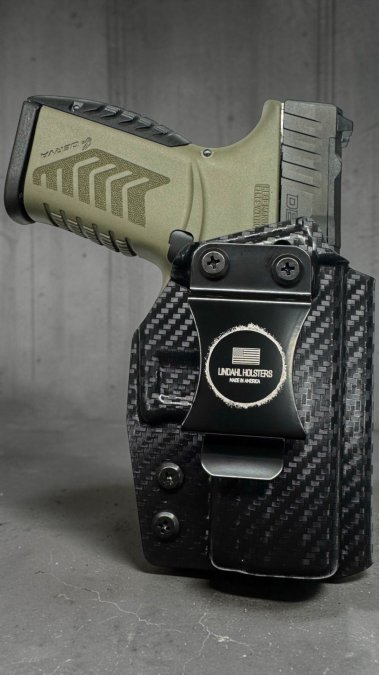
Lindahl Holsters builds custom Kydex holsters molded to your exact firearm, with adjustable retention, protective sweat guards, and a 1-3 business day lead time.
Get started with Lindahl Holsters and carry a setup you forget you're wearing.
Frequently Asked Questions
What makes a concealed carry holster comfortable?
Comfort comes from three main factors: a holster molded specifically for your firearm, a stiff belt that distributes weight evenly, and a design that matches your body geometry. Features like sweat guards, adjustable cant, and smooth Kydex edges reduce hot spots. A holster that sits at the right ride height and angle prevents pressure points during sitting, driving, or bending. The best IWB holster for everyday carry balances these elements without adding bulk.
Is IWB or OWB more comfortable for concealed carry?
IWB holsters sit inside the waistband and offer superior concealment, but they press against the body more, which can cause discomfort if the holster lacks a sweat guard or proper cant. OWB holsters distribute weight outside the waistband and often feel more comfortable for long days, but they require looser clothing to conceal. Many carriers choose IWB for deep concealment and OWB for range or cold-weather carry. Your body type and daily activities determine which works best.
How do I choose the right holster for my body type?
Body type affects where a holster sits and how it prints. Shorter torsos often benefit from appendix carry with a high-ride holster, while taller frames may prefer strong-side hip carry at 3 or 4 o'clock. A holster wedge or claw kit can rotate the grip toward your body, reducing printing regardless of build. Try adjusting cant angle and ride height before buying a new holster. Custom Kydex holsters molded for your specific firearm ensure a consistent fit.
How should a concealed carry holster sit on your belt?
A properly positioned holster sits snug against your body with the belt threaded through the clips or loops. The ride height should allow a full grip without the holster digging into your hip or ribs. Cant angle should match your draw stroke, typically 10 to 15 degrees for hip carry and near vertical for appendix. Belt tension matters too: too loose and the holster shifts; too tight and it digs in. Adjust retention screws and clip position until the holster stays put during movement.
Do Kydex holsters offer better comfort than leather?
Kydex holsters provide consistent retention, are moisture-resistant, and hold their shape, which reduces hot spots over time. Leather molds to your body and feels softer initially, but it can stretch and lose retention with heavy use. For everyday carry, Kydex with a sweat guard and adjustable retention often delivers more predictable comfort. Many carriers find that a well-molded Kydex holster with smooth edges and a proper cant angle outperforms leather for long-term wear.

