


Concealed Carry Gear Checklist for 2026
Table of Contents
- Quick Checklist Overview
- Selecting a Daily-Carry Handgun
- Best IWB Holster for Comfort and Concealment
- Concealed Carry Belt Requirements and Selection
- Holster Types and Retention Levels
- Spare Magazine and Reloading Devices
- Concealment Clothing and Layering Techniques
- Reliable Defense Ammunition Selection
- Everyday Carry Medical Kit Essentials
- Safe Storage, Legal Readiness, and Maintenance
- Draw Practice and Dry-Fire Training
- Frequently Asked Questions
Last Updated: September 18, 2026
Building a concealed carry gear checklist means understanding that comfort and retention are interdependent. A holster that prints defeats concealment. A belt that shifts wastes your practice. This guide covers the essentials: selecting your daily-carry handgun, choosing the right holster and belt, concealment strategy, ammunition, medical readiness, legal compliance, and maintenance. Preparedness extends beyond the immediate firearm setup, requiring a similar focus on the go bag essentials that sustain you during an emergency.
Quick Checklist Overview
| Gear Category | Key Consideration | Why It Matters |
|---|---|---|
| Daily-carry handgun | Size and ergonomics | Comfort determines carry consistency |
| Inside-the-waistband holster | Retention and concealment | Prevents printing and ensures secure carry |
| Dedicated gun belt | Rigidity and weight distribution | Prevents sagging and improves draw consistency |
| Spare magazine | Accessibility and capacity | Extends your defensive capability |
| Concealment clothing | Layering strategy | Minimizes printing across different seasons |
| Defense ammunition | Reliable expansion and penetration | Ensures stopping power when it matters |
| Medical kit | Quick-access IFAK components | Addresses bleeding before EMS arrives |
| Safe storage | Accessibility vs. security trade-off | Protects household while enabling quick access |
| Dry-fire practice | Trigger control and draw stroke | Builds muscle memory without range time |
Selecting a Daily-Carry Handgun
Your handgun choice determines holster fit, magazine compatibility, and concealment difficulty. Subcompact and micro-compact models balance shootability with concealability. A Glock 19 or SIG Sauer P365 represents the sweet spot: large enough for reliable shooting, small enough to disappear under a t-shirt.
Smaller guns recoil more and require more trigger control. Shoot your intended carry gun at a rental range before committing to it.
Magazine capacity matters less than reliable extraction and feeding. Test your gun with the specific defensive ammunition you'll carry.
Best IWB Holster for Comfort and Concealment
An inside-the-waistband (IWB) holster sits between your body and waistband, hiding better than outside-the-waistband alternatives and reducing printing.
Kydex holsters are durable, easy to clean, and provide consistent retention without breaking in. Leather holsters mold over time, potentially changing retention. For daily carry, Kydex wins on reliability.
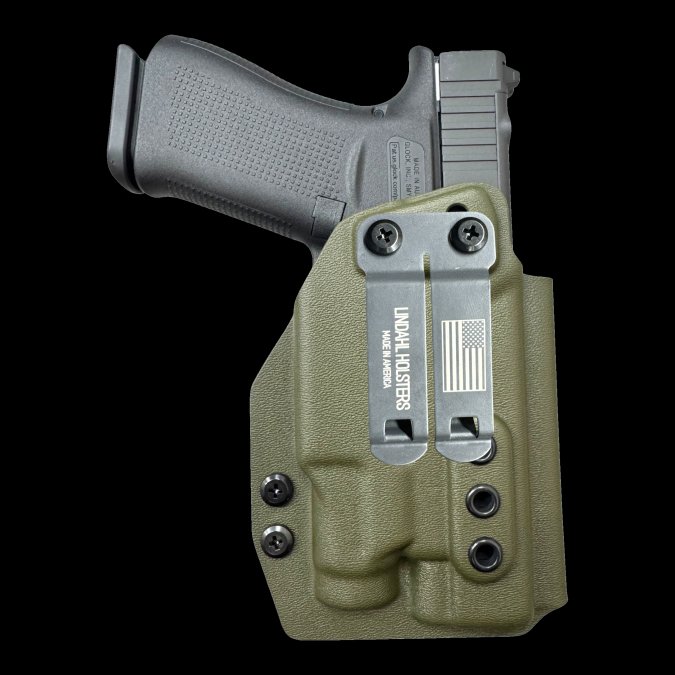
The Lindahl Holsters Glock 19/19X IWB Holster ($62.99) delivers precision fit with adjustable retention and cant, letting you customize the carry angle and draw position to match your body type and clothing. The slim Kydex profile minimizes printing, while the protective sweat guard keeps moisture off your slide. This is the baseline for what a quality IWB holster should deliver.

For micro-compact carriers, the Lindahl Holsters Glock 43X MOS IWB Holster ($62.99) follows the same design philosophy with custom molding for the 43X's geometry. If you're carrying a SIG P365, the Lindahl Holsters SIG Sauer P365 IWB Holster ($62.99) offers adjustable retention and cant (0-15°), a full-length sweat guard, and the audible "click" that confirms your weapon is safely seated.
Concealed Carry Belt Requirements and Selection
A gun belt is not a regular belt. Regular belts stretch and sag under weight. A proper concealed carry belt uses rigid materials to distribute the holster's weight evenly.
A quality gun belt prevents tilting and sagging, maintaining draw stroke consistency and holster position throughout the day.
Look for belts with reinforced stitching and material thickness of at least 0.15 inches. Velcro-backed belts offer quick adjustment without removing your pants, which matters when your carry position needs tweaking between appendix and strong-side. Leather belts look professional but require break-in time. Nylon belts work immediately and tolerate sweat better.
Holster Types and Retention Levels
Holster design varies by carry method. IWB holsters work for concealment. OWB holsters suit duty carry. AIWB positions the gun at your front hip for rapid access but requires a rigid holster and careful trigger guard coverage.
Retention levels describe draw force needed. Level 1 uses friction alone. Level 2 adds a thumb break. Level 3 adds a locking mechanism. Civilian carriers usually prefer Level 1 or Level 2 for faster access.
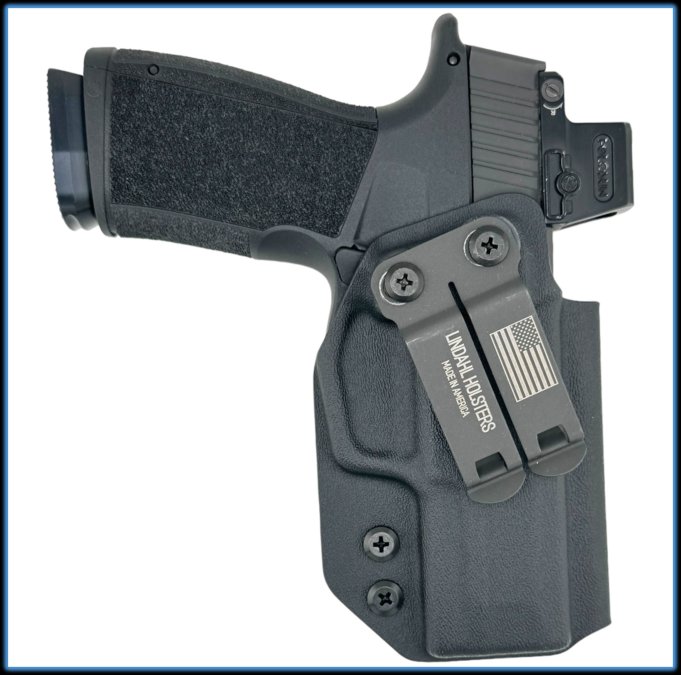
The Lindahl Holsters Springfield Hellcat OSP IWB Holster ($62.99) uses a closed-end muzzle for complete barrel protection and a full sweatshield for maximum slide coverage. The fully enclosed trigger guard ensures safe appendix or strong-side carry while maintaining a slim, low-printing profile. The Lindahl Holsters Springfield Echelon IWB Holster ($62.99) follows the same closed-end design philosophy for the Echelon's modular chassis.

Retention adjustment is essential. You should be able to reholster one-handed with your thumb and forefinger without the holster rotating or tilting. If the holster rotates during reholstering, retention is too loose. If it requires excessive force, retention is too tight and will slow your draw.
Spare Magazine and Reloading Devices
A spare magazine extends your defensive capability. Most carriers position one spare on the opposite hip from their holster.
Magazine carriers come in two types: IWB carriers conceal better; OWB carriers provide faster access.
Your spare magazine should stay in place during movement but come free with a deliberate draw. Loose carriers print; tight carriers slow reloads.
Kydex carriers resist moisture; leather carriers offer aesthetics but need maintenance.
Concealment Clothing and Layering Techniques
Concealment strategy changes with season and body type. Winter jackets hide full-size guns. Summer t-shirts force smaller guns or appendix carry. Concealment depends on how your body, posture, and movement interact with clothing.
How Body Composition Affects Concealment
Printing occurs when your holster or grip outline becomes visible through fabric. The visibility depends on three factors: your body shape, your carry position, and your clothing fit.
A carrier with a larger midsection can conceal a full-size handgun at strong-side carry because body mass creates shadow. Appendix carry prints more because the grip sits at the front hip.
A lean carrier will print more at any position. Appendix carry with a ModWing concealment claw ($9.99) or strong-side carry with a larger gun helps.

Body composition affects comfort. Limited core strength makes appendix carry uncomfortable during sitting. Shoulder mobility limitations favor appendix carry.
Seasonal Concealment Strategy
Winter: Jackets and sweaters hide full-size guns. Appendix carry is faster because the gun sits closer to your hands. Strong-side carry requires clearing the jacket with your support hand, adding time. Practice drawing through layers.
Spring/Fall: Light jackets and flannel create printing challenges. Appendix carry requires discipline; a ModWing claw and undershirt help. Strong-side carry prints less. Graphic t-shirts conceal better than solids.
Summer: A single t-shirt is your only option. Appendix carry requires the most discipline. Loose-fitting pants, undershirts, and graphic t-shirts help. Dark colors hide printing better than light colors. Consider a smaller gun if your primary prints noticeably.
Movement and Posture
Test your setup during normal movements: reaching overhead, sitting in a car, bending forward, and walking. If your grip becomes visible, adjust your holster cant, choose looser clothing, or switch carry positions.
Good posture improves concealment. Shoulders back and chest up keep the gun closer to your body.
Garment Recommendations by Season
Winter: Wool or synthetic insulated jackets provide structure. Avoid puffy jackets that compress and bulge. Flannel layered under a jacket allows faster access.
Spring/Fall: Flannel, light jackets, and cardigans work. Choose patterns over solids. Loose overshirts provide concealment without bulk.
IWB Kydex Holster for Glock 19/19X →
Summer: Graphic t-shirts with busy patterns conceal better than solids. Choose navy, black, or charcoal. Loose-fitting t-shirts, Henley shirts, and lightweight long-sleeves work. Avoid sleeveless shirts.
Reliable Defense Ammunition Selection
Defense ammunition uses expanding bullets that create larger wound channels than full-metal-jacket rounds and penetrate consistently.
Popular brands include Federal HST, Speer Gold Dot, and Hornady Critical Duty. What matters is reliable feeding and predictable expansion in your gun.
Fire at least 50 rounds through your gun to confirm reliable feeding. Ammunition that jams during practice will jam when it matters.
Store defense ammunition separately from range ammunition. Mark your carry magazines so you don't accidentally load range ammunition.
Everyday Carry Medical Kit Essentials
A concealed carry medical kit (IFAK) addresses bleeding before EMS arrives. Most gunshot wounds are survivable if bleeding is controlled within minutes.
A minimal IFAK includes a tourniquet, gauze pads, and an elastic bandage.
Position your IFAK where you can access it one-handed. A pocket, ankle, or belt-mounted pouch works. Don't leave it in your car.
Learn to apply a tourniquet before you need one. Practice on a training leg. Muscle memory helps under stress.
Safe Storage, Legal Readiness, and Maintenance
Safe storage balances accessibility with security. A 30-second safe is useless in an emergency. A nightstand gun creates risk for family and intruders.
A quick-access safe maintains rapid access. Biometric safes open with your fingerprint in under a second. For vehicles, a lockable glove compartment or small safe provides reasonable security.
Legal Readiness Checklist
Legal readiness means more than knowing your carry laws. Before you carry, complete this checklist:
Permit and Reciprocity: Verify your state's permit requirements and reciprocity status. Reciprocity laws change annually. Check the FFL database or your state's Attorney General office before crossing state lines.
Prohibited Locations: Know where you cannot carry. Federal law prohibits carry in federal buildings, courthouses, and airports. State and local laws add schools and posted private property. Carrying in prohibited locations can result in felony charges.
Use-of-Force Laws: Understand your state's self-defense statutes. Some states require retreat; others recognize "stand your ground." The threshold for drawing differs from firing. This distinction matters in court.
Carry Insurance: Consider self-defense liability insurance. A defensive shooting can cost $50,000-$150,000 in legal fees. Organizations like the Second Amendment Foundation offer plans covering legal representation and bail ($100-$300 annually).
Maintenance Schedule
Maintenance prevents failures. Create a maintenance calendar and stick to it:
Monthly (30 minutes):
- Wipe your holster exterior with a dry cloth.
- Tighten holster retention screws with a hex wrench.
- Wipe your gun's exterior with light oil (Ballistol, CLP). Don't oil firing pins or springs.
- Inspect your spare magazine for corrosion and test spring tension.
Quarterly (1 hour):
- Field-strip your gun and clean the barrel, slide, and frame. Pay attention to the feed ramp and chamber.
- Apply blue threadlocker ($2.99) to holster hardware screws to prevent backing out.
- Inspect your gun belt for cracks or delamination. Replace if failing.
Annually (2 hours):
- Replace magazine springs if older than three years or after 500+ rounds.
- Inspect your holster's Kydex for cracks. Replace if cracked.
- Test all carry ammunition by firing 10 rounds from each magazine. Discard ammunition that fails to feed.
- Deep-clean your gun and apply light oil to all moving parts.
Draw Practice and Dry-Fire Training
Dry-fire practice builds muscle memory and improves trigger control. Most shooters improve faster with dry-fire than live-fire because it's free and accessible.
Start with presentation drills: draw, press to eye level, and reholster. Add trigger control, then sight alignment.
Dry-fire requires a safe gun and safe direction. Verify your gun is unloaded. Treat every session like live-fire.
Practice appendix and strong-side carry differently. Appendix requires clearing clothing; strong-side requires hip rotation. Practice both if you switch.
Building a complete concealed carry gear checklist means investing in quality holsters, belts, and accessories that work together as a system. Lindahl Holsters custom-molded Kydex holsters start at $62.99 and deliver the precision fit and adjustable retention that everyday carriers demand. With 1-3 business day lead times and free shipping over $125, getting your complete rig set up is faster than you'd expect. FIND YOUR GUN MODEL and build your loadout today.
Frequently Asked Questions
What are the essential items for a concealed carry kit?
A complete concealed carry kit includes a reliable firearm, quality IWB holster, dedicated gun belt, spare magazine with carrier, concealment garment, defensive ammunition, and safe storage solution. Add a tactical light, medical kit (IFAK), and regular dry-fire training. Legal documentation and insurance are also critical. The specific loadout depends on your carry method (appendix, strong-side, hip) and daily environment. Start with these core items, then customize based on your needs and local laws.
How do I choose the right best IWB holster for comfort?
Comfort depends on fit, retention adjustment, and sweat guard coverage. Look for a holster custom-molded to your specific firearm model, this ensures secure retention and consistent draw. Adjustable cant and ride height let you position the holster for your body type and carry position. A quality sweat guard minimizes contact between the firearm and your skin. Test the holster with your carry belt and clothing to confirm printing doesn't occur. Lindahl Holsters IWB models ($62.99) offer adjustable retention and cant, protective sweat guards, and precision fit for popular carry firearms.
What are common concealed carry mistakes for beginners?
New carriers often skip a dedicated gun belt, which causes the holster to shift during draw and re-holstering. They underestimate printing, a loose concealment garment or poor holster selection exposes the firearm outline. Many neglect dry-fire practice, leading to inconsistent draw strokes and poor accuracy under stress. Beginners also fail to establish a maintenance schedule, allowing hardware screws to loosen or retention to drift. Carrying inadequate ammunition or no spare magazine limits defensive capability. Finally, many overlook legal requirements and insurance, creating liability exposure. Invest in proper gear, train consistently, and stay informed on local permit reciprocity rules.
Is a spare magazine necessary for everyday carry?
Yes. A spare magazine addresses ammunition capacity limits and mechanical failure. If your primary magazine fails to feed or you expend your firearm's magazine in a defensive situation, a spare ensures you remain capable. Most defensive trainers recommend carrying at least one spare magazine in a dedicated carrier on your gun belt. This adds minimal bulk and weight but significantly increases your readiness. Position the spare magazine carrier for quick access and ensure it's secure enough to prevent loss during daily movement or physical activity.
What legal considerations should I keep in mind for concealed carry in 2026?
Verify your state and local permit requirements, reciprocity rules vary widely. Understand your state's use-of-force laws, duty-to-retreat statutes, and self-defense immunity protections. Know where carry is prohibited (federal buildings, schools, private property with posted restrictions). Consider concealed carry insurance to cover legal defense costs if you're involved in a defensive incident. Document your training and maintain a clear record of your firearm's condition and maintenance. Stay updated on changes to state and federal firearms laws.

