


Custom Holster for Optics Ready: Top Picks & Guide
Table of Contents
- Quick Comparison: Top Custom Holsters for Optics Ready Pistols
- What Makes a Holster Truly Optics Ready?
- The Best IWB Holster for Red Dot Sight Carry
- Custom Light-Bearing Holsters for Pistol-Mounted Lights
- Optics-Ready Holster Retention: What to Expect
- Optic-Specific Compatibility: Will Your Red Dot Fit?
- Troubleshooting Optic Interference and Holster Wear
- Training Considerations for Optics-Ready Carry
- Conclusion: Choosing Your Custom Optics-Ready Holster
- Frequently Asked Questions
Last Updated: September 18, 2026
Quick Comparison: Top Custom Holsters for Optics Ready Pistols
A custom holster for optics ready pistols has to do one job most factory holsters fail at: clear a slide-mounted red dot without snagging, shifting, or scraping the optic body every time you draw. That single requirement changes the geometry of the entire shell, which is why generic fits so often disappoint.
At Lindahl Holsters, we hand-mold Kydex around your exact pistol, light, and optic combination, then ship in 1-3 business days. Below, we break down what separates a genuinely optics-ready shell from a marketing claim, and which configurations work best for daily carry.
Here's the core tension in this category: most holster manufacturers cut a channel wide enough to "accept" an optic, then never test whether the channel actually protects it. A proper optic cut does three things at once: it clears the optic housing, shields the lens from belt and cover-garment contact, and keeps the sight picture unobstructed through the full draw stroke.
That's the difference between a holster that works and one that lives in a drawer.
| Holster | Fits | Price | Best For |
|---|---|---|---|
| IWB Kydex for Glock 43/43X MOS + TLR-7 Sub | Glock 43/43X MOS, TLR-7/7X/HLX Sub | $62.99 | Subcompact EDC with a light |
| IWB Kydex for Glock 17 + TLR-7/7A/7X | Glock 17, TLR-7/7A/7X | $62.99 | Full-size duty and carry |
| IWB Kydex for Glock 48 MOS + TLR-7 Sub | Glock 48 MOS, TLR-7/7X/HLX Sub | $62.99 | Slimline EDC with optic and light |
| IWB Kydex for Glock 43X MOS | Glock 43X MOS | $62.99 | Optic-only subcompact carry |
What Makes a Holster Truly Optics Ready?
An optics-ready holster is a holster whose shell is molded with a dedicated channel that accommodates a slide-mounted red dot sight, protecting the optic while allowing a clean, unobstructed draw. The channel must be cut to the optic's actual width and height, not to a generic "one size fits most" profile.


Three things separate a real optic cut from a token one:
- Optic clearance: The shell must clear the optic body without touching the lens or housing. A shell that pinches the optic will shift your point of aim over time.
- Sight channel height: The channel needs enough vertical room for the optic to pass through without dragging on the sweat guard or the top edge of the Kydex.
- Muzzle and trigger guard coverage: Full coverage on both keeps the pistol indexed and prevents foreign objects from reaching the trigger.
What most guides miss is that optic readiness is a fit problem, not a feature checkbox. A holster either clears your specific optic or it doesn't. There's no middle ground.
The Best IWB Holster for Red Dot Sight Carry
The best IWB holster for red dot sight carry is one molded specifically for your pistol, light, and optic as a single unit. Kydex molded around the assembled configuration holds retention on the light body and trigger guard, leaving the optic free and clear.
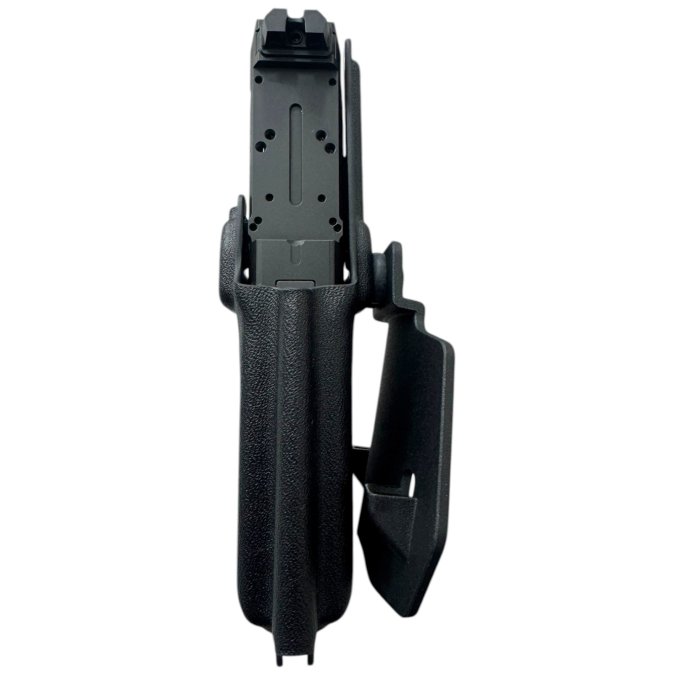
Two configurations cover most shooters, and both are available in our catalog.
Glock 43/43X MOS with Streamlight TLR-7 Sub
The IWB Kydex Holster for Glock 43/43X MOS with Streamlight TLR-7 Sub is molded for the subcompact MOS platform with the TLR-7 Sub mounted. It also fits the 7X Sub and HLX Sub models. Adjustable retention, a two-position clip, and a protective sweat guard keep the optic clear of your body while the slim Kydex profile minimizes printing under a t-shirt.
Glock 17 with Streamlight TLR-7/7A/7X
For full-size carry, the IWB Kydex Holster for Glock 17 with Streamlight TLR-7/7A/7X is custom-molded around the TLR-7, 7A, or 7X. One caveat worth flagging: this shell does not fit the Streamlight HLX models. If you run an HLX, order the Glock 17 TLR-7 HLX version instead.
Custom Light-Bearing Holsters for Pistol-Mounted Lights
Custom light-bearing holsters are molded around the light body itself, which becomes the primary retention point rather than the trigger guard alone. That's why a light-bearing shell cannot be interchanged between light models, even when the pistol is identical.
This is the part most buyers get wrong. A holster molded for a TLR-7 will not retain a TLR-7 HLX properly, because the light bodies differ in length and profile. Retention that indexes on the wrong surface is unreliable retention.
TLR-7 HLX vs. TLR-7 Sub: Which Fits Your Setup?
The TLR-7 HLX is a full-length light built for full-size and compact pistols. The TLR-7 Sub is the shorter variant built for subcompact and slimline frames. They are not interchangeable, and neither are the holsters molded for them.
Match your light to your pistol first, then order the holster molded for that exact pairing. Our catalog separates these configurations deliberately, so you're never guessing whether a shell will fit.
Optics-Ready Holster Retention: What to Expect
Optics-ready holster retention should feel firm and consistent, with an audible click when the pistol seats fully. Passive retention from precision molding holds the firearm; adjustable tension screws let you fine-tune how much resistance you feel on the draw. Achieving this balance of security and accessibility remains a cornerstone of your broader tactical gear essentials, ensuring that every component of your loadout functions in harmony with your primary sidearm.
What separates a good optic-cut shell from a bad one is where retention is applied. On a properly molded optics-ready holster, retention indexes on the trigger guard and, when a weapon light is mounted, the light body. The optic channel itself should apply zero retention. If you can feel the shell gripping the optic housing, the mold is wrong, and you'll see it as a wandering zero or scuffed anodizing within a few hundred draws.
How Retention Geometry Changes With an Optic
Adding a slide-mounted red dot raises the top of the pistol by roughly a quarter inch or more, depending on the optic. That extra height forces the holster maker to make three adjustments at once:
- Raise the sight channel. The top edge of the Kydex has to clear the optic housing without rubbing the lens or the emitter hood.
- Preserve trigger guard lockup. Retention still has to snap on the trigger guard, which sits lower than the optic and is unaffected by the cut.
- Keep the sweat guard below the optic. A sweat guard that rides too high will drag on the optic body on every draw and can push the pistol out of full seat.
A common pattern is that a shell cut for a micro optic (like a Holosun 407K/507K footprint) will pinch a full-size housing (like a Trijicon RMR or an Aimpoint Acro). The retention feels fine on the bench, then the optic shifts under recoil because the shell is contacting the housing instead of the trigger guard.
IWB Kydex Holster for Glock 43/43X Mos →
What Good Retention Actually Feels Like
- A distinct click when the trigger guard seats into the mold
- No movement of the pistol when you shake the holster upside down
- A draw that releases smoothly without dragging on the optic
- Tension that stays consistent after hundreds of draws
- No witness marks on the optic housing after a week of daily carry
If retention feels vague or the pistol rattles, the mold wasn't cut for your configuration. That's a fit problem, not a tension problem, and no amount of screw adjustment will fix it. Over-tightening the tension screws to compensate is one of the most common ways shooters damage an optic, the shell flexes inward and pinches the housing.
Optic-Specific Compatibility: Will Your Red Dot Fit?
Whether your red dot fits comes down to the optic's footprint and its height above the slide. Most slide-mounted reflex optics fall into a handful of footprint patterns, and a properly cut shell clears the housing without contacting the lens. This is the part most holster guides skip, they talk about the holster, not the optic. Here's the matching guide.
The Footprints You'll Actually Encounter
- Trijicon RMR / RMRcc footprint. The RMR is the de facto full-size standard; the RMRcc is its slimmer sibling for micro-compact slides. Many optics from other brands (Holosun 507C, 508T, and several Swampfox models) use an RMR-compatible footprint.
- Docter / Noblex footprint. Common on older and budget reflex sights; also the basis for the Vortex Venom and Viper footprints.
- Shield / RMSc footprint. The dominant micro-optic pattern for slimline pistols like the Glock 43X MOS and 48 MOS. Holosun 407K and 507K use a modified RMSc footprint with two of the four lugs removed.
- Aimpoint Acro footprint. A closed-emitter, enclosed design with a taller, boxier housing that needs more vertical clearance than any open-emitter optic.
- Leupold DeltaPoint Pro footprint. Wider and taller than an RMR; often found on full-size duty pistols.
Why Footprint Alone Isn't Enough
Two optics can share a footprint and still need different holster cuts. The variables that matter:
- Optic width: Wider housings need a wider channel. A shell cut for a micro optic may pinch a full-size housing.
- Optic height above the slide: Taller optics, especially enclosed designs like the Acro, need more vertical clearance in the sight channel.
- Emitter hood shape: Some optics have a squared-off hood that catches on a tight channel; others are rounded and clear easily.
- Co-witness setup: If you run suppressor height sights alongside the optic, the channel has to clear both the optic and the iron sights.
- Battery tray location: Bottom-load batteries (common on RMR-pattern optics) mean the optic has to come off the slide for battery changes, plan for re-zeroing, not for a holster change.
Matching Your Optic to a Holster Cut
The practical rule: match the holster to the assembled system, not to the optic name alone. A shell molded for a Glock 43X MOS with a Holosun 507K will not properly clear the same pistol with a larger enclosed optic, even though both are "optics ready."
A common mistake is assuming "optics ready" means "fits every optic." It doesn't. Compatibility is specific to the mold, which is why we ask for your exact pistol, light, and optic combination before cutting Kydex.
Troubleshooting Optic Interference and Holster Wear
Optic interference and holster wear almost always trace back to one cause: a shell that wasn't molded for the optic now riding in it. The symptoms show up as scratches on the optic body, a shifting point of aim, or a draw that catches mid-stroke.
Common fixes, in order of what actually works:
- Check the channel clearance. If the optic contacts the Kydex at any point, the mold is wrong for your setup. Replace the shell.
- Inspect the sweat guard. A sweat guard that sits too high can drag on the optic housing. Trimming is possible but voids the fit guarantee on most custom shells.
- Look for debris. Sand and grit trapped between the optic and the channel will scratch the housing. Clean the channel regularly.
- Verify retention screws. Over-tightened tension screws can pull the shell inward and pinch the optic.
The real difference between a holster that protects your optic and one that damages it comes down to molding precision. A shell molded around your exact optic leaves clearance by design, not by luck.
Training Considerations for Optics-Ready Carry
Training for optics-ready carry means rebuilding your draw stroke around the optic, not around iron sights. The red dot changes where your eye picks up the sight picture, and that changes how you present the pistol.
What to practice:
- Index the dot, don't hunt for it. A consistent grip and draw stroke brings the dot into view automatically. Hunting for the dot costs time.
- Practice from concealment. Drawing from under a cover garment with a light-bearing holster is a different motion than range work.
- Train the failure case. Know what to do if the dot is occluded or the battery dies. Backup irons and a consistent index solve this.
- Build reps with your actual carry setup. The holster, light, and optic you carry are the ones you should train with.
Rapid target acquisition with a red dot comes from repetition, not from the optic itself. The optic makes a good draw better; it doesn't fix a bad one.
Conclusion: Choosing Your Custom Optics-Ready Holster
The hard part of buying a custom holster for optics ready carry isn't finding options. It's finding a shell molded for your exact pistol, light, and optic combination, because that's the only fit that delivers reliable retention and protects the optic.
Lindahl Holsters builds every shell to your specific configuration, with adjustable retention, a two-position clip, and a protective sweat guard on each IWB model. We ship in 1-3 business days, offer a 15% discount for military, law enforcement, and first responders, and include free shipping on orders over $125.
FIND YOUR GUN MODEL and get a holster molded for the pistol you actually carry.
Frequently Asked Questions
What features should I look for in an optics-ready holster?
Look for a dedicated optic cut that clears your red dot sight without contact, adjustable retention so you can fine-tune draw resistance, a protective sweat guard to shield the optic from body moisture, and adjustable cant and clip positions for your preferred carry angle. The holster should be precision-molded for your exact pistol and light combination, not a universal fit. Kydex construction holds its shape and won't collapse, which keeps the optic channel open for a clean draw every time.
Can I use a standard holster with an optics-ready pistol?
A standard holster without an optic cut will press against the red dot sight, which can shift the optic, scratch the lens, or prevent the pistol from seating fully. Even if the gun fits, the added height of a slide-mounted optic changes the holster's profile and retention. You need a holster molded specifically for your pistol with an optic cut. Lindahl Holsters builds every IWB holster with an optic cut, so your red dot sight sits in a dedicated channel without interference.
How does a sweat guard protect my pistol optic?
A sweat guard is a raised section of Kydex that sits between your body and the firearm. It blocks perspiration, lint, and debris from reaching the slide and optic lens. Without one, moisture can fog the lens, corrode the optic housing, and degrade the red dot's clarity over time. All Lindahl Holsters IWB models include a protective sweat guard as a standard feature, which matters for daily concealed carry in warm climates or during physical activity.
Do optics-ready holsters require a specific cut for the red dot?
Yes. The optic cut is a relief area molded into the holster body that gives the slide-mounted red dot sight clearance. It must match the optic's width and height so the pistol seats fully and retention works correctly. A generic cut may fit one optic but bind on another. Lindahl Holsters molds each holster around the specific pistol and optic platform, and the Glock 48 MOS model accommodates many popular slide-mounted red dot configurations.
What is the difference between IWB and OWB for optics-ready carry?
IWB holsters sit inside the waistband for deeper concealment, making them the standard choice for everyday concealed carry with a red dot sight. OWB holsters ride outside the belt, offering faster access and more comfort for open carry or range use but less concealment. Both can be optics-ready. Lindahl Holsters specializes in IWB Kydex holsters for red dot sight carry, with slim profiles designed to minimize printing under a t-shirt.

