


Custom vs. Mass-Produced Kydex Holsters: Which Fits Your Carry?
Table of Contents
- The Core Difference: Custom Kydex vs. Mass-Produced Holsters
- Holster Compatibility With Firearm Model and Accessories
- Custom Kydex Holster Cost: What You Actually Pay
- Retention, Draw Security, and Material Durability
- We The People Holster Review: A Practical Comparison
- Best Kydex Holster for Everyday Carry: Custom Molding Advantages
- Carry Position Options: IWB, OWB, AIWB, and Shoulder Carry
- How to Verify Safe Fit and Function Before You Carry
- The Real Value: Warranty, Return Policy, and Total Cost of Ownership
- Frequently Asked Questions
Last Updated: October 17, 2026
The Core Difference: Custom Kydex vs. Mass-Produced Holsters
Choosing between a custom Kydex holster and mass-produced options like We The People comes down to two questions: does precision fit justify the cost, and what does "good enough" mean for your carry?
A custom Kydex holster is vacuum-formed to your specific firearm model, accounting for every contour, rail, and mounted accessory. Mass-produced holsters fit multiple variants within a category, which affects retention, draw consistency, and how securely your gun stays positioned all day.
Custom molding grips your exact firearm: no extra space, no shifting, precise trigger guard coverage. Mass-produced options accept a wider range of firearms, so they're built with more internal clearance: they work for many guns, but perfectly for none.
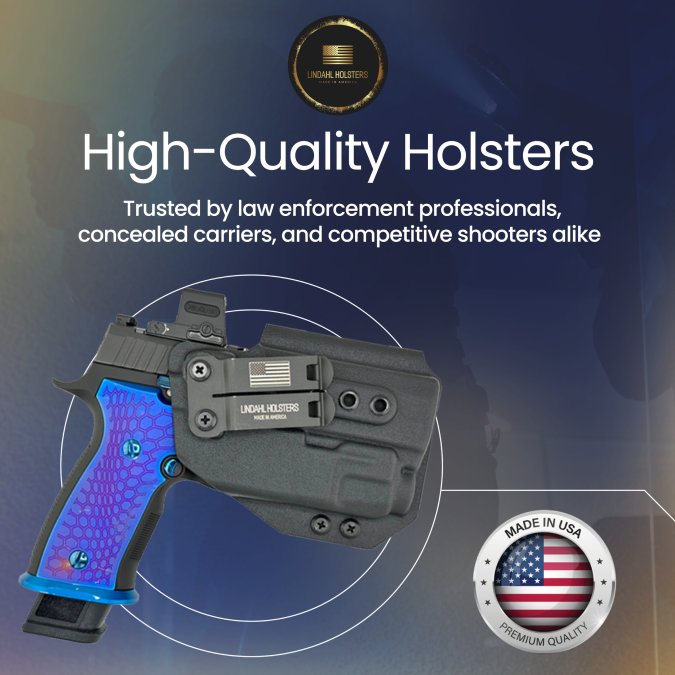
Lindahl Holsters specializes in custom Kydex holsters handcrafted for specific firearm models. Each is molded to the exact specifications of your gun, whether that's a standard Glock 19 or a platform with mounted optics or lights, which directly impacts retention, comfort, and draw speed under stress.

Custom holsters typically run $60 to $150 depending on carry style and options; mass-produced options often start under $50.
Holster Compatibility With Firearm Model and Accessories
When a holster is molded specifically for your firearm, compatibility isn't a guessing game, it's guaranteed.
Mass-produced holsters list compatibility by firearm family: "Fits Glock 19 and similar models." That phrase conceals real problems. A standard Glock 19 might fit fine, but add a mounted light and the holster is too tight or the light snags; add higher-profile night sights and the draw becomes inconsistent.
Custom molding builds the holster around your exact configuration. Carry a Glock 19 with a TLR-7A light and the Kydex is formed with that light in place, creating a secure pocket that accommodates it without binding or pressure points.
Lights, Optics, and Non-Standard Configurations
Weapon-mounted lights and optics are standard for serious carriers, but they're where mass-produced holsters often fail. A holster designed for a bare slide won't account for a mounted light's added width and profile, producing either a loose fit that compromises retention or a tight fit that makes drawing difficult.
Custom Kydex holsters handle this seamlessly. Specify your exact configuration when ordering, including light model, optic type, and other accessories, and the holster is molded to accommodate everything.
At Lindahl Holsters, we build holsters for the firearm you actually carry. Run a Glock 19 with a red dot and a light, and we mold around that exact configuration, so it fits like it was made for that gun, because it was.

| Configuration Type | Custom Kydex | Mass-Produced |
|---|---|---|
| Bare slide | Perfect fit | Good fit |
| With mounted light | Perfect fit | May be loose or tight |
| With optics | Perfect fit | Variable fit |
| With light + optics | Perfect fit | Often problematic |
| Non-mainstream model | Perfect fit | May not be available |
Custom Kydex Holster Cost: What You Actually Pay
The upfront cost of a custom Kydex holster ranges from around $60 to $150, depending on carry style, material thickness, and customization options. Lindahl Holsters IWB holsters start at $62.99.
But upfront price tells only part of the story; total cost of ownership includes lead time, return policies, and long-term use.
Most custom makers quote 2-3 weeks. Lindahl Holsters delivers in 1-3 business days.
Return policies vary: some custom makers charge restocking fees or don't accept returns on custom-molded products. Lindahl Holsters backs every holster with a lifetime warranty.
The real cost comparison emerges when you factor in failure: a mass-produced holster that doesn't fit right wastes money, while a custom holster that doesn't work is covered by the warranty.
Retention, Draw Security, and Material Durability
Retention is the single most important job a holster does: your gun must stay put during movement and release smoothly on the draw. Most comparisons settle this with adjectives; a more useful approach is a repeatable test protocol you can run in about 20 minutes with an unloaded firearm, a stopwatch, and a kitchen scale.
A Repeatable Retention and Fit Test
Run these checks on any holster, custom or mass-produced, before you trust it for daily carry. Record the results so you can re-test after a month and after a year.
- Inverted shake test. Unload the firearm, holster it, and hold the holster upside down over a padded surface. Shake firmly for five seconds. A carry holster should hold the gun; a duty or retention holster should hold it through a harder shake. If the gun falls out, retention is too light for anything but range use.
- Pull-force check. With the gun holstered and the holster secured in a vise or held firmly by a partner, hook a luggage scale to the grip and pull straight up. Note the pound reading at which the gun releases. Most practitioners find a defensively usable range sits roughly between 8 and 15 lb for concealed carry; below that the gun can work loose during activity, and well above that the draw becomes slow and inconsistent under stress. Record the number, then repeat five times and note the spread. A tight spread (within about 2 lb) indicates consistent molding; a wide spread points to uneven internal clearance.
- Trigger-guard coverage check. With the gun holstered, try to insert a finger, a pen, or a folded index card into the trigger guard area from every angle. Nothing should reach the trigger. This is the single most important safety check, and it is where broad-fit holsters most often fall short because the extra internal clearance leaves gaps around the guard.
- Movement and shift test. Wear the holster for 30 minutes while walking, sitting, bending, and climbing stairs. Note whether the gun shifts, rattles, or requires readjustment. A holster that lets the gun migrate is a holster you will fidget with, and fidgeting defeats concealment.
- Reholster check. With the gun unloaded, reholster one-handed without looking. The mouth of the holster should stay open and accept the gun without catching on the sight, the light, or the optic. A collapsed or snagging mouth is a common failure on thin, broad-fit shells.
What the Test Reveals About Custom Versus Mass-Produced
Custom Kydex holsters tend to score well because the shell is molded to your exact firearm: precise trigger guard coverage, a snug grip area, and a consistent draw from the first pull to the fiftieth. That consistency builds muscle memory, which is what matters under stress.
Mass-produced holsters achieve retention through broader tolerances. They can pass the shake and pull tests, but the fit is looser by design and the spread between pulls is often wider. Some carriers accept that; others find the gun shifts and needs constant readjustment.
Material Durability: What to Inspect and When
Quality Kydex is durable and moisture-resistant, which matters for daily carry and humid climates; cheap Kydex can warp, crack, or develop stress marks. Inspect for these failure points:
- Stress whitening at the bend. Look for pale, cloudy lines where the shell curves around the trigger guard and dust cover. Whitening is the first sign of fatigue.
- Edge cracking at the rivets and eyelets. Hardware holes are stress concentrators; hairline cracks there spread.
- Mouth collapse. If the holster mouth no longer stays open for one-handed reholstering, the shell has softened or thinned.
- Retention drift. A pull-force reading that has dropped noticeably since your baseline log is a durability signal, not just a preference issue.
- Hardware loosening. Check belt clips, screws, and retention adjusters for backing out; a little thread-locker on user-serviceable screws prevents most of it.
Lindahl Holsters uses American-made Kydex (.08" thickness in our premium options) that resists moisture, temperature changes, and daily wear.
We The People Holster Review: A Practical Comparison
We The People is one of the largest mass-produced holster manufacturers, with widely available, affordable products designed to fit a broad range of models. The useful question is how a specific We The People holster compares to a custom Kydex holster molded for the same gun, using the test protocol above.
Side-by-Side on the Things That Matter
| Dimension | We The People (mass-produced) | Custom Kydex (molded to your gun) |
|---|---|---|
| Fit philosophy | One shell fits a family of models (for example, several Glock 9mm double-stack variants) | One shell molded to your exact model and configuration |
| Trigger-guard coverage | Generally adequate on a bare gun; can open up on modified guns | Precise, because the guard area is molded directly |
| Retention consistency | Passes shake and pull tests, but pull-force spread is often wider | Tighter pull-force spread; adjustable retention lets you tune it |
| Light and optic support | Limited; many models are molded for a bare slide | Built around your specific light and optic |
| Less-common firearms | Catalog covers popular models; gaps exist | Available for most models on request |
| Lead time | In stock, ships quickly | Varies by maker; Lindahl Holsters ships in 1-3 business days |
| Upfront price | Lower | Higher, typically $60-$150 depending on style and options |
| Warranty and returns | Standard return window; check current terms | Varies; Lindahl Holsters offers a lifetime warranty and a 30-day return window |
Where We The People Works Well
We The People holsters excel at accessibility: a price point that makes concealed carry affordable for new permit holders, broad compatibility so you can find a holster quickly, and a straightforward return policy. For a carrier with a common, unmodified pistol who wants to start carrying this week on a budget, that combination is hard to beat.
Where the Broad-Fit Approach Shows Its Limits
A We The People holster designed to fit Glock 19 variants includes the 19, 19X, 45, and sometimes multiple generations, which requires internal clearance that sacrifices precision. Run the tests and the difference shows in the numbers: a wider pull-force spread, more movement in the shift test, and a trigger-guard check that can open up once you add a light or aftermarket sight.
If you are carrying a standard Glock 19 with no accessories, a We The People holster is likely adequate. If you are carrying the same gun with a mounted light, the fit becomes questionable. If you are carrying a less common firearm model, We The People may not have a compatible option at all.
The Total-Cost Comparison
The upfront price gap is real but not the whole equation. Add shipping, a replacement if the first holster doesn't work out, and your time waiting on a return. A cheaper holster that ends up in a drawer is the most expensive holster you can buy; a custom holster that fits on day one and carries a lifetime warranty spreads its cost across years of actual carry.
Glock 19X IWB Holster – Kydex Concealed Carry Holster →
Do not judge either holster by how it feels in the store. Run the inverted shake, pull-force, trigger-guard, movement, and reholster checks with an unloaded firearm before you commit to daily carry. The test results, not the marketing copy, tell you which holster is good enough for your gun.
The practical difference: you will carry a custom Kydex holster that fits your exact firearm and configuration. You may carry a We The People holster, depending on how well it works with your specific setup. Running the same tests on both is how you replace "may" with a number.
Best Kydex Holster for Everyday Carry: Custom Molding Advantages
Everyday carry demands a holster that works reliably day after day, under clothing, through your normal routine, sitting and standing repeatedly. It needs to stay comfortable, secure, and unobtrusive.
Custom molding delivers this consistency. When your holster is formed around your exact firearm, the fit is optimized for your specific gun: no excess internal space creating shifting or noise, no tight spots causing discomfort or making the draw difficult. The holster simply works.
Lindahl Holsters IWB holsters are designed specifically for everyday carry. Each one is custom-molded for your firearm model, includes adjustable retention so you can fine-tune the draw to your preference, and features a protective sweat guard to minimize contact between your gun and your body. For a Glock 19 or Glock 43/X, our IWB holsters start at $62.99 and ship within 1-3 business days.
The advantage of custom molding for everyday carry is consistency. You carry the same gun every day in the same holster. That consistency builds confidence. You know exactly how the holster will perform because it's designed for that specific gun.
Carry Position Options: IWB, OWB, AIWB, and Shoulder Carry
Your carry position determines holster design requirements. Different positions demand different retention mechanisms, material thickness, and attachment hardware.
IWB (inside-the-waistband) holsters sit inside your pants, typically at the 3-4 o'clock position for right-handed carriers. They're the most popular choice for concealed carry because they're easy to conceal and provide good retention. IWB holsters require a secure belt attachment and a protective sweat guard to keep your firearm from pressing directly against your skin.
OWB (outside-the-waistband) holsters sit outside your pants, typically for open carry or duty use. They're faster to draw from and more comfortable for all-day wear because there's no gun pressing against your body. OWB holsters are larger and more visible, so they're less suitable for concealed carry.
AIWB (appendix inside-the-waistband) holsters position the gun at the 1-2 o'clock position for right-handed carriers, sitting in front of the hip. AIWB carry is popular for deep concealment because the gun sits naturally under a t-shirt without printing. AIWB holsters require precise molding to ensure safe trigger coverage and comfortable positioning during sitting.
Shoulder holsters distribute weight across your shoulders rather than your belt. They're comfortable for all-day wear and work well under jackets, but they're slower to draw from and less suitable for active carry.
Custom Kydex holsters can be designed for any of these positions. Mass-produced holsters typically focus on IWB and OWB because those are the largest markets.
How to Verify Safe Fit and Function Before You Carry
Before you carry a holster daily, confirm it's safe and functional. A holster that doesn't fit properly can fail when you need it most.
Start with a dry fire test. With your firearm unloaded, place it in the holster and practice drawing. The gun should come out smoothly without binding or requiring excessive force. The holster should retain the gun securely when you move around, no shifting, no rattling, no loose fit.
Check trigger guard coverage. The holster should completely cover the trigger guard, preventing anything from contacting the trigger during carry or draw. Inadequate trigger guard coverage is a serious safety issue.
Verify retention under movement. Wear the holster for 15-30 minutes while moving normally, walking, sitting, bending. The gun should stay in position without shifting. If the holster allows the gun to move, it's not secure enough for daily carry.
Test the draw under stress. After you're comfortable with normal draws, practice drawing while under mild physical stress, after exercise, when your hands are slightly shaky. The draw should remain consistent and smooth.
If any of these tests reveal problems, address them before carrying. Adjust retention if the holster allows it. Return the holster if it doesn't fit properly. A holster that works is non-negotiable.
The Real Value: Warranty, Return Policy, and Total Cost of Ownership
Lindahl Holsters backs every custom Kydex holster with a lifetime warranty. If your holster fails due to manufacturing defect, we replace it at no cost. That's not a marketing promise, it's a commitment to quality and customer satisfaction.
Return policies matter because fit is subjective. What feels comfortable to one carrier might feel wrong to another. Lindahl Holsters accepts returns within 30 days if the holster doesn't work for you. That gives you time to test the holster in real-world carry before committing.
Lead time affects total cost of ownership because it determines how quickly you can start carrying. A 2-3 week lead time means you're waiting a month after ordering. Lindahl Holsters delivers in 1-3 business days, so you're carrying within days of ordering, not weeks.
When you add up the components, precision fit, reliable retention, fast lead time, lifetime warranty, and a 30-day return window, custom Kydex holsters deliver better value than mass-produced alternatives. You're paying for a holster that works perfectly for your gun, backed by a guarantee that protects your investment.
The decision between custom and mass-produced comes down to your priorities. If you want a holster that fits your exact firearm perfectly, delivers reliable retention, and comes backed by a lifetime warranty, custom Kydex is the answer. Every holster includes adjustable retention, a protective sweat guard, and precision molding for your specific firearm. FIND YOUR GUN MODEL and get a holster that actually works for your carry setup.
Frequently Asked Questions
Are custom Kydex holsters worth the extra cost?
Custom Kydex holsters deliver precision fit, adjustable retention, and durability that mass-produced options often cannot match. The upfront investment typically ranges from $62.99 to higher price points depending on customization. You gain a holster molded to your exact firearm model, better trigger guard coverage, and adjustable cant and clip positions. For daily carry, the improved comfort and security often justify the cost. A lifetime warranty on custom holsters also protects your investment long-term, reducing replacement costs over time.
How should a custom Kydex holster fit my specific firearm?
A properly fitted custom Kydex holster should have a snug, secure fit with no gaps between the holster shell and your firearm's contours. You should hear a distinct audible click when holstering, confirming the weapon is seated correctly. The trigger guard must be fully enclosed, and there should be no movement or rattle when you shake the holster. Adjustable retention allows you to fine-tune how much pressure the holster applies. Before carrying, verify the holster works smoothly with your firearm's specific generation, optics, or mounted accessories like weapon lights.
What's the difference between We The People and custom Kydex holster options?
We The People produces mass-manufactured holsters designed for popular firearm models at lower upfront costs. Custom Kydex holsters like those from Lindahl Holsters are precision-molded for your exact firearm configuration, including optics and lights. Custom options offer adjustable retention, multiple cant positions, and hand-crafted quality control. Mass-produced holsters prioritize affordability and quick availability but may not fit less-common firearm models or accessories as securely. For shooters with standard configurations and tight budgets, mass-produced works; for those wanting perfect fit and durability, custom Kydex delivers performance.
Can a mass-produced holster safely accommodate my firearm with a mounted light or optic?
Most mass-produced holsters are designed for standard firearm configurations and may not safely accommodate weapon lights, lasers, or optics without gaps or instability. This creates retention and safety risks. Custom Kydex holsters can be specifically molded around your exact setup, including popular lights like the TLR-7A or TLR-8. Before using any holster with accessories, verify the fit is snug, the trigger guard is fully covered, and the holster retains your firearm securely. If your mass-produced holster doesn't fit your light-equipped firearm properly, a custom option ensures safe, reliable carry.

