


Duty Grade Holster Requirements: 2026 Guide
Table of Contents
- What Makes a Holster Duty Grade?
- Holster Retention Levels Explained: Level I, II, and III
- Duty Holster Safety Features That Matter
- Active Retention and Weapon Retention Compared
- Materials and Construction Standards
- Weapon Light and Optics Compatibility
- Departmental Policy and Authorized Equipment
- Holster-to-Body Mechanics and Draw Consistency
- How to Buy a Level 2 Duty Holster
- Transitioning from Concealed Carry to Duty Carry
- Liability and Legal Implications of Holster Choice
- Environmental Durability and Holster Maintenance
- Conclusion
- Frequently Asked Questions
Last Updated: September 16, 2026
What Makes a Holster Duty Grade?
A duty grade holster is a holster engineered to hold a firearm securely through physical struggle, vehicle operations, foot pursuits, and weather exposure while still allowing a fast, consistent draw under stress. At Lindahl Holsters, we build custom Kydex holsters for everyday carry and duty use, and the questions we field most often come from officers and armed professionals trying to sort real duty grade holster requirements from marketing claims.
That distinction matters because the gap between a good concealed carry holster and a duty-rated one is not cosmetic. It comes down to three things: retention that survives a fight, construction that survives years of daily wear, and a fit that matches your exact firearm, light, and optic configuration.
Below, we break down what each of those requirements actually looks like, how retention levels are classified, and how to buy a Level 2 duty holster without guessing.
Holster Retention Levels Explained: Level I, II, and III
Retention levels describe how many independent mechanisms must be defeated before the firearm leaves the holster. A Level I holster uses one; a Level III holster uses three. Most agency policies and duty gear standards key off this classification, which is why it is the first spec to confirm before you order.
The classification is a count, not a quality ranking. A well-built Level II holster with a hood and a trigger-guard lock can be more secure than a poorly executed Level III, and a Level III with three mechanisms packed into one thumb path can actually be slower to defeat than a clean Level II. What matters is whether each mechanism is independent and whether you can defeat all of them in one consistent motion.
Active vs. Passive Retention
Passive retention is friction: the molded shell grips the frame and trigger guard, and nothing has to be released for the draw. Every well-made Kydex holster has it, and it is the baseline, not a substitute for a locking system.
Active retention is a mechanism you must deliberately release: a thumb break, a hood, a rotating hood, or a trigger-guard lock. This is the retention that keeps a firearm in the holster when someone else is pulling on it.
A common mistake is assuming a tight passive fit equals duty-grade security. It does not. Friction can be overcome by use, and it loosens with heat, debris, and repeated draws.
How the Levels Map to Real Mechanisms
Level |
Mechanism Count |
Typical Configuration |
Common Use |
|---|---|---|---|
Level I |
One active release |
Thumb break or single hood over the slide |
Plainclothes, off-duty, some investigative assignments |
Level II |
Two active releases |
Hood plus trigger-guard lock, or thumb break plus retention screw |
Standard patrol where policy allows |
Level III |
Three active releases |
Rotating hood, trigger-guard lock, and a secondary release (often a push-button or lever) |
Patrol and tactical assignments with the strictest policy language |
Agencies that specify "Level II minimum" are usually requiring two independent mechanisms, not a specific brand. That distinction matters when you shop, because two holsters can both be labeled Level II and still have very different release ergonomics. Read the mechanism list, not just the level number.
The Release Sequence Is the Real Spec
What most guides miss is that the level number tells you how many mechanisms exist, but not how they are sequenced. A Level III holster where all three releases sit under one thumb sweep draws faster than a Level II where the releases are split between two hands or two positions. Before you buy, ask three questions:
- Can every release be defeated with one hand while maintaining a firing grip?
- Is the release order the same every time, or does it change with holster wear?
- Does the mechanism reset automatically when the firearm is reholstered, or do you have to reset it manually?
That third question is where duty holsters separate. A mechanism that does not reset on reholstering forces you to break your grip and reset it under stress, which is exactly when you can least afford it.
Why the Level Number Alone Is Not Enough
Two holsters can both be Level II and still fail different agency policies. Some policies specify the level, some specify the mechanism type (for example, "a hood that covers the rear of the slide"), and some specify both. Confirm which language your agency uses before you assume a Level II holster qualifies. If your policy names a mechanism, match the mechanism, not just the level.
Duty Holster Safety Features That Matter
The safety features that matter most on a duty holster are the locking mechanism, full trigger guard coverage, and a release that cannot be defeated accidentally during a struggle. Everything else is secondary.
Locking Mechanisms and Quick-Release Systems
Locking systems fall into a few practical categories:
- Thumb-break straps: simple, inexpensive, and prone to wear and snagging over time
- Trigger-guard locks: retain the firearm at the strongest point on the frame
- Rotating hoods: cover the rear of the slide and release with a natural thumb sweep
- Push-button or lever releases: fast, but placement matters enormously under stress
What most guides miss is that release ergonomics decide whether a locking system works for you. A mechanism you cannot reach without shifting your grip is a mechanism you will fumble when your hands are shaking.
Active Retention and Weapon Retention Compared
Active retention and weapon retention are related but distinct. Active retention is a feature of the holster. Weapon retention is the skill of keeping your firearm from being taken, and it depends on the holster, your positioning, and your training together.
A holster with three locking mechanisms does not make an officer weapon-retention proficient. It buys time. That time only converts into control if the officer has trained to create distance, protect the holster, and counter a grab.
This is the part manufacturers rarely say out loud: retention ratings describe hardware performance, not officer performance. Both have to be developed.
Materials and Construction Standards
Duty holsters are built from Kydex, injection-molded polymer, or occasionally boltaron, and each material behaves differently under heat, cold, and impact. Kydex holds its molded shape well. Injection-molded polymer is uniform and cheap to produce at volume but cannot be adjusted to your specific firearm.
Construction quality shows up in the details:
- Thickness consistency across the shell
- Rivets and hardware that do not loosen with vibration
- Edge finishing that will not cut into a duty belt or uniform
- Molded features that support the firearm at the trigger guard and slide, not just the barrel
For a custom-molded option built around an exact firearm, the 1911 5" Railed W X300 OWB Paddle Holster is molded in-house around the pistol and light combination, with light-bearing retention that locks onto the SureFire X300 rather than relying only on the trigger guard.

Weapon Light and Optics Compatibility
Weapon light and optic compatibility is where most holster purchases go wrong. A holster molded for a bare pistol will not accept the same pistol with a light attached, and a holster cut for standard sights may not clear suppressor-height sights or a red dot.
Check three things before ordering:
1911 5" Non-Railed OWB Paddle Holster →
- The holster is molded for your exact firearm model
- The mold accounts for your specific light, not a generic "light-bearing" cut
- The optic cut accommodates your red dot without contacting the housing
Light-bearing holsters that retain on the light itself tend to hold more consistently than designs that grip only the frame, because the light becomes a structural anchor point. If you carry a railed 1911 with an X300, a holster like the Kimber 1911 5" OWB Paddle Holster with SureFire X300 compatibility is molded for that exact pairing rather than a universal shell.

Configuration |
What the Holster Must Be Molded For |
Common Failure |
|---|---|---|
Pistol only |
Exact model and barrel length |
Slide length mismatch |
Pistol + weapon light |
Specific light model |
Generic light cut, loose fit |
Pistol + optic |
Optic footprint and sight height |
Housing contacts red dot |
Pistol + light + optic |
All three together |
Light cut blocks optic clearance |
Departmental Policy and Authorized Equipment
Departmental policy usually decides the retention level, the approved holster list, and sometimes the exact mounting system before you ever shop. Authorized equipment lists exist because agencies carry liability for what their officers carry, and a holster outside policy can create problems after an incident.
Before buying, confirm:
- The minimum retention level your agency requires
- Whether the holster must appear on an approved equipment list
- Whether the mounting system must match existing duty gear
- Whether a weapon light or optic is authorized at all
If your policy specifies a mounting standard, look for a holster compatible with that system. Lindahl Holsters OWB paddle holsters are compatible with G-Code, Safariland, and Blade-Tech attachments, which lets officers configure the holster to duty gear they already run.
Holster-to-Body Mechanics and Draw Consistency
Holster-to-body mechanics determine whether your draw is repeatable. The holster's ride height, cant, and distance from the body all change where your hand meets the grip, and a change of even a small amount throws off a draw you have practiced thousands of times.
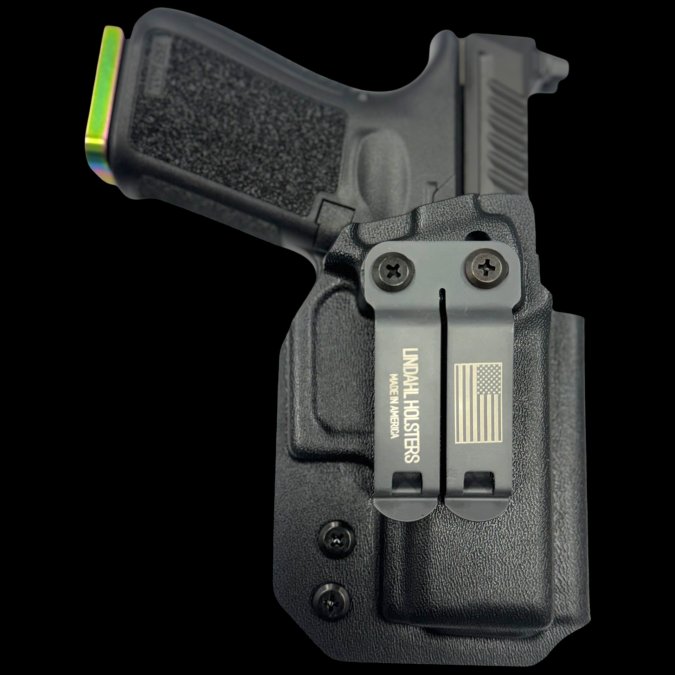
Holster cant is the angle of the holster relative to vertical. Mid-ride and drop-leg positions change the draw arc, and each suits a different body type and duty assignment.
How to Buy a Level 2 Duty Holster
To buy a Level 2 duty holster, match the holster to your exact firearm, light, and optic configuration first, then confirm it meets your agency's retention requirement and mounting standard. Everything else is preference.
What to Check Before You Order
- Confirm your exact firearm model, barrel length, and rail configuration
- Confirm your weapon light model if you carry one
- Confirm your optic footprint and sight height
- Confirm your agency's minimum retention level
- Confirm the mounting system matches your duty belt
- Confirm the holster is molded for your full configuration, not a universal fit
- Confirm the return policy before you commit
That last item matters more than people admit. A holster that does not fit your setup is useless, and custom-molded gear is only worth the money if the maker stands behind the fit. Lindahl Holsters builds each holster to the firearm configuration ordered, with a 1-3 business day lead time so you are not waiting weeks for a duty holster you need now.
Transitioning from Concealed Carry to Duty Carry
Transitioning from concealed carry to duty carry requires unlearning habits that work fine in plainclothes but fail on a duty belt. Concealed carry prioritizes concealment and a smooth, unobtrusive draw. Duty carry prioritizes retention, accessibility over body armor, and a draw that works while moving.
Liability and Legal Implications of Holster Choice
Holster choice carries liability implications that most buyers never consider until after an incident. Agencies and individual officers can both face scrutiny over whether equipment met policy and industry practice, and a holster outside authorized equipment creates an avoidable question.
Environmental Durability and Holster Maintenance
Environmental durability testing is the angle almost nobody covers, and it is where duty holsters separate from range holsters. A duty holster lives in heat, cold, rain, dust, and vehicle interiors that reach extreme temperatures, and it has to keep its shape and retention through all of it.
How Each Environment Attacks the Holster
Heat. A closed vehicle interior can exceed 140°F in summer sun. Kydex and injection-molded polymer both soften as they approach their glass transition temperature, and a holster under constant pressure from a seated draw can take a permanent set. That is how a holster that fit perfectly in March starts feeling loose in August. The fix is not to overtighten the retention screws, which stresses the shell at the mounting points, but to re-verify retention before each shift.
A Practical Inspection Schedule
Most practitioners find that a simple schedule catches problems before they become failures:
- Before each shift: verify retention by testing the firearm in the holster, and confirm the release resets cleanly.
- Weekly: check retention screws and rivets for loosening, and wipe the shell interior of dust and debris.
- Monthly: inspect the release mechanism for wear, cracking, or sluggish travel, and check exposed hardware for corrosion.
- Annually, or after any hard impact: have the holster inspected by the maker or a qualified armorer, and replace worn hardware rather than tightening past spec.
What to Look For During Inspection
- Cracks radiating from mounting holes or rivets, especially after cold-weather use
- A release that no longer resets on reholstering, or that requires a second motion to reset
- Hardware that has backed out, stripped, or corroded
- A shell interior that has become polished or glazed from repeated draws, which reduces passive retention
- Any modification, non-standard hardware, or field repair, which weakens both the holster and the equipment record
Why This Matters Beyond the Gear
The environmental angle connects directly to the liability question. An agency's authorized equipment list assumes the holster performs as designed for its service life. A holster that has been cooked in a vehicle, dropped on concrete in freezing weather, or run past its inspection schedule may not. Documenting your inspection and maintenance is part of treating the holster as duty gear rather than an accessory.
Conclusion
The hardest part of buying duty gear is that the requirements are not printed on the box. Retention level, materials, light and optic compatibility, policy compliance, and body mechanics all have to line up before a holster is genuinely duty grade, and most listings only tell you part of the story.
Frequently Asked Questions
What is considered a duty holster?
A duty holster is a holster designed for professional use by law enforcement, security, and first responders. It must provide active retention beyond friction, full trigger guard coverage, and a stable mounting platform on a duty belt. Duty grade holster requirements typically include Level II or Level III retention, compatibility with weapon lights and optics, and construction that holds up to daily patrol use. Departmental policy often specifies the exact retention level and approved models.
What is the difference between Level 2 and Level 3 retention?
Level 2 retention uses two mechanisms to hold the firearm, usually friction plus one active locking system such as a thumb break or hood. Level 3 adds a third mechanism, often combining a hood, a rotating retention device, and friction. The extra step slows the draw slightly but makes it much harder for someone else to take the weapon. Many departments require Level 3 for uniformed patrol and allow Level 2 for plainclothes or off-duty use.
Do duty holsters need to meet specific NIJ standards?
The National Institute of Justice does not currently publish a certification standard specifically for duty holsters. Retention levels are defined by manufacturers and adopted by departments through policy. Some agencies run their own standardized testing, including drop tests, weapon retention drills, and environmental exposure. When you buy a level 2 duty holster, check whether your department accepts the manufacturer's retention rating or requires documented testing results.
What materials are best for duty grade holsters?
Kydex and other thermoformed polymers are the most common materials for duty grade holsters because they hold their shape, resist moisture, and provide consistent retention. What matters most is that the holster shell is molded to your exact firearm and light combination, not a universal fit.
How does holster retention affect draw speed and safety?
Higher retention adds steps to the draw, which can add fractions of a second. Level 2 holsters typically require one deliberate motion to release, while Level 3 requires two. That tradeoff is intentional: the extra step prevents a weapon grab in a struggle. With practice, officers can complete a Level 3 draw in under two seconds. The goal is a draw that is fast enough under stress but secure enough that no one else can take your firearm.
What features should I look for in a professional duty holster?
Look for active retention that locks onto the firearm or weapon light, full trigger guard coverage, adjustable cant and ride height, and compatibility with your duty belt width. Check that the holster is molded for your exact pistol, light, and optic combination. Also verify that the mounting system is compatible with your belt or drop-leg platform, and that replacement parts are available for the locking mechanism.
Can I use a concealed carry holster for duty use?
No. Concealed carry holsters typically rely on friction retention only, which does not meet duty grade holster requirements. They also lack the active locking systems and mounting stability needed on a duty belt. If you are transitioning from concealed to duty carry, expect a different draw stroke, a higher ride height, and a retention release you must train until it becomes automatic.
How long does a custom duty holster order take?
Lead times vary by manufacturer. Some custom Kydex makers ship in one to three business days, while others quote two to three weeks. If your department requires a specific model and you need it quickly, ask about rush options before ordering. Also confirm the return policy in case the fit is not right for your firearm and light combination.

