


Holster for Glock with Light: Best IWB Options
Table of Contents
- Why a Standard Holster Won't Work with a Weapon-Mounted Light
- Holster for Glock with Light: Compatibility You Can't Skip
- IWB Holster for Light Bearing: Concealment and Comfort
- Kydex Holster Retention Adjustment and Tension
- Concealed Carry Holster Safety Standards for Light-Bearing Setups
- How to Maintain Your Light-Bearing Holster
- Conclusion: Secure Your Glock and Light
- Frequently Asked Questions
Last Updated: September 5, 2026
Why a Standard Holster Won't Work with a Weapon-Mounted Light
Adding a weapon-mounted light to your Glock changes the gun's dimensions, balance, and profile. A holster molded for a bare frame will not accept a slide with a light attached. Forcing it can damage the finish, break the retention mechanism, or prevent the firearm from seating properly.
The light's bezel and body add bulk around the trigger guard and dust cover. Standard Kydex shells are precisely formed to the exact contours of a specific firearm model. They have no room for a rail-mounted accessory. This is why a holster for Glock with light requires a shell molded around both the pistol and the specific light model.
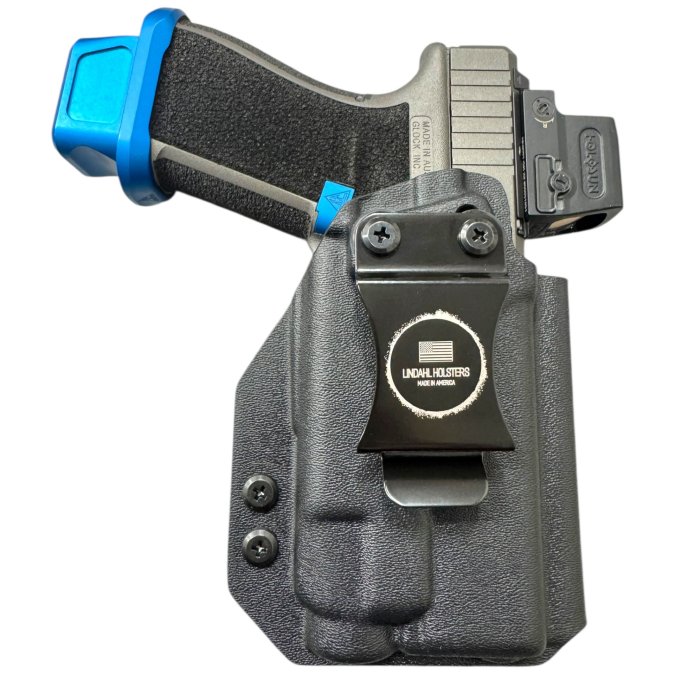
IWB Kydex Holster for Glock 19 With Tlr-7/7A/7X
Most firearm owners discover this after buying a generic holster: the gun clicks in but the trigger guard does not fully seat, or the light's bezel digs into the shell and prevents smooth draws. At Lindahl Holsters, we build every light-bearing holster around the exact dimensions of your Glock and your chosen tactical light.
Holster for Glock with Light: Compatibility You Can't Skip
A holster for Glock with light is only as good as its compatibility with your specific light model. Streamlight, SureFire, and other manufacturers produce lights with different body lengths, bezel diameters, and rail profiles. A holster built for a TLR-7A will not correctly fit a TLR-7 HLX, even though both mount to the same rail.
The right approach is to match three variables: the Glock generation and model, the exact light model, and whether you run an optic. If you carry a Glock 17 with a TLR-7/7A/7X, you need a shell molded for that combination. The same Glock with a different light requires a different holster.
Lindahl Holsters offers a custom Kydex IWB holster for the Glock 17 with TLR-7/7A/7X light and red dot optic cut for $62.99. We also produce dedicated models for the Glock 22 with TLR-7/7A/7X and the Glock 22 with TLR-7 HLX. Each shell is formed specifically for that light-bearing setup, not adapted from a generic mold.
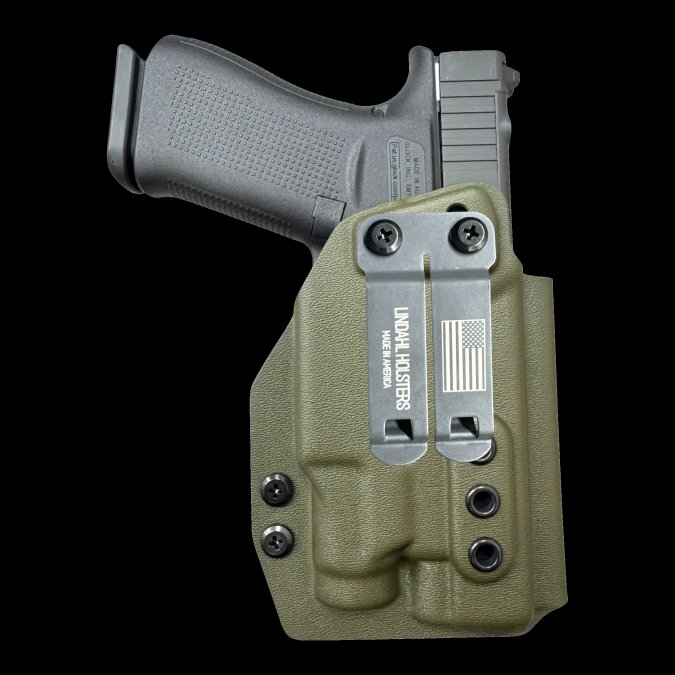
IWB Kydex Holster for Glock 43X With TLR-7 SUB
The table below summarizes the key compatibility factors to verify before ordering.
Compatibility Factor |
What to Check |
Why It Matters |
|---|---|---|
Glock model and generation |
Frame dimensions and slide profile |
A Gen 5 shell may not fit a Gen 3 frame |
Light model |
TLR-7A vs. TLR-7 HLX vs. other |
Bezel length and body diameter differ |
Optic cut |
Red dot mounted or iron sights |
Optic clearance requires extra shell depth |
Muzzle coverage |
Full-length shell vs. open bottom |
Protects the light bezel and prevents debris |
IWB Holster for Light Bearing: Concealment and Comfort
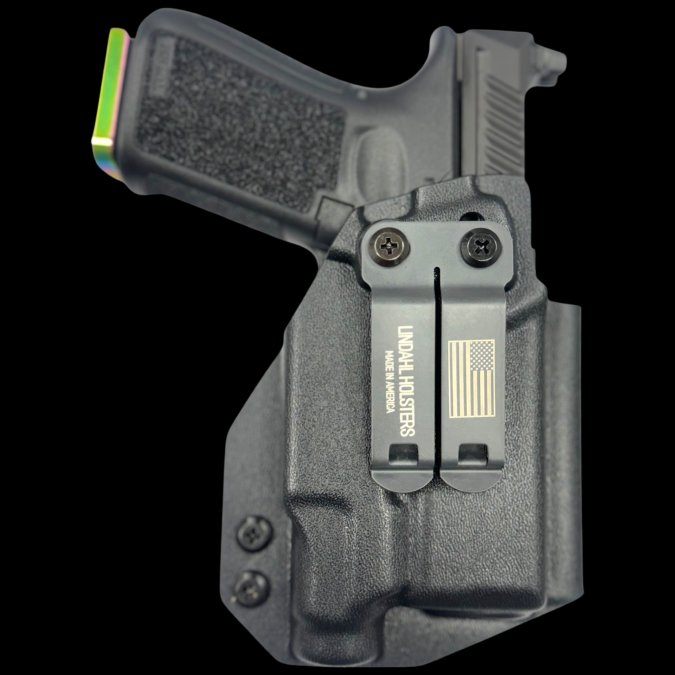
An IWB holster for light bearing must balance two competing demands: keeping the firearm hidden and keeping it comfortable for all-day wear. Light-bearing setups add width at the trigger guard, which can increase printing against a t-shirt. A holster claw or wing pushes the grip inward toward your body, reducing the visible outline.
The Physics of Printing with a Light
The concealment problem with a light-bearing Glock is the added width at the belt line. A standard Glock 19 is about 1.26 inches wide at the slide; adding a Streamlight TLR-7A brings the width at the trigger guard to roughly 1.5 inches (glock.com). That extra quarter-inch presses outward against your cover garment, creating a bulge even when the grip is tucked in.
A simple holster without a claw or wing is often insufficient for appendix carry with a light. The holster body acts as a lever, with the belt clip as the fulcrum; the weight of the light tilts the top of the holster away from your body, pushing the grip outward. A claw or wing changes this leverage point, pulling the grip flat against your abdomen.
Claw vs. Wing: What Actually Works
There are two primary attachment styles for pulling the grip in:
- Claw (or Modwing): A rigid plastic fin that presses against your belt from the inside. It pushes the holster body away from the belt, which in turn rotates the grip toward your body. Claws are effective but can be uncomfortable if they dig into your thigh or abdomen.
- Wing (or RCS Wing): A wider, flatter attachment that distributes pressure over a larger area of the belt. Wings are generally more comfortable for all-day wear but may not provide as aggressive a tuck as a claw.
Most quality holsters, including those from Lindahl Holsters, use a claw design with an adjustable position. You can tune the claw's angle and length to match your body type. If you are carrying a larger light like a SureFire X300U, you may need a more aggressive claw setting to counteract the additional forward weight.
The Wedge: The Missing Piece for Light-Bearing Rigs
A claw fixes the grip, but not the muzzle-end. With a light attached, the heavier muzzle end can tilt away from your body, creating a bulge at the top of your pants. A foam or rubber wedge on the rear of the holster pushes the muzzle into your thigh for a flatter profile.
A medium-density foam wedge, roughly 1 inch thick at the rear, positioned just below the trigger guard, fills the gap between your abdomen and thigh, preventing the holster from canting outward. Without a wedge, many shooters find a light-bearing holster prints more at the belt line than a standard holster.
Position and Ride Height Adjustments
Appendix carry is the most common position for light-bearing IWB holsters because the abdomen's natural curve helps break up the grip profile. Strong side carry works, but the light's bulk can press into your hip bone during long sits. Adjustable cant and ride height let you fine-tune the angle and depth.
For appendix carry with a light, a neutral cant (0 degrees) or a slight forward cant (up to 5 degrees) is typically best, helping the grip tuck into the hollow of your lower abdomen (usconcealedcarry.com). Ride height should place the belt clip just below your belt line, so the grip angles into your body without digging into your ribs.
Comfort: The Light's Pressure Point
The light's bezel sits directly against your body in an IWB setup. A sharp-edged bezel can dig into your hip or thigh when sitting or bending. A smooth, rounded shell edge at the muzzle end mitigates this, and a full-length shell distributes pressure better than an open-bottom design.
A slim profile with a minimal gap between the holster and firearm keeps the package tight. Lindahl Holsters crafts each IWB holster for light-bearing Glocks with a compact footprint, a holster claw for grip tuck, and a secure belt clip, so the setup disappears under an untucked shirt without sacrificing draw speed.
Kydex Holster Retention Adjustment and Tension
Kydex holster retention adjustment is what separates a safe holster from a liability. Retention refers to how firmly the shell grips the firearm. Too loose, and the gun can fall out during a run or a struggle. Too tight, and your draw stalls at the worst possible moment.
Most quality Kydex holsters use a tension screw at the trigger guard. Turning it clockwise increases friction; counterclockwise loosens it. The correct setting lets the gun click in with moderate pressure and draw out with a smooth, consistent pull, never requiring a yank or a fight to reholster.
Passive retention from the Kydex shell itself is the standard for IWB carry. The shell wraps the trigger guard and light body, holding the firearm securely until you deliberately draw it. Active retention mechanisms, such as thumb breaks or hoods, belong on duty holsters where retention against an attacker grabbing the weapon is a primary concern.
Concealed Carry Holster Safety Standards for Light-Bearing Setups
Concealed carry holster safety standards become more demanding when a weapon-mounted light enters the equation. The light adds material around the trigger guard, which can interfere with the holster's trigger coverage if the shell is poorly designed. Your holster must fully enclose the trigger guard on all sides, with no gap that admits a finger, a drawstring, or debris.
The Trigger Guard Gap: A Light-Specific Hazard
The most critical safety difference is the potential for a gap at the trigger guard. The shell must be molded to accommodate both the trigger guard and the light body; if not precisely formed, a void can expose the trigger. This is a leading cause of negligent discharges with light-bearing setups.
How to verify your holster is safe:
- The 'Finger Probe' Test: With the firearm unloaded and the holster removed from your belt, press your index finger firmly along the entire seam where the holster meets the light and trigger guard. You should feel a solid, continuous barrier. If your fingertip can enter the holster cavity or feel the trigger itself, the holster is unsafe for carry.
- The 'Drawstring' Test: Holster the unloaded firearm, then run a shoelace or piece of paracord along the trigger guard seam. If the cord snags or slips inside the shell, a piece of clothing or a drawstring could do the same during reholstering, potentially depressing the trigger.
- The 'Rock' Test: With the firearm holstered, grip the holster and attempt to rock the gun side-to-side and front-to-back. Any movement beyond a few millimeters indicates the shell is not locking onto the light body and trigger guard correctly, which can allow the firearm to shift and compromise the trigger barrier.
Reholstering: The Bezel Catch
The light's bezel also creates a reholstering hazard. If the holster mouth does not stay open, the muzzle can catch on the shell edge and push the light out of alignment. Quality Kydex holds its shape for one-handed reholstering, which matters most in low-light scenarios where you must rely on muscle memory.
A common failure point is the sharp bezel edge catching on the shell's leading edge, causing the holster to fold or the user to push harder. A well-designed holster has a beveled or flared mouth that guides the light and muzzle in without snagging.
Fitment is a Safety Feature
Holster fitment is a safety issue, not just a convenience issue. A firearm that seats partially can leave the trigger exposed or the light misaligned. Before carrying, verify that the trigger guard clicks fully into place and that the firearm does not rock side to side. According to firearm safety guidance from the National Shooting Sports Foundation, proper holster fit is a core component of responsible concealed carry.
For light-bearing holsters, this guidance is amplified: the light body is a primary retention surface. If the shell does not lock onto the light's specific contours, the holster is not providing proper passive retention. A holster relying solely on friction against the slide or frame, rather than a positive click over the light, is a red flag.
The 'Unloaded' Dry-Fire Draw Practice
To build safe muscle memory, practice draws at home with a cleared firearm. Focus on a smooth, straight-up draw that clears the light bezel without tilting the muzzle. Then practice reholstering slowly, using your support hand to push the holster body away from your torso to keep the mouth open.
How to Maintain Your Light-Bearing Holster
Light-bearing holsters collect more debris than standard models because the light body and rail create additional surfaces for dust, lint, and moisture. Regular maintenance keeps retention consistent and prevents the light from scratching the shell or slide.
Clean the shell interior periodically with a soft cloth and mild soap and water, avoiding solvents that degrade the polymer or attract dirt. Dry completely before reholstering. Check the tension screw every few weeks, as vibration can loosen it over time.
Inspect the light for carbon buildup or bezel damage, as a compromised light can shift in the holster. Examine the belt clip and hardware for cracks or bending; a worn clip can fail during a draw.
A properly molded Kydex shell will not scratch your slide. If you notice wear marks, check for debris trapped between the shell and slide, and clean the holster more frequently.
Conclusion: Secure Your Glock and Light
Carrying a Glock with a weapon-mounted light demands a holster engineered for that exact configuration. Generic options fail on fit, retention, and safety. The right holster encloses the trigger guard, seats the light bezel securely, and maintains consistent tension.
Lindahl Holsters builds custom Kydex IWB holsters for popular light-bearing Glock models, including the Glock 43/43X MOS with TLR-7 Sub and the Glock 17 with TLR-7/7A/7X. Each holster is handcrafted in Riverside, CA, with a red dot optic cut, holster claw for concealment, and precision retention. Prices start at $62.99, with a 1-3 business day lead time and free shipping on orders over $125 within the United States.

Get started with Lindahl Holsters and secure your Glock and light with a holster that fits like it was made for your gun, because it was. Lindahl Holsters product catalog
Frequently Asked Questions
What is the best holster for a Glock 19 with a light?
A custom Kydex IWB holster molded specifically for your Glock model and light combo is the best choice. It offers a precise fit around the trigger guard and light bezel, ensuring passive retention and safety. Look for options with adjustable cant and ride height, like the Lindahl Holsters IWB for Glock 17 with TLR-7, for $62.99, to tailor concealment to your body.
Can I use a standard holster if I add a light to my Glock?
No. A standard holster won't accommodate the wider profile of a weapon-mounted light, which prevents the firearm from seating fully and can compromise trigger guard coverage. This creates a safety hazard. You need a dedicated light-bearing holster with a molded channel for the light body to ensure proper retention and protection.
How does a weapon-mounted light affect holster retention?
A weapon-mounted light changes the holster's retention points. Instead of relying on the trigger guard alone, the holster must lock onto the light body or a combination of the light and muzzle. Kydex holsters for lights use precise molding around the light to create passive retention, which is adjustable with tension screws for a secure fit.
How do I ensure my holster is compatible with my specific light model?
Always check the holster's fitment list for your exact Glock model and light version. Lights like the Streamlight TLR-7A and TLR-7 HLX have different dimensions. Lindahl Holsters lists specific models, such as the IWB for Glock 22 with TLR-7 HLX. Ordering a match prevents fitment issues and ensures your firearm is held securely.

