


How to Prevent Holster Printing: 7 Proven Methods
Table of Contents
- What Is Holster Printing and Why It Matters
- Concealed Carry Holster Claw vs Wedge: Which Works Better
- How to Dress for Concealed Carry Without Printing
- Concealed Carry Holster Ride Height Adjustment
- Choosing the Right IWB Holster to Prevent Printing
- The Role of a Quality Gun Belt in Concealment
- Conclusion
- Frequently Asked Questions
Last Updated: September 4, 2026
What Is Holster Printing and Why It Matters
Holster printing is the visible outline of your firearm and holster showing through your clothing, the most common concealment failure for new carriers. Preventing it matters because concealed carry means no one should know you are armed.
Most people notice printing as an unnatural bulge or hard angular line, most often at the grip. This guide covers proven methods to prevent it: hardware upgrades like the ModWing™ Concealment Wing, ride height adjustment, and choosing the right gun belt.

Concealed Carry Holster Claw vs Wedge: Which Works Better
The claw and wedge solve different concealment problems and are not interchangeable. Adding both without diagnosis often creates over-rotation that worsens concealment or causes discomfort.
How the Claw Works
A holster claw attaches to the side of the holster facing your belt and presses against it to rotate the grip toward your body, tucking it flat against your torso. This reduces printing at the grip, the most visible part of the gun. The stiffer your belt, the more effectively the claw works; on a flimsy belt, rotation is minimal.
The claw is most effective for appendix carry (12-1 o'clock) and strong-side carry (3-4 o'clock) because the belt runs perpendicular to the holster body at these positions, allowing the claw's pressure to directly oppose the outward push of the grip.
How the Wedge Works
A wedge attaches to the rear of the holster near the muzzle end and pushes the top away from your body, tipping the grip inward and filling the gap between holster and body. Unlike the claw, it does not rely on belt tension.
The wedge is most effective for reducing printing at the muzzle end and for eliminating the "shelf" that forms between the holster and your body when you sit. It is particularly useful for appendix carry because it prevents the muzzle from printing against your thigh when seated.
Diagnosing Which You Need
Start with the claw alone using a quality stiff belt. Check for printing at the grip and muzzle end in a mirror. If the grip prints, adjust ride height or belt tension before adding a wedge. If the muzzle prints when sitting but the grip is concealed, add a wedge. If both print, check belt stiffness and ride height first, many carriers find these adjustments eliminate the need for a wedge.
For appendix carry, the claw is almost always necessary. For strong-side carry, it is the first choice, though some carriers solve the problem with ride height adjustment alone. For larger frames in appendix carry, the wedge becomes more important due to muzzle pressure against the thigh.
Adjusting for Body Type
Athletic or lean carriers often need a more aggressive claw because they have less body mass to hide the profile. The ModWing™ Concealment Wing Kit from Lindahl Holsters uses interchangeable inserts (standard to aggressive) to fine-tune rotation for your specific body geometry.
Larger carriers may find a standard claw too aggressive, causing discomfort or over-rotation. Test a lower-profile claw or wedge-only setup; body geometry often hides enough of the grip for the wedge alone to work.
Common Mistakes
Common mistakes: adding both claw and wedge without testing each individually (creates over-rotation and discomfort), installing a claw on a weak belt (the claw cannot work without belt tension), and mixing claw and wedge designs from different manufacturers without testing (conflicting forces worsen concealment).
Testing and Adjustment
Wear your setup for 2-3 hours before adding a wedge; printing often becomes apparent after extended wear. Test in typical daily clothing and positions you spend the most time in. If printing appears only in specific positions, a wedge may help. If it appears in all positions, the problem is likely ride height, belt tension, or holster molding.
How to Dress for Concealed Carry Without Printing
Clothing choice determines roughly half of concealment success, but strategy must shift with body type and season. Body geometry changes how a holster sits and how fabric drapes.
Body-Type Specific Strategies
Athletic or lean frames have less body mass to hide the profile. Use structured, heavier fabrics (7-8 ounce cotton or cotton-blend) that hold their shape. Layer a fitted undershirt with a looser patterned overshirt to break up the grip line. Avoid compression-fit athletic wear.
Larger frames naturally conceal better due to body contours. Focus on consistent ride height and a stiff belt to prevent sagging. Patterned or textured materials still outperform solid colors.
Carriers with athletic build and defined waist should prioritize a well-fitted belt and claw. A structured button-up shirt worn open over a fitted base layer provides concealment and mobility.
Seasonal Wardrobe Transitions
Summer requires light, breathable fabrics. A patterned short-sleeve button-up shirt worn open over a fitted undershirt is ideal. If wearing a t-shirt, choose subtle all-over print rather than solid colors. Fabric should be at least 5-6 ounces; thinner performance shirts cling to the holster.
For summer appendix carry, use a higher ride position to keep the muzzle from printing when sitting. Pair with a patterned shirt that extends past your waistband.
Winter offers more concealment flexibility through layering. Transition seasons (spring and fall) are where most carriers struggle. A single structured layer like a denim overshirt provides concealment without winter bulk. Test your wardrobe before season changes.
Shirt hem length is critical: it must cover the holster when you bend, reach, or sit. Choose shirts with a hem extending at least 2-3 inches below your waistband, or keep the shirt untucked if your carry position allows.
Fabric and Pattern Selection
Patterned clothing is your strongest ally. Plaid, camo, and subtle geometric prints break up the firearm profile. Solid light colors are worst; solid dark colors are better but still inferior to patterns. Fabric texture also matters: brushed cotton diffuses light differently than smooth jersey knit.
Use at least 5.5 ounces for summer, 6-8 ounces for spring and fall. Winter layers can be lighter individually due to cumulative concealment.
Concealed Carry Holster Ride Height Adjustment
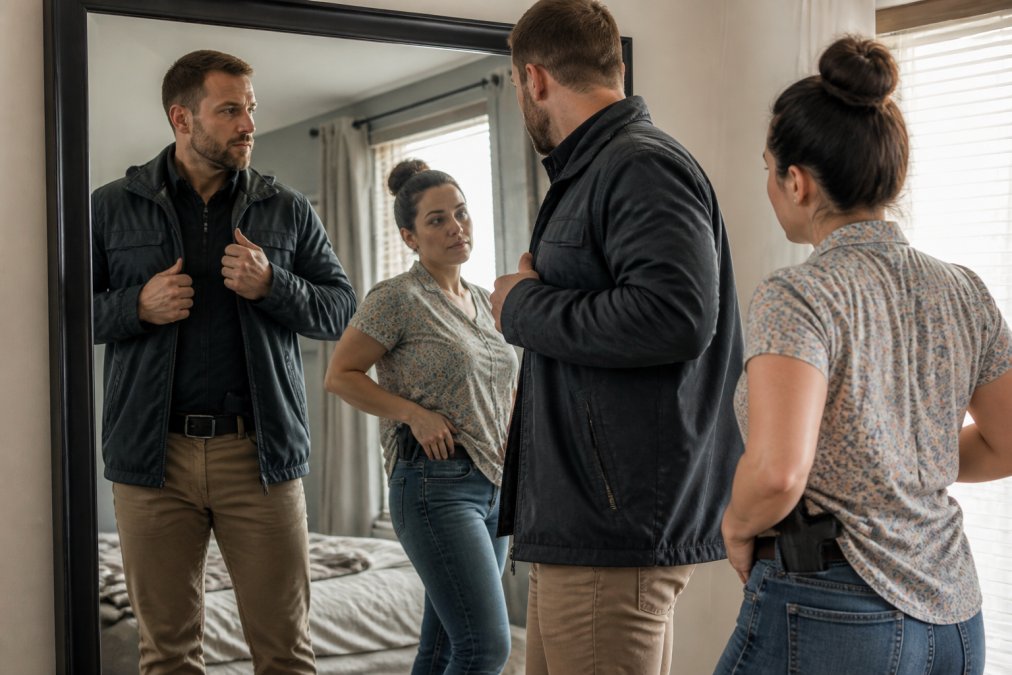
Ride height controls where the grip lands on your torso. Start with the grip just below your belt line, then adjust in small increments. Appendix carry typically needs higher ride height to clear the thigh when sitting; strong-side carry benefits from lower ride height. Most IWB holsters offer multiple belt clip holes for adjustment. Test each position while sitting, bending, and reaching.

Choosing the Right IWB Holster to Prevent Printing
An inside-the-waistband holster is standard for preventing printing. Holster molding is critical: excess material around the trigger guard or muzzle creates a bulky footprint that prints even under good clothing. A well-molded Kydex holster hugs the firearm tightly and holds its shape over years of daily carry.
Belt clips are another concealment factor. Standard plastic clips can gap away from your waistband, allowing the holster to tilt outward. The [DCC Monoblock(/products/dcc-monoblock-iwb-belt-clip-discreet-carry-concepts) IWB Belt Clip from Discreet Carry Concepts | discreetcarryconcepts.com] uses high-strength spring steel to anchor the holster flat against your belt, maintaining a low-profile appearance. For beltless carry, the Ulticlip UltiTuck system attaches directly to your clothing, which opens up deep concealment options when you cannot wear a belt.
The Role of a Quality Gun Belt in Concealment
A dedicated gun belt is not optional. A flimsy dress belt flexes under the weight of a firearm and holster, allowing the whole setup to sag and tilt away from your body. That tilt is what creates printing: the grip rotates outward as the belt gives way.
A proper gun belt is stiff enough to distribute the holster's weight evenly across your waistband. This belt tension keeps the holster pressed flat against your body, which is exactly what the claw and wedge need to work. Without a stiff belt, even the best concealment hardware cannot do its job because there is no solid surface for the claw to press against.
Look for a belt with a polymer or steel reinforcement core. Leather belts marketed for casual wear typically lack the rigidity needed for concealed carry. The belt should be at least 1.5 inches wide to match standard IWB clips. As documented in the US Concealed Carry Association's guidance on carry belts, the belt must maintain its stiffness through a full day of wear, not just when you first put it on.
Conclusion
Preventing holster printing comes down to understanding that concealment is a system, not a single product. The holster's molding, the claw's rotation, the ride height position, clothing fabric, and belt stiffness all work together to keep your firearm profile invisible. Start with a quality IWB holster and a stiff belt, then add a claw and adjust ride height based on your body geometry and typical wardrobe.
At Lindahl Holsters, we build custom Kydex holsters molded to your exact firearm model, with a lead time of just 1 to 3 business days and free shipping over $125. Our ModWing™ Concealment Wing Kit and upgraded belt clips give you the hardware to fine-tune concealment without buying a new holster. Military, law enforcement, and first responders save 15% on every order.
NRA's concealed carry fundamentals guide reinforces that practice and adjustment are essential to building confidence in your carry setup. Get started with Lindahl Holsters and find the holster that disappears under your everyday clothes.
Frequently Asked Questions
What exactly is holster printing and how do I know if mine is showing?
Holster printing occurs when the outline or shape of your firearm and holster become visible through your clothing. You'll notice a telltale bulge, shadow, or defined shape of the grip, slide, or holster edges against your shirt or pants. Check yourself in a mirror from multiple angles, especially when standing and sitting. Slight shadowing is different from printing—printing is when someone can clearly identify a firearm shape, while shadowing is just a subtle outline. Most people carrying concealed want to eliminate both to maintain true discretion.
Does the type of holster affect how much printing occurs?
Absolutely. IWB (inside-the-waistband) holsters generally print less than OWB (outside-the-waistband) options because they sit closer to your body. The holster's cant angle, ride height, and material thickness all impact concealment. Kydex holsters molded to your specific firearm create a tighter profile than generic leather options. Adding concealment hardware like a claw or wedge significantly reduces printing by rotating the grip closer to your body. Your holster choice is one of the most critical factors in preventing printing.
How does a holster claw or wedge actually help prevent printing?
A claw (or concealment wing) works by leveraging your belt to rotate the grip of your firearm inward toward your body, reducing the outward profile. A wedge is a foam or rubber insert placed between the holster and your body to push the grip closer in and angle it away from view. Both work on the same principle: moving the firearm's profile closer to your centerline makes it harder to see through clothing. The ModWing Concealment Wing Claw Kit from Lindahl Holsters ($9.99) uses this proven technology to enhance concealment on most IWB setups.
Can ride height adjustment really make a difference in preventing printing?
Yes, significantly. Ride height is how high or low your holster sits on your waistline. A higher ride position can print more because the grip extends higher and may peek above your shirt hem. A lower ride hides more of the firearm under your waistband, but too low becomes uncomfortable and slows your draw. The sweet spot is typically mid-ride: high enough to be accessible and safe, low enough to stay concealed under most clothing. Adjustable holsters let you test different positions to find what works with your body type and clothing choices.

