


Is a Level 2 Duty Holster Worth It for Civilians?
Table of Contents
- What Are Holster Retention Levels and How Do They Work?
- Level 2 vs. Level 3 Retention: Key Differences
- The Real Trade-Off: Draw Speed vs. Security
- The Retention Training Barrier for Civilians
- How to Practice Drawing From a Level 2 Holster
- Concealability vs. Retention: Can You Have Both?
- Is a Level 2 Duty Holster Worth It for Your Carry Style?
- Frequently Asked Questions
Last Updated: August 30, 2026
What Are Holster Retention Levels and How Do They Work?
Holster retention levels are standardized classifications measuring how much active or passive resistance a holster provides against weapon removal. The system ranges from Level 1 (passive friction only) through Level 3 (multiple active retention mechanisms), with Level 2 using a single active retention device requiring deliberate manipulation to release the firearm.
Understanding retention means balancing security versus accessibility. A holster that's impossible to draw from is worthless in a defensive situation; one with zero retention invites disaster in a struggle. Level 2 holsters split this difference, offering meaningful security without the complexity of duty-grade Level 3 systems.
Passive Retention vs. Active Retention
Passive retention relies purely on the holster's shape and material to grip the firearm. Kydex molded holsters create friction fit through custom-formed material, keeping the gun in place through pressure alone. This requires no moving parts and theoretically enables faster draws since you skip any release step.
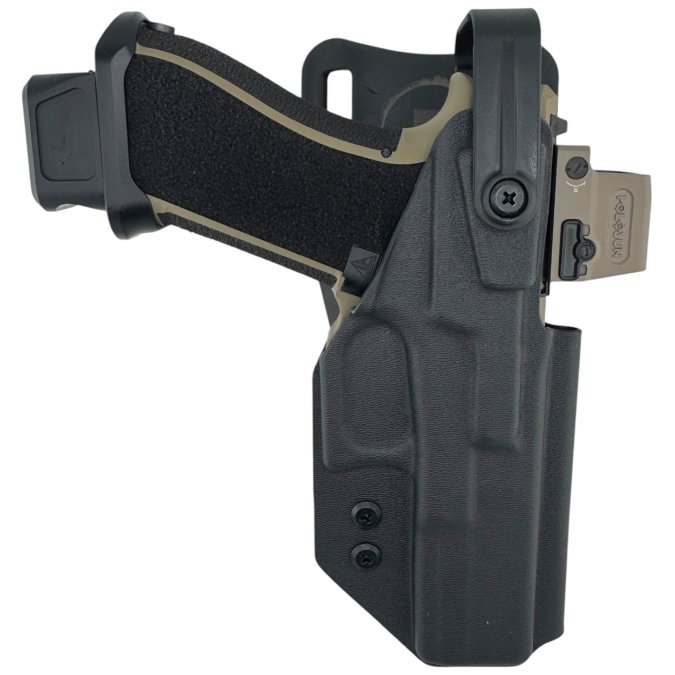
Active retention introduces a mechanical component, a lever, strap, hood, or button that must be deliberately disengaged before drawing. This adds a deliberate action step to your draw stroke, gaining security against snatch attempts and accidental dislodgment while adding complexity and a potential failure point.
Most Level 1 holsters are purely passive. Level 2 and Level 3 holsters are active, with Level 2 having one mechanism and Level 3 having two or more.
Common Release Mechanisms: Thumb vs. Finger
Thumb releases are most common in duty holsters. Your dominant-hand thumb naturally moves to disengage the mechanism as your hand wraps around the firearm during the draw. This intuitive motion is a gross motor movement that works well under stress, with typically short training time.
Index finger releases (hood releases) require your index finger to perform disengagement as you draw. This adds a separate fine motor task during high-stress moments. Some shooters find it awkward; others train through it successfully. The advantage is that thumb releases can theoretically be defeated if an attacker controls your thumb during a struggle.
Both mechanisms work. The choice depends on your training comfort and draw style. What matters is practicing the specific mechanism until it becomes automatic.
Level 2 vs. Level 3 Retention: Key Differences
A Level 2 duty holster uses one active retention mechanism. A Level 3 adds a second, typically a hood or secondary strap requiring a second deliberate action before drawing. A Level 2 draw involves one release step; a Level 3 involves two.
A Level 2 draw, when trained, adds roughly 0.2 to 0.4 seconds to your presentation compared to a passive holster (peer-reviewed research). A Level 3 typically adds 0.4 to 0.6 seconds (peer-reviewed research). For most civilians, this difference is irrelevant; for law enforcement or competitive shooters, it becomes measurable.
Security widens the gap. A Level 2 holster stops casual snatch attempts and prevents the gun from falling out during physical activity. A Level 3 is designed to defeat determined weapon-grab scenarios common in law enforcement custody situations. For civilians carrying in normal daily environments, Level 3 security is usually unnecessary; for officers in high-contact situations, it's standard.
Level 2 holsters have one mechanical component to inspect; Level 3 holsters have two. More moving parts mean more potential failure points, though modern retention systems are generally reliable when properly maintained.
The Real Trade-Off: Draw Speed vs. Security
Every retention mechanism costs draw speed. The question is whether the security gain justifies the speed cost for your situation.
A passive holster lets you draw as fast as your body can move. Under perfect conditions, a trained shooter with a passive holster will always be faster than the same shooter with a Level 2.
But real defensive scenarios rarely offer perfect conditions. The real advantage of active retention is reliability under stress and during physical contact. If someone grabs your holster or arm during a draw attempt, a passive holster offers zero protection. A Level 2 keeps the gun secured until you've completed your release action, buying time to reposition or create distance.
For civilians, this scenario is statistically rare. Most civilian defensive encounters happen at distance with clear space to move. For law enforcement, weapon-grab scenarios are a known and trained-for risk, which is why duty holsters are almost universally Level 2 or Level 3.
If you're a civilian carrying for self-defense and training regularly, a Level 2 holster's speed penalty is negligible. Your draw speed is already limited by your training level, not your holster's retention.
The Retention Training Barrier for Civilians
A passive holster requires zero training to draw correctly. A Level 2 holster requires learning a specific release action and practicing it until automatic. This is non-negotiable.
Many civilians who buy Level 2 holsters never train on them. They assume it works like other holsters and carry without practicing the draw. When they actually need to draw, they fumble the release mechanism or forget the step entirely. The holster becomes a liability instead of an asset.
This is a training barrier, not a holster problem. If you're not willing to spend 30 minutes at a range practicing your draw from a Level 2 holster until the release is automatic, you shouldn't carry one. A passive holster you actually train with beats a Level 2 you don't.
At Lindahl Holsters, we recommend that any civilian considering a Level 2 holster commit to at least one dedicated training session before carrying it in public. Dry-fire practice (with a clear, unloaded firearm and proper safety protocols) can accelerate this process. The goal is reaching the point where your release action happens without conscious thought.
How to Practice Drawing From a Level 2 Holster
Practicing your draw from a Level 2 holster should follow a specific progression: start slow, build the motor pattern correctly, then add speed only after the motion is reliable.
Phase 1: Dry-fire practice at home. With an unloaded, verified-clear firearm, practice your draw 10-15 times daily for a week. Focus entirely on the release mechanism. Your hand should move to the holster, find the release, disengage it, and draw the firearm as one continuous action. If using a thumb release, your thumb should naturally contact and depress the mechanism as your hand wraps around the grip. If using a finger release, your index finger should clear the hood as your hand moves into draw position.
Shooter's hand demonstrating proper thumb release mechanism engagement during draw stroke at outdoor training range, showing grip transition and finger position on retention lever
Phase 2: Range practice with live fire. Once dry-fire motion is smooth, move to the range. Start at 3-5 yards. Draw and fire a single shot, focusing on the release action first, speed second. Do 20-30 repetitions at this distance. Your goal is consistency and correctness, not speed.
Phase 3: Add distance and complexity. Move to 7-10 yards. Add a second shot per draw, then target transitions. The retention release should now be completely automatic. Your conscious attention should be on your sight picture and trigger control.
Phase 4: Stress inoculation. Once mechanics are solid, add stress through time pressure or competitive scenarios. This trains your nervous system to execute the release under adrenaline.
The entire progression should take 4-6 weeks of consistent practice for most shooters (peer-reviewed research). This training is non-negotiable.
Concealability vs. Retention: Can You Have Both?
Duty holsters are designed for open carry or duty belts and aren't subtle. An OWB Level 2 holster under a t-shirt is visible. This is why most civilians carry IWB (inside the waistband) passive holsters for better concealment.
Some manufacturers produce Level 2 IWB holsters that conceal better than OWB duty rigs. However, the retention mechanism adds bulk. A thumb release lever extends from the holster body; a hood adds depth. The overall profile is thicker and harder to hide than a passive IWB holster.
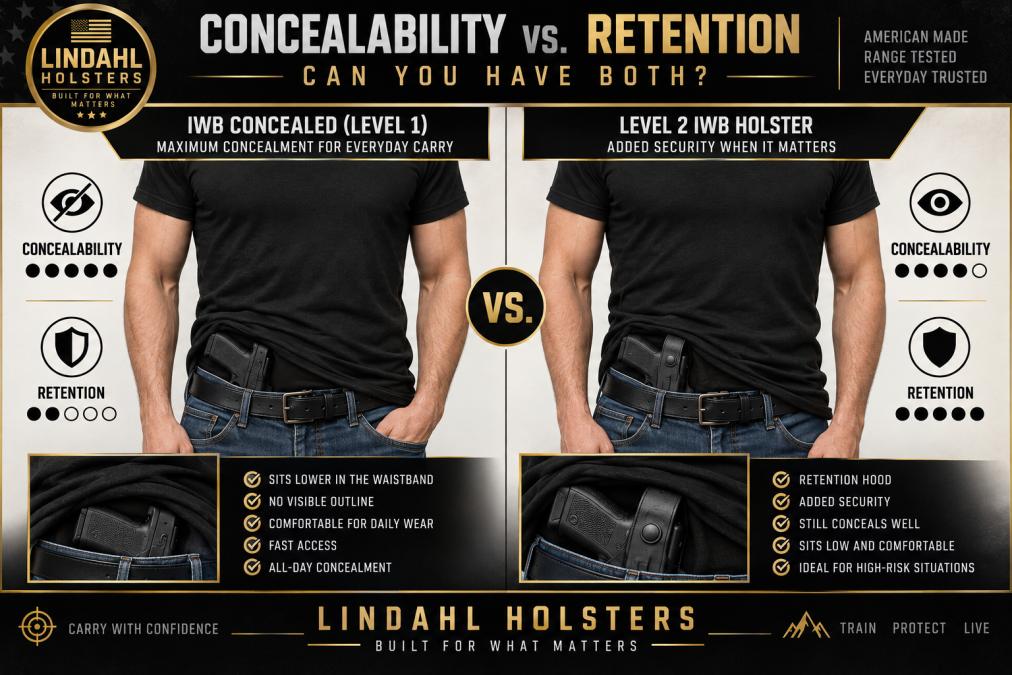
Side-by-side comparison of person wearing fitted t-shirt with IWB passive holster (no visible outline) versus person wearing same t-shirt with Level 2 IWB holster (subtle outline visible at 3-4 o'clock position)
You're choosing a priority. If concealment is your top concern, a passive IWB holster is better. If security and retention are your top concern, you accept the visibility trade-off. A Level 2 IWB holster is a compromise that doesn't fully satisfy either priority.
For civilians in normal daily environments, most people choose passive IWB. The security of active retention isn't worth the concealment penalty when you're not operating in a high-contact threat environment.
Is a Level 2 Duty Holster Worth It for Your Carry Style?
The answer depends on your actual use case, not your aspirations or fears.
For appendix carry, IWB, or everyday concealed carry: A Level 2 is probably not worth it. The concealment penalty is real, the training requirement is significant, and your risk profile doesn't justify the security gain. A quality passive IWB holster from Lindahl Holsters, molded to your specific firearm and carry position, offers sufficient security for daily civilian carry.
For open carry or duty-belt carry: A Level 2 becomes more relevant. If you're not concealing, the bulk of an active retention mechanism doesn't matter. The security gain is meaningful, and the training investment makes sense if you're working in an environment where weapon-grab scenarios are realistic.
For competitive shooting: A Level 2 is usually overkill. Competition holsters are designed for speed, and retention is less of a concern in a controlled range environment.
For someone with limited training or irregular practice: A passive holster is the right choice. If you're not going to train regularly, don't add mechanical complexity to your carry system.
Most civilians don't need Level 2 retention. They benefit more from a well-fitted passive holster, consistent carry, and regular training. A Level 2 is a tool for a specific use case: duty carry, high-threat environments, or shooters committed to mastering the system.
At Lindahl Holsters, we build Level 2 holsters for people who genuinely need them. We also build excellent passive options for the majority of civilians who do. The question isn't which is better in absolute terms, it's which is right for your actual life and training commitment.
The decision to carry a Level 2 duty holster as a civilian comes down to one question: does your realistic threat environment and training commitment justify the security gain over the added complexity? For most people carrying daily in normal civilian environments, the answer is no. A well-fitted passive Kydex holster from Lindahl Holsters, custom-molded to your specific firearm and carry position, delivers the security and reliability you need without the training barrier. If you do decide a Level 2 is right for you, commit to training it properly. The holster is only as good as your ability to use it under stress.
Frequently Asked Questions
What's the difference between a Level 1, Level 2, and Level 3 holster retention?
Level 1 uses friction fit alone—the gun stays in place through grip pressure. Level 2 adds one active retention mechanism, typically a thumb release or hood. Level 3 requires two separate actions to draw (thumb release plus hood, or similar). For civilians, Level 2 offers weapon security without the complexity of Level 3, making it a middle ground between everyday concealed carry and duty-grade protection.
Do I need a Level 2 duty holster if I carry concealed every day?
Not necessarily. Most civilians carrying concealed benefit from Level 1 holsters—friction fit designs that prioritize draw speed and concealability. A Level 2 duty holster makes sense if you carry openly, work in high-risk environments, or want maximum weapon security. The trade-off is bulk, slower draws, and the need for dedicated training. Evaluate your actual threat environment and carry method before committing to the extra complexity.
How long does it take to get comfortable drawing from a Level 2 holster?
Most shooters need 200-500 dry practice repetitions to build reliable muscle memory for a Level 2 release mechanism. Wet practice (at a range) requires another 100-200 rounds. The timeline depends on your baseline shooting experience and practice frequency. This training barrier is significant for civilians—many people buy Level 2 holsters but never invest the time to master them, leaving the retention features underutilized or creating dangerous fumbles under stress.
Will a Level 2 holster work with my Glock 19 with a mounted light?
It depends on the holster's design and the specific light model. Many Level 2 holsters are built around duty guns with rails and lights, but not all accommodate every combination. Custom-fit holster makers can mold specifically for your firearm and light setup. Check the holster manufacturer's compatibility list or request a custom order to ensure proper retention and fit—a poorly fitted holster defeats both security and concealability.

