


Is Appendix Carry Comfortable for Everyone? A 2026 Guide
Table of Contents
- Why Appendix Carry Comfort Varies: The Anatomy Factor
- Appendix Carry Body Type Considerations: Who Feels It Most
- Holster Design and Appendix Carry Holster Comfort
- How to Adjust Holster Ride Height for a Better Fit
- The Role of Wedges and Claws in Reducing Discomfort
- Appendix Carry vs. Strong-Side Carry: Comfort Comparison
- Safety and Trigger Protection in Appendix Carry
- Gradual Transition Protocol: How to Get Comfortable with Appendix Carry
- Conclusion: Is Appendix Carry Comfortable for Everyone?
- Frequently Asked Questions
Last Updated: September 26, 2026
Why Appendix Carry Comfort Varies: The Anatomy Factor
The answer to "is appendix carry comfortable for everyone" is no, and the reason starts with your skeleton. Appendix carry places a holster at the 1 o'clock position, just inside the waistband, where the holster sits against the lower abdomen and the top of the thigh. That location is unforgiving of anatomical variation in a way hip carry simply is not.
This guide from Lindahl Holsters breaks down the anatomical and equipment variables that decide whether AIWB works for you, then gives you a protocol to test it without wasting money on gear that ends up in a drawer.
Hip Structure and Pelvic Tilt
Two people with identical waist measurements can have completely different experiences with the same appendix carry holster. An anterior pelvic tilt pushes the lower abdomen forward, which creates a natural pocket for the holster to sit in. A posterior tilt or a flatter pelvis does the opposite: the holster has nowhere to go except into the thigh crease, and that is where the complaints start.
How Your Torso Length Affects Holster Placement
A short torso leaves less real estate between the belt line and the ribcage. The holster and grip crowd the diaphragm when you sit, and the muzzle end has less room to clear the hip crease. Longer torsos tolerate a higher ride height without the grip disappearing under the ribs. Neither build is a dealbreaker, but they require different holster configurations.
Appendix Carry Body Type Considerations: Who Feels It Most
Body type is the single biggest predictor of appendix carry comfort, ahead of holster brand or price. A common mistake is assuming that a slim build automatically means comfortable AIWB. In practice, the opposite is often true: very lean carriers have less soft tissue to cushion the holster, so the muzzle end and the wing can dig into the pelvic bone.
Waist Size and Holster Real Estate
Carriers with a larger waistline often find appendix carry surprisingly workable, because the abdomen creates a shelf that supports the holster and tucks the grip. The trade-off is that a full-size pistol may print more as the waistband rolls over the top of the holster. A sub-compact or a J-frame in the appendix position frequently solves this.
Mobility Limitations and Medical Conditions
Hip replacement recipients, people with limited hip flexion, and anyone who cannot comfortably bring the knee toward the chest will struggle to get a clean draw from AIWB. This is not a reason to abandon the position, but it is a reason to test the draw stroke before you commit to daily carry. Safety and ergonomics have to come before concealment.
Holster Design and Appendix Carry Holster Comfort
Holster design determines whether the position is merely workable or genuinely comfortable. The variables that matter most are the length of the holster body, the width of the backing, and whether the design includes a wedge or claw. Kydex holds its shape against the body, which is why a properly molded appendix holster with a full-length body distributes pressure better than a short, stubby one.
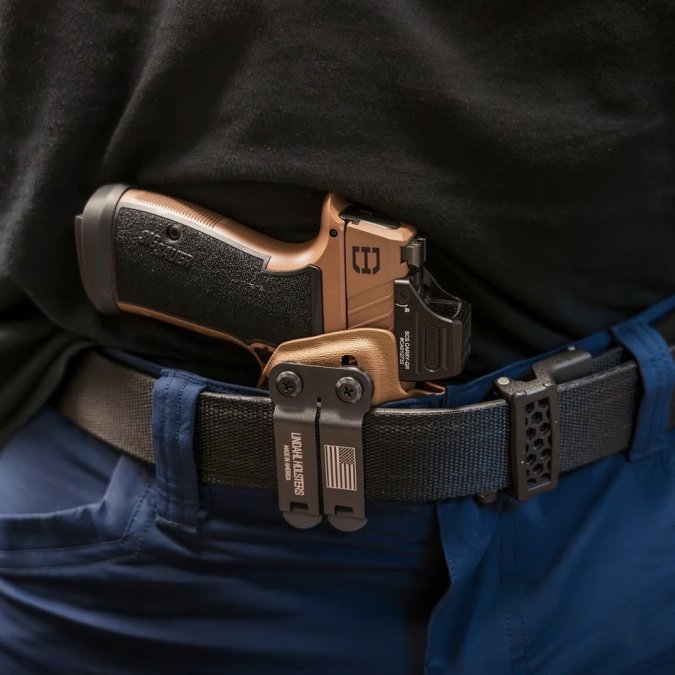
Why a Proper Gun Belt Matters More Than the Holster
A gun belt does more for appendix carry comfort than any holster feature. A stiff, reinforced belt keeps the holster from rotating and keeps the muzzle end pressed against the body instead of tipping away. A flimsy dress belt lets the whole rig shift with every step, which turns a comfortable holster into an uncomfortable one by mid-afternoon. The DCC Monoblock IWB Belt Clip from Discreet Carry Concepts is a low-profile steel upgrade that anchors the holster firmly and reduces the shifting that causes hot spots.

How to Adjust Holster Ride Height for a Better Fit
Adjusting ride height is the fastest fix for most appendix carry discomfort, and it costs nothing. Ride height is the vertical position of the holster relative to the belt line, and moving it up or down by a single hole changes where the pressure lands on your body. The rule of thumb: raise the holster until the grip clears your belt without your knuckles dragging, then drop it one setting if the muzzle digs into your thigh when seated.
Cant and Ride Height: Finding Your Sweet Spot
Cant is the angle of the holster relative to the belt, and in appendix carry it usually runs between 0 and 15 degrees. More cant tucks the grip toward the centerline for better concealment but can push the muzzle into the hip crease. Less cant keeps the draw stroke straight but may print the grip. Adjust one variable at a time, carry for a full day, and note where the pressure points develop.
The Role of Wedges and Claws in Reducing Discomfort
Wedges and claws solve two different problems, and confusing them is why many carriers give up on AIWB. Most guides describe what these accessories do in one sentence and move on. The mechanics matter more than the labels, because each one changes a different pressure vector against your body.
What a Claw (Wing) Actually Does
A claw, also called a wing, is a small protrusion mounted on the holster body near the belt line. When you tighten your belt, the claw presses against the inside of the belt and uses it as a fulcrum. That leverage rotates the entire holster, and therefore the grip of the gun, inward toward your centerline. The result is less printing at the rear of the slide, which is the part that typically pokes out under a fitted shirt.
The trade-off is that the claw concentrates force at one point on the belt line. Carriers with a pronounced hip bone or a very lean build often feel that point as a hot spot after a few hours. A claw with interchangeable inserts lets you dial the rotation up or down: a strong insert for a loose cover garment, a mild insert for a tucked shirt where you want less aggressive tuck. The ModWing Concealment Wing (Claw) Kit is built around this idea, a reversible spine that works for right- or left-hand carry, with inserts you swap to match your attire.
What a Wedge Actually Does
A wedge is a foam or molded pad attached at the muzzle end of the holster, on the body side. Its job is not to hide the grip. Its job is to tilt the entire holster so the muzzle end lifts away from your thigh and the grip end tucks in against your abdomen. Think of it as changing the holster's angle of incidence against your body rather than its lateral position.
This is why a wedge is the single most effective fix for seated discomfort. When you sit, your thigh rises and presses against the bottom of the holster. Without a wedge, that pressure transfers straight into the muzzle end and the hip crease. With a wedge, the pad absorbs and redirects that force upward along the holster body, so the pressure spreads across a larger area instead of concentrating at one point.
Wedge thickness is not a one-size decision. A thicker wedge tucks the grip harder but can push the muzzle end out far enough to print under a thin shirt. A thinner wedge is subtler but does less for seated pressure. Most carriers land on a medium-density foam wedge around three-quarters of an inch thick at the muzzle end, then trim it with a knife until the seated pressure disappears.
How the Two Work Together
A claw and a wedge are not competing upgrades, they address perpendicular problems. The claw controls rotation around the vertical axis (how much the grip tucks toward your centerline). The wedge controls tilt around the horizontal axis (how the muzzle end sits against your thigh). A rig with a claw but no wedge will hide well standing up and hurt when you sit. A rig with a wedge but no claw will sit comfortably but print at the rear of the slide. Refining the mechanical balance between these two components remains essential for concealment, though the effectiveness of any holster setup ultimately relies on how well it integrates with your chosen tactical apparel options.
Ride Height Changes Everything Downstream
Neither accessory works if your ride height is wrong. Ride height is the vertical position of the holster relative to the belt line, and it determines where the wedge and claw contact your body. Raise the holster too high and the claw rides above the belt, losing its fulcrum. Drop it too low and the wedge presses into the top of your thigh instead of the crease. The practical sequence is: set ride height first, then add the wedge, then add the claw. Changing all three at once makes it impossible to tell which adjustment helped.
ModWing™ Concealment Wing (Claw) Kit →
Appendix Carry vs. Strong-Side Carry: Comfort Comparison
Strong-side hip carry wins on raw comfort for most people on day one, because the holster sits over the hip bone and the body already has soft tissue there. Appendix carry wins on access speed, concealment under a tucked or fitted shirt, and the ability to protect the weapon in a struggle. The honest trade-off is this: AIWB demands more tuning, but once dialed in, many carriers find it more comfortable than hip carry because the rig moves with the body instead of against it.
Factor |
Appendix Carry (AIWB) |
Strong-Side Hip Carry |
|---|---|---|
Setup time to comfort |
Days to weeks of tuning |
Often immediate |
Seated/driving comfort |
Depends on ride height and wedge |
Generally easier |
Concealment under fitted clothing |
Strong, minimal printing |
Requires cover garment |
Access speed while seated |
Fast, especially belted in |
Slower |
Best for |
Lean or average builds with tuning |
Most body types, minimal fuss |
Safety and Trigger Protection in Appendix Carry
Safety is the non-negotiable part of the appendix carry conversation, because the muzzle points at the femoral artery. Trigger guard coverage is the whole game. A quality Kydex holster fully encloses the trigger guard, and that is what makes AIWB as safe as any other carry position. Muzzle discipline starts with the holster, not the carrier's attention. Re-holstering is where accidents happen, so look the gun into the holster every time, and never re-holster with a garment or a foreign object inside the holster mouth.
Gradual Transition Protocol: How to Get Comfortable with Appendix Carry
Transitioning to appendix carry gradually is the difference between a permanent switch and another holster in the drawer. Most people who fail at AIWB do too much too fast: they strap on a full-size pistol in a brand-new holster and carry it for ten hours on day one. The body needs time to adapt to pressure in a new location, and the gear needs time to be tuned. This protocol separates those two jobs.
Why a Break-In Period Matters
Appendix carry puts a rigid object against soft tissue that has never carried load there before. The skin, fascia, and muscle in the lower abdomen and hip crease are not conditioned to that pressure the way the hip bone is after years of strong-side carry. A gradual ramp lets you distinguish between adaptation soreness, which fades, and a genuine fit problem, which does not. If you skip the ramp, you cannot tell the two apart, and most people quit on day two assuming the position will never work.
The Protocol
Stage 1, Empty holster, at home (2-3 days). Wear the empty holster inside the waistband around the house for two hours at a time. No gun. The goal is to map pressure points without the weight of a firearm confusing the feedback. Note where the holster contacts your body: belt line, hip crease, thigh, abdomen. If the empty holster already creates a sharp hot spot, the problem is holster shape or ride height, not the weight of the gun.
Stage 2, Add the gun, no draw (2-3 days). Carry loaded at home only. Sit in your normal chair, stand, and get in and out of a car. Seated pressure is the single most common failure point, and it shows up here. If the muzzle end digs into your thigh, stop and adjust before continuing, do not push through it.
Stage 3, Tune ride height and cant (3-5 days). Change one variable per day. Raise or lower the holster by one setting, carry for a full day, and note where the pressure moved. Then adjust cant by a few degrees and repeat. The rule of thumb: raise the holster until the grip clears your belt without your knuckles dragging, then drop it one setting if the muzzle digs into your thigh when seated. Do not change ride height and cant on the same day, you will not know which one helped.
Stage 4, Add the wedge, then the claw (3-4 days). Install the wedge first. Carry for a full day before adding anything else. If seated pressure improves, the wedge is doing its job. Then add the claw and carry another full day. If the claw creates a new hot spot at the belt line, swap to a milder insert or remove it and rely on the wedge alone.
Stage 5, Short errands (1 week). Carry on trips under an hour: grocery store, gas station, school pickup. This is where you learn how the rig behaves when you bend, reach, and get in and out of the driver's seat repeatedly. Note any shift in holster position after each trip.
Stage 6, Full-time carry. Only now commit to AIWB as your daily position. By this point you should be able to sit for an hour, drive, and bend over without a sharp pressure point. If you still have one, go back to Stage 3, the fix is almost always ride height, a wedge, or a stiffer belt, in that order.
When to Stop and Reassess
Not every discomfort is a tuning problem. Stop the protocol and reconsider the position if you experience: numbness or tingling in the thigh or groin (nerve compression, not adaptation soreness), pain that worsens rather than fades over the first week, or an inability to get a clean, unobstructed draw because of hip flexion limits. These are anatomical signals, not willpower tests. A different holster or a different carry position may be the right answer.
The Gear Check That Runs Alongside the Protocol
A break-in period only works if the gear is capable of being tuned. Before Stage 1, confirm three things: the holster fully encloses the trigger guard in rigid material, the belt is stiff enough that the holster does not rotate when you walk, and the holster has at least two ride-height settings and some cant adjustment. If any of those is missing, fix the gear before starting the clock, otherwise you will spend a month tuning a rig that cannot be tuned.
Conclusion: Is Appendix Carry Comfortable for Everyone?
No, appendix carry is not comfortable for everyone, and any guide that promises otherwise is selling something. Hip structure, torso length, waist size, and mobility all shape the experience, and some carriers will always prefer strong-side carry. For everyone else, comfort comes down to three things: a holster molded for your exact firearm, a stiff gun belt, and the patience to tune ride height and cant.
That is the work Lindahl Holsters is built around. Custom Kydex holsters are molded to your specific firearm model, including weapon-mounted lights and optics, with a 1-3 business day lead time and free shipping on orders over $125. Military, law enforcement, and first responders get a 15% discount. If your current appendix rig has become a drawer holster, it is probably a fit problem, not a position problem. FIND YOUR GUN MODEL and get a holster built for the way you actually carry.
Frequently Asked Questions
How uncomfortable is appendix carry?
Appendix carry comfort varies by individual and setup. Some experience pressure points or discomfort when seated, especially with a full-size pistol. However, with a properly fitted holster, a sturdy gun belt, and adjustments like a concealment wing or wedge, most people find it comfortable for daily wear. The key is matching the holster to your body type and carrying position.
Does body type affect appendix carry comfort?
Yes, body type significantly affects appendix carry comfort. Those with a shorter torso or higher waist may find the holster digs into the thigh when seated. A longer torso or higher hip bones can make appendix carry more comfortable. Adjusting ride height and cant, or using a wedge, can help accommodate different body types and improve overall comfort.
What features should I look for in an appendix holster for comfort?
Look for a holster with adjustable ride height and cant, a sweat guard to protect your skin, and a concealment wing or claw to reduce printing. A sturdy gun belt is equally important for distributing weight. Materials like Kydex offer durability and a consistent fit. Also consider a wedge for extra padding and to push the muzzle away from your body.
How can I make my appendix holster more comfortable?
To improve appendix carry comfort, start by adjusting the ride height and cant to find your ideal position. Add a concealment wing like the ModWing to rotate the grip inward, reducing pressure. A wedge can fill the gap between the holster and your body. Ensure your gun belt is stiff enough to support the weight. Experiment with different holster positions, such as 1 o'clock, and consider a smaller firearm if discomfort persists.

