


IWB Holster Comfort Tips That Work
Table of Contents
- Why Your IWB Holster Hurts (And How to Fix It)
- Start with the Best Gun Belt for Concealed Carry
- Master Holster Cant and Ride Height Adjustment
- Choosing the Right Concealed Carry Holster Positions
- Wardrobe Adjustments: Clothing and Waistband Fit
- Use a Claw, Wedge, and Quality Clips to Eliminate Pressure Points
- Breaking In Your Holster and Managing Skin Irritation
- Common Mistakes That Ruin Comfort
- Frequently Asked Questions
Last Updated: September 8, 2026
Why Your IWB Holster Hurts (And How to Fix It)
If you carry inside the waistband, you already know the drill: by hour three, your hip feels bruised, the muzzle digs into your thigh when you sit, and you start wondering if iwb holster comfort is just a myth. The good news is that most IWB holster comfort tips boil down to a handful of mechanical fixes that are entirely within your control. At Lindahl Holsters, we build custom Kydex holsters every day.
An IWB holster is a rigid shell held against your body by belt tension, and every point of discomfort traces back to how that pressure is distributed. The grip angle, the ride height, the cant, the clip positioning, and even your waistband size all change where that pressure lands. Get those variables aligned with your body mechanics, and all-day comfort follows. Get them wrong, and no amount of padding will save you.
Below, we'll walk through the specific adjustments that resolve most comfort complaints, starting with the foundation: the belt.
Start with the Best Gun Belt for Concealed Carry
The single biggest mistake new carriers make is pairing a quality holster with a flimsy belt. A stiff belt is not a luxury; it is the structural anchor for your entire concealment setup. Without adequate support, the holster tilts away from your body, creating pressure points at the belt line and causing the grip to print through your shirt.
Belt Stiffness and Width Matter More Than You Think
A proper gun belt for concealed carry should be rigid enough that it does not sag or roll when the holster is empty. Look for reinforced nylon, leather with a steel core, or similar materials that resist vertical compression. Width matters too: a belt that is too narrow allows the holster clips to shift, while a belt that matches your holster clips (typically 1.5 inches) locks everything in place.
When you cinch the belt, you want firm tension, not a tourniquet. The holster should stay put when you draw, but you should still be able to slide a finger between the belt and your abdomen. Many carriers find that adjusting belt tension by a single notch changes their comfort level dramatically throughout the day.
Master Holster Cant and Ride Height Adjustment
Once the belt is solid, the next variables are the angles at which the holster sits. Most quality Kydex holsters offer adjustable cant and ride height via the clip mounting holes. These two adjustments determine how the grip angles relative to your body and how deep the holster sits below the waistline.
Finding the Right Cant Angle for Your Draw Stroke
Cant refers to the forward or backward tilt of the holster. A neutral cant (0 degrees) keeps the firearm vertical, which often suits appendix carry. A forward cant (10 to 15 degrees) tilts the grip toward your belly button, which is a common choice for strong-side carry at the 3 to 4 o'clock position (usconcealedcarry.com). The right cant angle matches your natural draw stroke: your wrist should not have to contort to reach the grip.
A common mistake is copying a cant setting from a friend or an online forum. Your draw stroke is unique to your shoulder mobility and arm length. Start at 10 degrees forward and experiment in 5-degree increments. If your knuckles scrape your hip bone during the draw, the cant is likely too aggressive.
Ride Height: Higher Isn't Always Better
Ride height controls how much of the holster sits above the belt line. A higher ride makes the draw shorter, but it also pushes the grip outward, which increases printing and creates a hard pressure point against your ribs. A lower ride tucks the firearm deeper, improving concealment, but it can make the draw awkward and cause the muzzle to dig into your leg when you sit.
The ideal ride height is the lowest setting that still allows a full, clean grip. You should be able to wrap your hand around the firearm without the holster shifting. For appendix carry, this often means the holster sits low enough that the claw or wing engages your belt properly.
Choosing the Right Concealed Carry Holster Positions
Your body type and daily activities dictate which of the common concealed carry holster positions will work for you. There is no universally comfortable position; there is only the position that fits your specific anatomy.
Appendix vs. Strong Side: A Comfort and Access Tradeoff
Appendix carry (at the 12 to 1 o'clock position) offers the fastest access and the best concealment for most body types, because the firearm rides in the natural hollow of your hip. The tradeoff is that the muzzle points at your femoral artery, and sitting for long periods can cause the holster's muzzle to press into your thigh. A foam wedge at the bottom of the holster solves this by tilting the grip inward and lifting the muzzle off your leg. fixing garment shifting.
Strong-side carry (at the 3 to 4 o'clock position) is often more comfortable for all-day wear because the holster sits over the gluteal muscle rather than a bony prominence. The access is slightly slower, and printing becomes more noticeable when you bend forward. Most carriers who switch to strong side report that a forward cant of 10 to 15 degrees is essential for a clean draw.
The 4 O'Clock Position for All-Day Wear
For many people, the 4 o'clock position offers the best balance of comfort, concealment, and access. The firearm rides behind the hip bone, which keeps it from digging into your side when you sit in a car or at a desk. The key is pairing this position with a holster that features a claw or wing; without one, the grip tends to tilt away from your body and print through a light shirt.
Wardrobe Adjustments: Clothing and Waistband Fit
Your holster can be perfectly adjusted, but if your pants are too tight, you will still be miserable. A holster adds roughly half an inch to your waistline, so you likely need to size up one inch in your pants (policemag.com). Wearing pants that are snug at the waist forces the holster to press directly into your hip bone, creating a bruise within hours.
Choose pants with sturdy belt loops that sit close together. Wide belt loops or loops positioned far apart allow the belt to bow inward, which reduces the tension that keeps the holster upright. When you sit, the waistband naturally expands; a holster claw helps maintain the grip angle during this transition.
Use a Claw, Wedge, and Quality Clips to Eliminate Pressure Points
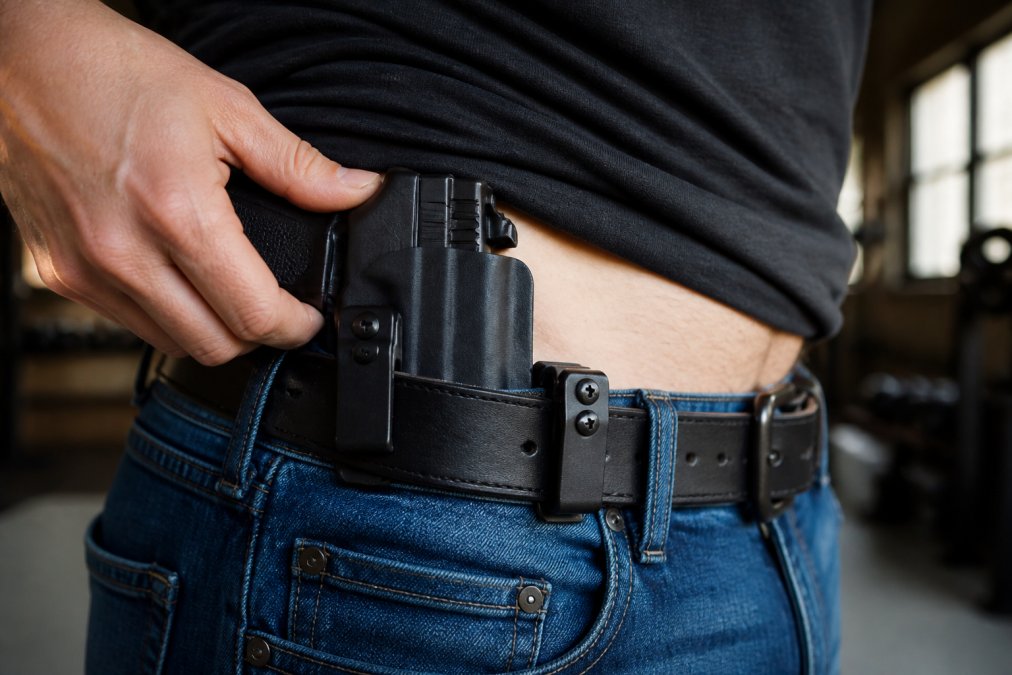
If you have optimized the belt, cant, and ride height but still feel a sharp pressure point near the grip, the solution is hardware. A concealment wing (often called a claw) is a small plastic tab that presses against your belt, rotating the holster's grip toward your body. This single addition resolves most printing issues and, counterintuitively, often improves comfort by distributing pressure across a wider area.

Adding a Concealment Wing or Claw
The ModWing™ Concealment Wing Kit from Lindahl Holsters is a standalone piece of hardware that attaches to the holster's clip. It allows your belt to apply use that rotates the holster and the grip of the gun toward your body, creating better concealment and less printing. The ModWing is available in standard and light-bearing versions, and interchangeable inserts let you tune the amount of pressure.
A holster wedge serves a different purpose. Mounted at the rear of the holster near the muzzle, a wedge pushes the top of the holster away from your body, which prevents the muzzle from digging into your thigh when you sit. Together, a claw and wedge transform a rigid shell into a system that conforms to your body's curves.
Quality clips are the final piece. The DCC Monoblock IWB Belt Clip from Discreet Carry Concepts is a premium steel clip that provides superior retention and stability for inside-the-waistband holsters. Its low-profile design keeps the holster anchored without adding bulk. For beltless carry, the Ulticlip UltiTuck IWB Belt Clip attaches directly to your clothing, which is useful when you cannot wear a belt.


Breaking In Your Holster and Managing Skin Irritation
Kydex does not "stretch" like leather. If you feel a sharp edge against your skin, the issue is often the holster's molding. Applying a thin layer of talcum powder or using a moisture-wicking undershirt can resolve most skin irritation at the pressure points.
For long-term irritation management, check the holster's edges for burrs or rough spots. A quality Kydex holster should have smooth, rounded edges at the top and bottom. If the skin under the clip or claw becomes red or raw, the clip tension is likely too high. Adjust the clip's retention screws to reduce pressure. Rotating carry positions every few days can prevent chronic skin issues in a single spot.
Common Mistakes That Ruin Comfort
Most comfort problems trace back to a few predictable errors. First, buying a holster without adjustable cant or ride height locks you into a geometry that may not match your body. Second, skipping the claw or wedge to save money results in printing and pressure points that make you abandon the holster. Third, wearing a belt that is too flexible allows the holster to roll away from your body, which increases friction and causes chafing.
| Mistake | The Fix | Impact on Comfort |
|---|---|---|
| Weak, flexible belt | Invest in a reinforced gun belt | Eliminates rolling and sagging |
| Fixed cant and ride height | Choose a holster with adjustable clips | Allows tuning to your draw stroke |
| No claw or wing | Add a concealment wing | Reduces printing and grip pressure |
| Tight waistband | Size up one inch in pants | Prevents hip bone bruising |
| Ignoring skin irritation | Use undershirts and adjust clip tension | Prevents chronic chafing |
Another frequent error is over-tightening the belt to eliminate printing. Excessive belt tension compresses the holster into your abdomen and restricts blood flow, causing numbness by midday (peer-reviewed research). The correct tension is just enough to keep the holster from moving during a draw. Finally, do not ignore the holster itself. A holster that scratches your slide or fails to retain your firearm is both a comfort and a safety issue. A custom-fit Kydex holster, molded specifically for your firearm model, eliminates the movement and friction that generic holsters create.
The path to comfortable all-day carry is a process of elimination. Start with a proper gun belt, then adjust cant and ride height, then add a claw and wedge, and finally refine your wardrobe. Working through these steps in order can help you find a setup you can wear for extended periods without thinking about it.
Comfortable concealed carry is not about buying the most expensive gear; it is about understanding how each component interacts with your body mechanics. At Lindahl Holsters, we build custom Kydex holsters with adjustable cant and ride height, and we offer the ModWing™, DCC clips, and UltiTuck clips to fine-tune your setup. Our holsters are crafted for a precise fit with your specific firearm model, with lead times of just 1 to 3 business days and free shipping on orders over $125. Find your gun model and build a carry setup that disappears on your hip.
Frequently Asked Questions
How do I make my IWB holster more comfortable?
Start by checking your gun belt. A stiff belt prevents the holster from shifting and digging in. Next, adjust the ride height and cant so the holster sits flat against your body without creating pressure points. Add a concealment wing or claw to rotate the grip inward, which reduces printing and hot spots. Finally, experiment with your carry position; moving the holster even an inch can change comfort dramatically.
What is the most comfortable position to carry an IWB holster?
For most people, the strong-side hip at the 4 o'clock position offers the best balance of comfort and concealment. This area has more soft tissue and curves that naturally accommodate a holster. Appendix carry at 1 o'clock is popular for quick draws but can press on the hip bone or thigh when sitting. Try both positions with your specific holster and body type to see which one causes less friction during daily movement.
What are the common mistakes that make IWB carry uncomfortable?
Wearing a flimsy belt is the top mistake; it allows the holster to tilt and jab you. Another is setting the ride height too low, which forces the holster into your leg when you walk. Many people also skip the break-in period and give up on a new Kydex holster too soon. Finally, ignoring holster cant means your draw stroke and your body fight each other all day, causing fatigue and soreness.

