


Sig P365 DH3 Holster Review: Best Fits for 2026
Table of Contents
- SIG P365 DH3 Holster Options Compared
- P365 DH3 Holster Compatibility: What Actually Fits
- SIG P365 DH3 IWB Holster: Deep Concealment Done Right
- P365 DH3 AXG FOXTROT2R Holster: Light-Bearing Considerations
- SIG P365 DH3 OWB Holster: When Outside Carry Makes Sense
- Retention, Safety, and Draw Testing Methodology
- Comfort and Concealment Across Body Types
- Attachment and Adjustment Trade-Offs
- Conclusion
- Frequently Asked Questions
Last Updated: October 5, 2026
SIG P365 DH3 Holster Options Compared
Finding a sig p365 dh3 holster that actually fits means matching the holster to your exact slide and grip configuration, not just the "P365" name on the box. The P365 FUSE DH3 and the P365 FUSE AXG DH3 share a lineage but differ enough that a holster molded for one will not seat the other correctly. At Lindahl Holsters, we build every shell from a specific model mold, which is why our catalog lists separate SKUs for the DH3, the AXG DH3, and the light-bearing versions of each.
Below, we break down what fits, what does not, and how to choose between inside-the-waistband, outside-the-waistband, and light-bearing setups. The comparison table further down summarizes our current DH3 holster lineup so you can scan the options before reading the details.
Here is the short version: the right holster depends on three variables. Which DH3 variant you own, whether you run a weapon light, and how you carry. Get those three right and the rest of the decision gets simple.
Holster |
Carry Style |
Light Compatibility |
Best For |
Price |
|---|---|---|---|---|
IWB |
None |
Standard DH3, deep concealment |
$62.99 |
|
P365 FUSE AXG DH3 IWB Holster |
IWB |
None |
AXG DH3, deep concealment |
$62.99 |
P365 FUSE DH3 + TLR-7 HLX IWB Holster |
IWB |
Streamlight TLR-7 HLX |
Light-bearing DH3 carry |
$62.99 |
P365 FUSE AXG DH3 + TLR-7 HLX IWB Holster |
IWB |
Streamlight TLR-7 HLX |
Light-bearing AXG DH3 carry |
$62.99 |
P365 FUSE AXG DH3 + Olight PLX IWB Holster |
IWB |
Olight PLX |
AXG DH3 with Olight setup |
$62.99 |
P365 DH3 Holster Compatibility: What Actually Fits
P365 DH3 holster compatibility comes down to the slide and grip module, not the P365 family name. A holster molded for a standard P365 or P365XL will not fit a DH3 pistol because the FUSE-length slide and the DH3 grip geometry sit differently in the shell.

The P365 FUSE DH3 and the P365 FUSE AXG DH3 are two distinct molds. The AXG version uses a metal grip module that changes the frame's external dimensions, so a holster cut for the standard DH3 will not lock the AXG in place. If you own both, you need two holsters.

Light-bearing compatibility adds a second layer. A holster molded for a DH3 with a Streamlight TLR-7 HLX will not work with the same pistol unlit, and it will not accept an Olight PLX. The light determines the front of the shell.
SIG P365 DH3 IWB Holster: Deep Concealment Done Right
The SIG P365 DH3 IWB holster is the default choice for everyday carry because it keeps the pistol close to the body and hides under a t-shirt. Our IWB shells for the DH3 and AXG DH3 use a slim profile and a full-length sweat guard, which keeps the slide off your skin and reduces printing.
Adjustable retention and cant from 0 to 15 degrees let you tune the draw angle to your carry position. Appendix carry usually wants a slight forward cant. Strong-side hip carry often wants more.
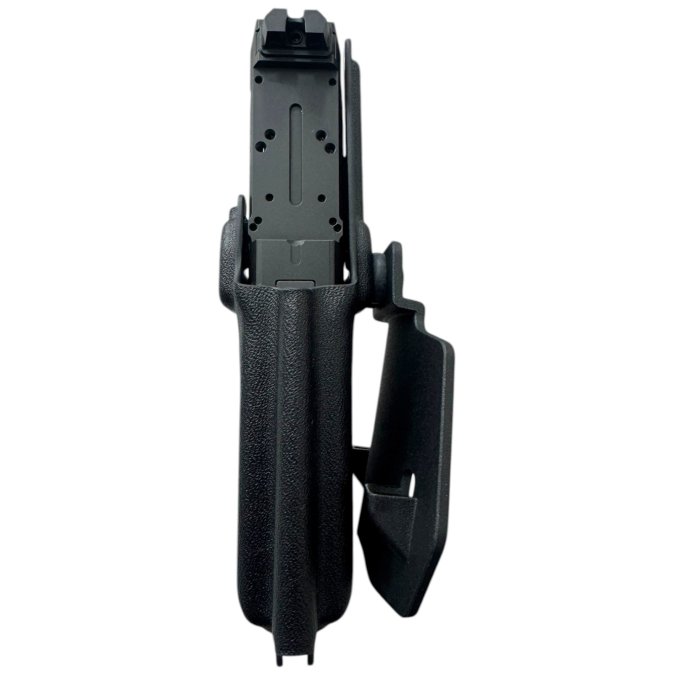
An audible click confirms the pistol is seated. That sound is not a gimmick. It is the fastest way to know the shell has captured the trigger guard without looking down.
For the standard DH3, our Lindahl Holsters P365 FUSE DH3 IWB Holster is molded to the exact slide contours and ships in one to three business days. The AXG version has its own dedicated shell.
P365 DH3 AXG FOXTROT2R Holster: Light-Bearing Considerations
Light-bearing holsters are molded around the specific light, not just the pistol, so the light model is as important as the firearm model. A shell cut for one light will not accept another, even when both lights mount to the same rail.
The FOXTROT2R and the Streamlight TLR-7 HLX do not share a footprint. The FOXTROT2R uses a SIG-specific mounting interface, while the TLR-7 HLX uses the industry-standard rail key system. That difference changes the front of the shell, the bezel clearance, and where the holster indexes on the trigger guard. A holster molded for a TLR-7 HLX will not seat a FOXTROT2R-equipped AXG DH3, and the reverse is also true.
We currently offer AXG DH3 holsters molded for the Streamlight TLR-7 HLX and the Olight PLX. Both use the same slim IWB profile as our non-light shells, with a full sweat guard and adjustable retention.
If your light is not one we list, the honest answer is that a molded Kydex shell for a different light will not fit. Kydex does not stretch. A universal nylon holster might accept the combination, but it will not give you the retention or the draw consistency of a molded shell.
How to verify light and pistol fit before ordering
Model names overlap across the P365 line, so confirm the exact configuration rather than trusting the family name. Work through these checks before you add a holster to the cart:
- Confirm the pistol model on the slide or frame reads P365 FUSE AXG DH3, not P365 AXG or P365 FUSE.
- Confirm the light model and its mounting interface. TLR-7 HLX, and Olight PLX are two different shells.
- Confirm the optic. An enclosed-emitter optic can change the slide's overall height and may contact a sweat guard cut for a lower profile.
- Confirm the holster SKU lists both the pistol model and the light model. A SKU that lists only one is a mismatch risk.
- Confirm the return window before ordering, in case the configuration does not seat.
Attachment and adjustment on a light-bearing shell
A light-bearing pistol is longer and heavier at the muzzle, which changes how the holster hangs on the belt. The added length gives the shell more leverage to rotate away from the body, so attachment choice matters more here than on a non-light shell.
- A single appendix clip lets the longer shell rotate slightly with your movement, but it can shift the draw angle over a long day.
- Two clips or soft loops lock the longer shell in place and keep the draw consistent, at the cost of a slower on-and-off.
- A stiff 1.5-inch gun belt is the minimum for a light-bearing IWB setup. A floppy belt lets the muzzle end sag away from the body, which is what actually causes printing.
Set retention first, then cant. On a light-bearing shell, retention is indexed at the trigger guard and sometimes at the light bezel, so changing cant after dialing in retention means re-testing both.
If you plan to run a weapon light, buy the light first and carry it for a month before ordering the holster. Switching lights later means buying a new holster, because the shell is molded to the light's exact profile.
SIG P365 DH3 OWB Holster: When Outside Carry Makes Sense
Outside-the-waistband carry trades some concealment for faster access, better comfort on long days, and room for a larger footprint.
OWB makes particular sense when you add a weapon light. A light-bearing pistol is bulkier, and moving it outside the waistband reduces the pressure points that show up after a few hours of IWB carry.
For open carry in a professional setting, retention becomes the priority. A holster with active retention, meaning a mechanism you must deliberately defeat before the draw, is the right call for duty or security work. Passive friction retention is fine for concealed carry, but it is not a substitute for active retention when the pistol is visible.
The trade-off is printing and access. OWB hides well under a jacket or an untucked shirt. Under a fitted t-shirt, it does not. Choose OWB when your clothing allows it and your priority is speed and comfort.
SIG SAUER P365 FUSE DH3 COMPATIBLE IWB HOLSTER →
Retention, Safety, and Draw Testing Methodology
Retention is not a number you can compare across brands, because every maker measures it differently. What matters is whether the holster holds the pistol during a shake test, a jump test, and a hard fall, and whether it still releases cleanly on the draw.
Here is how we think about testing a new holster before you trust it.
- Confirm the pistol seats with an audible click every time
- Invert the holster and shake it firmly; the pistol should not move
- Jog in place and do ten jumping jacks with the holster worn
- Draw fifty times from concealment and check for consistent release
- Re-check retention screws after the first week of carry
- Verify the trigger guard is fully covered at all times
If the pistol shifts during the shake test, tighten the retention screw a quarter turn at a time. If it still moves, the shell is wrong for your model. Do not carry it.
Comfort and Concealment Across Body Types
Comfort and concealment depend as much on your body and clothing as on the holster. A setup that disappears on one carrier may print on a smaller frame or dig in on a larger one.
Three adjustments do most of the work.
Cant angle. More forward cant tucks the grip into your side and reduces printing at the appendix position. Less cant suits hip carry.
Ride height. A higher ride keeps the grip above the belt line for a faster draw but shows more of the pistol. A lower ride hides more but can dig into the thigh when you sit.
Belt stiffness. A floppy belt lets the holster sag away from the body, which is what actually causes printing. A stiff 1.5-inch gun belt holds the shell tight against your side. Wider belts, up to 2 inches, add stability for heavier light-bearing setups.
Clothing matters as much as hardware. A patterned shirt breaks up the outline better than a solid one. A slightly looser fit at the waist hides the grip. None of this is complicated, but it is the difference between a holster you wear daily and one that ends up in a drawer.
Attachment and Adjustment Trade-Offs
Attachment hardware decides how the holster sits and how it moves with you. The choice is less about brand and more about what you need the holster to do. The three dials that actually matter are attachment type, ride height, and cant, and they interact.
Attachment types
- Clip-on. Fast to put on and take off, which suits carriers who cannot wear a holster into work. The trade-off is that clips can shift during the day and may not hold as tightly as loops, especially on a heavier light-bearing shell.
- Belt loops and soft loops. Hold the holster in place more securely and resist shifting during the draw. They take longer to put on and are less convenient if you remove the holster often.
- Single clip at appendix. Allows the holster to rotate slightly with your body, which many carriers find more comfortable. The trade-off is a draw angle that can drift over a long day.
- Two clips or loops. Lock the holster in place and reduce movement, which helps with a consistent draw. The trade-off is a slower on-and-off and less forgiveness if your belt line shifts when you sit.
Ride height
Ride height is how high the holster sits relative to the belt line, and it is the adjustment most carriers ignore until they sit down.
- A higher ride keeps the grip above the belt line for a faster, cleaner draw but shows more of the pistol and can feel top-heavy.
- A lower ride hides more of the grip but can dig into the thigh when you sit, and it can slow the draw because your hand has to travel further to reach the grip.
- For appendix carry, a mid ride is the common compromise. For strong-side hip carry, a slightly higher ride often draws faster.
Cant
Cant is the forward or rearward tilt of the holster, and it is the adjustment that most affects printing.
- More forward cant tucks the grip into your side and reduces printing at the appendix position.
- Less cant suits hip carry, where the grip already sits along the body.
- Adjustable cant typically runs from 0 to about 15 degrees. Set retention first, then cant. Changing cant after you have dialed in retention means re-testing both.
How the three interact
Attachment, ride height, and cant are not independent. A single appendix clip with a high ride and a forward cant behaves very differently from two loops with a low ride and no cant, even on the same shell. The practical approach is to pick the attachment that matches how often you remove the holster, set ride height for how you sit and stand during the day, then tune cant last to control printing.
Conclusion
Getting the right sig p365 dh3 holster is a matter of matching three things: your exact DH3 variant, your light, and your carry style. Get those wrong and no amount of adjustment will save the fit.
Lindahl Holsters builds custom Kydex shells molded to the specific DH3 and AXG DH3 models, with light-bearing options for the Streamlight TLR-7 HLX and Olight PLX. Every holster ships with adjustable retention and cant, a full sweat guard, and an audible click for secure holstering, all made in the USA with a one to three business day lead time.
FIND YOUR GUN MODEL and get a holster molded for the pistol you actually carry.
Frequently Asked Questions
What holsters fit the SIG P365 AXG DH3?
The SIG P365 AXG DH3 requires a holster molded specifically for that model. The P365 FUSE AXG DH3 IWB Holster from Lindahl Holsters is custom-molded from Kydex to the exact contours of the AXG DH3 frame, with adjustable retention and cant from 0 to 15 degrees. Light-bearing versions are available for the Streamlight TLR-7 HLX and Olight PLX. A standard P365 holster will not fit the AXG DH3 because the grip module and slide dimensions differ.
Is the SIG P365 DH3 the same size as other P365 models?
No. The P365 DH3 and P365 AXG DH3 use a larger grip module and slide than the standard P365 or P365XL. That difference means holsters molded for a base P365 will not seat the DH3 properly. Lindahl Holsters product listings confirm that their DH3 holsters do not fit standard P365 or P365XL grip modules. Always verify the exact model name and any mounted light before ordering.
Will a standard P365 holster fit the AXG DH3?
A standard P365 holster will not fit the AXG DH3. The AXG DH3 has a different grip module profile and slide length than the base P365. Holsters molded for the standard P365 or P365XL leave the DH3 sitting too deep or too shallow, which affects retention and draw. Order a holster explicitly labeled for the P365 FUSE AXG DH3, and confirm whether it accommodates a weapon light if you carry one.
Which holsters are compatible with the SIG P365 DH3 and FOXTROT2R?
Holsters for the P365 DH3 with a FOXTROT2R light must be molded for that exact firearm-and-light combination. The Lindahl Holsters catalog includes IWB holsters for the P365 FUSE DH3 and P365 FUSE AXG DH3 with the Streamlight TLR-7 HLX and Olight PLX. Universal-fit holsters rarely hold proper retention with a light attached.
How do you check holster retention and fit before carrying?
Start with the firearm unloaded. Insert it into the holster and listen for the audible click that confirms it is seated. Turn the holster upside down and shake gently; the firearm should stay in place. Adjust the retention screw until you get a firm hold without binding the draw. Then practice drawing and reholstering at least 20 times to confirm smooth, repeatable access before you carry.

