


SIG SAUER P365 AXG DH3: P365 DH3 vs AXG DH3 Guide
Table of Contents
- SIG SAUER P365 AXG DH3 vs P365 DH3: What Actually Changes
- P365 DH3 vs P365 AXG DH3: Full Spec Comparison
- Slide, Barrel, and Compensator Differences
- Grip Module and Ergonomics: Polymer vs Metal
- Optic Ready Setup and Sight Radius
- Choosing the Right P365 DH3 Holster
- Choosing the Right P365 AXG DH3 Holster
- Which Model Fits Your Carry Setup?
- Frequently Asked Questions
Last Updated: September 11, 2026
SIG SAUER P365 AXG DH3 vs P365 DH3: What Actually Changes
The SIG SAUER P365 AXG DH3 and the P365 DH3 are both FUSE-family pistols built on the same slide and barrel architecture, and the differences between them come down to one component: the grip module. The AXG DH3 wears a metal grip module, while the DH3 uses the polymer frame. That single change ripples through weight, balance, recoil impulse, holster fitment, and how the gun carries against your body all day.

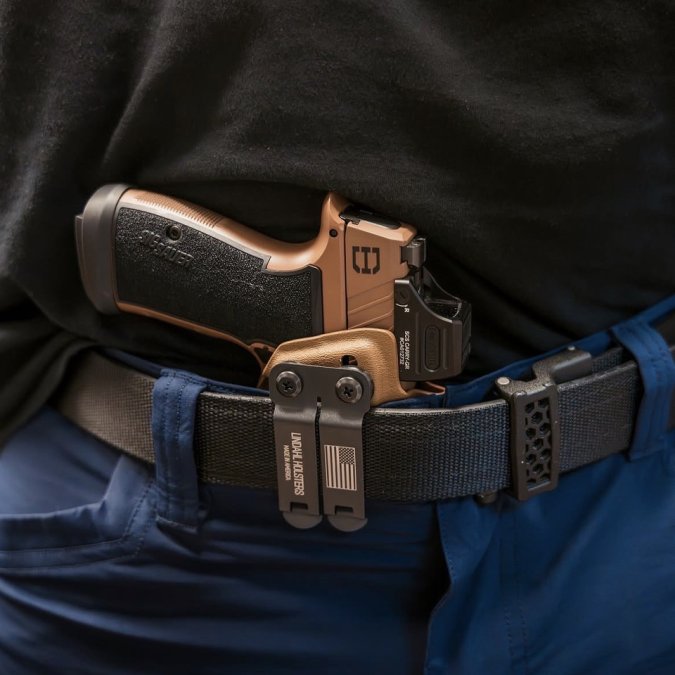
This guide breaks down the P365 DH3 vs P365 AXG DH3 comparison the way a shooter actually evaluates it: what changes at the bench, what changes on the belt, and which holster each model needs. Below, we cover the full spec comparison, the slide and compensator differences, grip module ergonomics, optic setup, and a holster compatibility guide for both.
If you already know which pistol you own, the short version is this: they do not share holsters. The AXG and polymer grip modules have different external dimensions, and a holster molded for one will not properly retain the other. That single fact drives most of the buying decisions .
P365 DH3 vs P365 AXG DH3: Full Spec Comparison
The P365 DH3 and P365 AXG DH3 share a slide assembly, barrel length, and optic-ready configuration, but diverge on frame material, weight, and grip profile. The table below summarizes the practical differences that matter for carry and competition.

Feature |
P365 DH3 |
P365 AXG DH3 |
|---|---|---|
Grip module |
Polymer |
Metal AXG |
Frame weight |
Lighter |
Heavier |
Recoil impulse |
Snappier |
Flatter |
Grip texture |
Molded polymer |
Machined panels |
Holster fit |
DH3-specific |
AXG DH3-specific |
Best for |
All-day carry |
Range and competition |
The throughline here is weight distribution. A polymer frame keeps the pistol light and easy to conceal, which matters when the gun sits against your body for ten hours. A metal grip module adds mass low in the hand, which tames muzzle rise and lets you get back on target faster. Neither is objectively better. They solve different problems.
One thing most comparisons get wrong: the slide is not the variable. The slide-integrated expansion chamber, the lightening cuts, and the optic cut are effectively shared across the FUSE family. If you are shopping for a P365 DH3 holster or a P365 AXG DH3 holster, the frame is what determines fit, not the slide.
Slide, Barrel, and Compensator Differences
Slide and barrel specifications are shared between the two models, so the compensator behavior is nearly identical. Both pistols run a 3.7-inch barrel chambered in 9mm Luger and both use the slide-integrated expansion chamber that vents gas upward to reduce muzzle flip. What differs is how the shooter perceives that compensation, and how much maintenance the design demands.
How the Slide-Integrated Expansion Chamber Works
The expansion chamber is not a threaded add-on. It is machined directly into the slide ahead of the barrel's muzzle, with ports cut through the top of the slide. When a round fires, propellant gas that would normally exit straight forward is redirected upward through those ports. That upward thrust counteracts the muzzle's natural rise, which is why the pistol tracks flatter than a standard P365 of similar barrel length.
Because the chamber is part of the slide, there is no muzzle device to time, torque, or re-check after a range session. There is also no thread pitch to worry about, and the pistol stays the same overall length as a non-compensated slide of the same profile. That matters for holster fitment: the holster is molded to the slide's outer envelope, not to a protruding compensator.
What the Frame Changes About Felt Recoil
The compensator does the same mechanical work on both pistols. The frame decides how much of the remaining recoil you feel. On the polymer DH3, the lighter frame transmits more of the recoil impulse into the hand. On the AXG DH3, the added mass of the metal grip module absorbs more of that energy before it reaches your wrist.
A common mistake is assuming the compensator makes the two guns shoot the same. It does not. The compensator reduces muzzle rise. The frame changes how the gun tracks between shots. Those are separate variables, and most shooters who test both back to back notice the difference within the first magazine.
Cleaning and Disassembly Nuances
This is the part most write-ups skip. The expansion chamber collects carbon and copper fouling in the port area faster than a standard slide, because hot gas is being redirected through small openings instead of exiting cleanly (nssf.org). A few practical patterns most owners settle into:
- Scrape the ports, don't just wipe them. A nylon brush and a carbon scraper reach the port edges better than a patch. Fouling that bridges the ports will reduce the compensation effect over time.
- Watch the barrel hood and chamber face. Gas blowback leaves a darker, stickier residue than a non-compensated pistol, so a slightly more frequent bore and chamber wipe-down is common.
- Field-strip is unchanged. The slide comes off the frame the same way as any P365-family pistol. The expansion chamber does not add a step to basic field-stripping; it adds a step to your cleaning routine, not your takedown routine.
- Do not soak the slide in solvent for extended periods. Standard practice is to keep solvent contact brief and dry the ports thoroughly, since pooled solvent in the port channels is hard to remove and can trap grit.
Barrel Length and Muzzle Rise
The 3.7-inch barrel is the same on both pistols, so raw muzzle rise from barrel length is identical. The variable is the frame, and the AXG's metal grip module measurably reduces how much the muzzle climbs during rapid strings.
That matters most in competition and in any drill where you are firing multiple rounds quickly. For a single defensive shot at close range, the difference is negligible. For a bill drill or a plate rack, the AXG DH3 is the easier gun to keep flat.
Compatibility With Existing Platforms
Because the slide and barrel are shared across the FUSE family, slide-mounted accessories and optic plates that fit the FUSE slide footprint carry over. What does not carry over between the two models is anything that contacts the frame: holsters, grip panels, and magazine baseplate extensions that index off the grip module. If you are moving from a polymer DH3 to an AXG DH3, plan on a new holster. The slide is not the variable, the frame is.
Grip Module and Ergonomics: Polymer vs Metal
Grip module material is the defining difference between these two pistols, and it changes both how the gun feels in hand and how it sits against your body. The polymer DH3 uses a molded frame with integrated texture. The AXG DH3 uses a machined metal grip module with panel-style texture and a different backstrap profile.
In practice, this means the AXG DH3 fills the hand more completely and gives you a more consistent index on the draw. The polymer DH3 is lighter and slightly more forgiving to carry inside the waistband because there is less hard material pressing against your hip.
The trigger guard, controls, and magazine release are positioned the same way across both, so manual of arms does not change. What changes is the felt recoil impulse and the way the pistol balances in your hand at full extension.
Optic Ready Setup and Sight Radius
Both pistols are optic ready and use the same slide, so the optic cut, footprint, and sight radius are identical between the P365 DH3 and the P365 AXG DH3. Your optic choice does not depend on which model you buy. What changes is how the optic behaves under recoil, and how you set it up for carry versus competition.
Footprint and Mounting
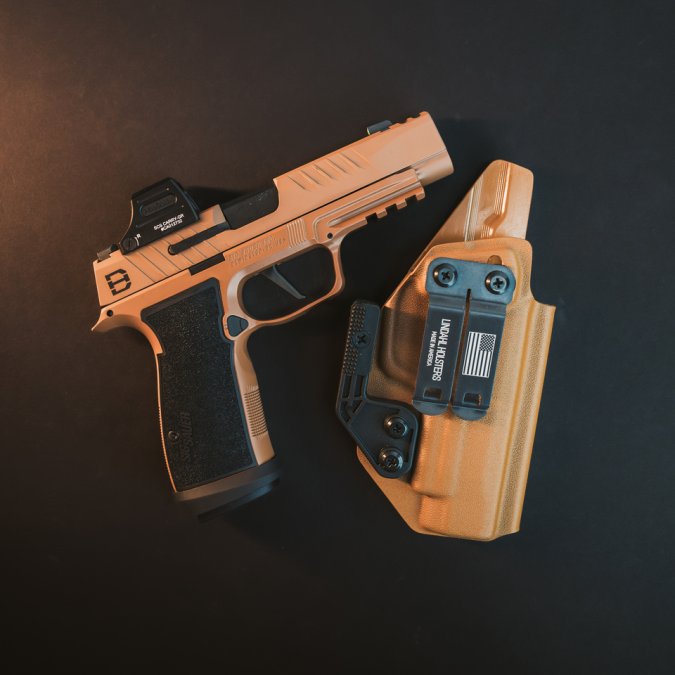
The slide is cut for a micro red dot footprint, and the pistol ships with a filler plate and the mounting hardware needed to seat a compatible optic. Because the cut is in the slide and the slide is shared, the same optic and the same plate work on either model. If you already own a compatible micro red dot, it moves between the two pistols without a new plate.
A few setup points that apply to both:
- Use a torque driver. Optic screws should be tightened to the manufacturer's specified value, not hand-tight (sigsauer.com). Over-torquing strips the slide threads; under-torquing lets the optic shift under recoil.
- Apply a small amount of threadlocker to the mounting screws, per the optic maker's guidance, and let it cure before live fire.
- Re-check screw torque after the first range session and again after a few hundred rounds. Vibration from the recoil cycle is the usual cause of a loosening optic.
- Confirm the filler plate is seated flush before mounting. A plate that sits proud will not hold zero.
Sight Radius and Iron Sights
Sight radius is identical because the slide and barrel are shared. Both pistols use the same iron sight configuration, and both allow a lower-third co-witness with most micro red dots depending on the optic's deck height. If you prefer to run irons only, nothing about the frame material changes your sight picture.
How the Optic Behaves Under Recoil
Where the models diverge is how the optic interacts with the recoil cycle. A red dot on a polymer-framed pistol is more affected by muzzle rise because the frame moves more under recoil. The same optic on the AXG DH3 tracks flatter and settles faster, which makes the dot easier to reacquire during rapid fire.
For a carry gun, this matters less than most people think. You are not chasing split times. For competition or high-round-count training, the AXG DH3 gives you a small but real advantage in how quickly the dot returns to the target.
Carry Versus Competition Setup
- For concealed carry: keep the optic as low-profile as possible, confirm the dot does not snag on the draw, and verify the holster is cut to clear the optic. Both the polymer and AXG holsters from Lindahl Holsters are optic-ready.
- For competition: a larger window optic is common, and the AXG's flatter tracking pairs well with it. Confirm your holster still clears the taller optic body.
- For both: re-verify zero after any change to the optic, plate, or mounting hardware. A dot that was zeroed on one pistol should be re-zeroed if moved to the other, since the two slides are separate assemblies even though the cut is the same.
The optic cut and footprint are shared, so your red dot and plate carry over between the two pistols. The frame is what changes how fast the dot settles, and the frame is also what determines which holster you need.
Choosing the Right P365 DH3 Holster
The P365 DH3 holster must be molded specifically for the polymer-frame FUSE DH3, because the polymer grip module has different external dimensions than the AXG. A holster built for the AXG will not properly retain the polymer DH3, and vice versa.
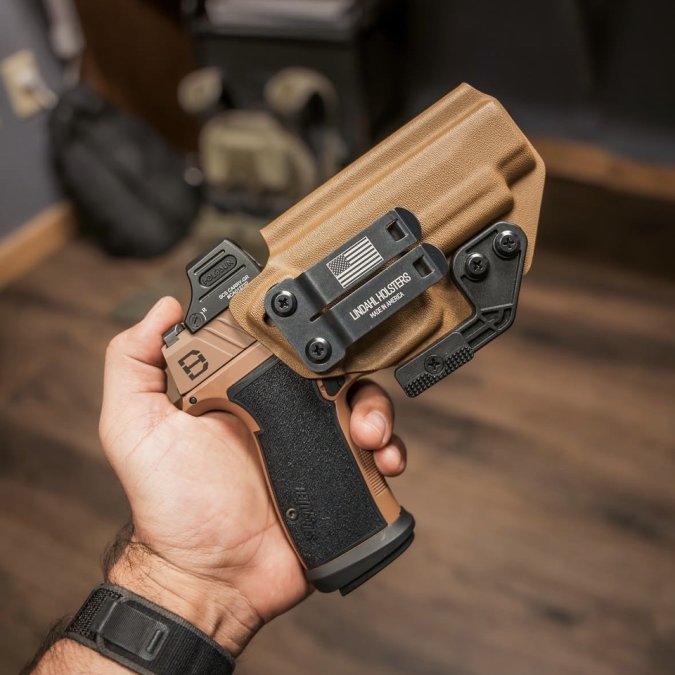
For inside-the-waistband carry, a custom-molded Kydex holster is the standard answer. Lindahl Holsters builds the IWB holster for the P365 FUSE DH3 with adjustable retention and cant from 0 to 15 degrees, a full-length sweat guard, and an audible click that confirms the pistol is seated. If you run a weapon-mounted light, the light-bearing version is molded for the Streamlight TLR-7 HLX and fits the MACRO, TACOPS, and COMP versions of the FUSE when using that same light.

For outside-the-waistband use, the optic-ready pancake holster is built from .08 Kydex with 1.5-inch belt loops and three ride-height positions.
Choosing the Right P365 AXG DH3 Holster
The P365 AXG DH3 holster must be molded for the metal grip module, and it is not interchangeable with the polymer DH3 holster. This is the single most common fitment mistake we see from shooters who assume the two pistols share holster compatibility.
Lindahl Holsters molds the IWB holster for the P365 FUSE AXG DH3 to the exact contours of the metal frame, with the same adjustable retention and cant range as the polymer version. The light-bearing option is molded for the AXG DH3 paired with the Streamlight TLR-7 HLX, and it also fits the Wilson Combat grip module. It does not fit standard P365 or P365XL grip modules.
If you carry outside the waistband, the optic-ready OWB pancake holster for the AXG DH3 uses the same .08 Kydex construction with a close-to-body fit and three-position ride height.
The rule is simple: match the holster to the frame, not the model name.
Which Model Fits Your Carry Setup?
Choose the P365 DH3 if your priority is all-day concealed carry comfort. The polymer frame is lighter, prints less under a shirt, and is easier to live with against your body for long stretches. It is the better choice for a daily carry gun that spends more time holstered than at the range.
Choose the P365 AXG DH3 if your priority is shooting performance. The metal grip module adds weight where it helps most, reduces muzzle rise, and gives you a flatter, faster-tracking pistol for competition, high-round-count training, or range work. It is the better choice if you shoot often and want the gun to work with you rather than against you.
Both are capable carry pistols. The decision is about which compromise you would rather live with: a little more felt recoil, or a little more weight on your belt.
The harder question is not which pistol to buy, it is which holster to trust with it. A holster molded for the wrong frame will not retain the gun properly, and that is a safety problem, not a comfort problem (nssf.org). Lindahl Holsters builds custom Kydex holsters for both the P365 DH3 and the P365 AXG DH3, with adjustable retention, a full sweat guard, and a 1-3 business day lead time on most orders. Military, law enforcement, and first responders receive a 15% discount, and shipping is free on orders over $125. Find your gun model and order the holster molded for your exact frame.
Frequently Asked Questions
Do the SIG P365 DH3 and P365 AXG DH3 use the same holster?
No. The two pistols use different grip modules, so a holster molded for one will not fit the other correctly. The P365 DH3 uses a polymer grip module, while the AXG DH3 uses a metal grip module with different contours. Retention depends on the holster matching the frame shape, so you need a holster molded specifically for your model. Lindahl Holsters lists separate IWB and OWB options for each version, so check the product title before ordering.
What is the difference between the P365 DH3 and the P365 AXG DH3?
The main difference is the grip module. The P365 DH3 uses a polymer frame, which keeps weight down. The P365 AXG DH3 uses a metal AXG grip module, which adds weight and changes the balance and recoil impulse. Both share the P365 Fuse slide and barrel length, the slide-integrated expansion chamber, and the coyote Cerakote finish. The metal frame version costs more and is heavier, which matters for all-day concealed carry.
Is the P365 AXG DH3 better for concealed carry than the standard P365 DH3?
It depends on your priorities. The P365 AXG DH3 is heavier because of the metal grip module, which some shooters prefer for recoil management and follow-up shots. The standard P365 DH3 is lighter, so it tends to carry more comfortably for long days. Both are full-size configurations with a 3.7-inch barrel, so neither is a micro-compact. Try both if you can, and pick based on whether you value shootability or lighter weight.
What optics are compatible with the SIG P365 AXG DH3?
The P365 AXG DH3 is optic ready and uses the SIG SAUER slide cut pattern, so it accepts the standard micro red dot footprint used across the P365 line. Confirm the specific footprint before buying an optic. On the holster side, an optic-ready holster like the Lindahl OWB Pancake for the P365 Fuse AXG DH3 has clearance for a slide-mounted red dot, so you do not need to remove the optic to holster the pistol.

