


Best Custom Kydex Holster Features Explained
Table of Contents
- What Makes a Custom Kydex Holster Worth Buying
- Precision Molding and Trigger Guard Coverage
- Adjustable Retention Holster Benefits: Passive vs. Active Systems
- Holster Claw and Wedge Explained: How They Improve Concealment
- IWB vs OWB Kydex Holster Comfort: Choosing the Right Carry Style
- Belt Attachment Options and Hardware Quality
- Maintaining Your Custom Kydex Holster for Long-Term Performance
- Conclusion
Last Updated: August 29, 2026
The holster you carry every day is a safety device first and a comfort solution second. Most buyers discover this after their second or third failed purchase. This guide on the best custom kydex holster features exists to break that cycle, whether you've been carrying for a decade or just got your permit last month.
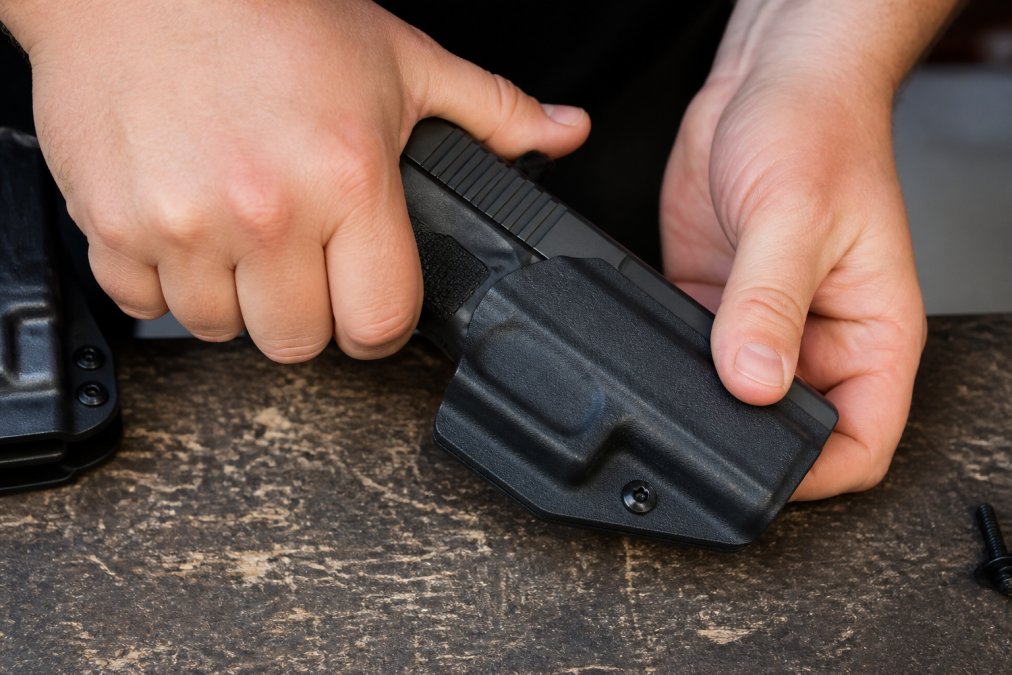
A custom Kydex holster is a retention device formed from thermoplastic sheeting, molded precisely to a specific firearm model, and configured with hardware that controls draw angle, ride height, and belt attachment.
What Makes a Custom Kydex Holster Worth Buying
The difference between a generic holster and a purpose-built custom Kydex holster comes down to three things: fit, retention, and configurability. Generic options are molded to approximate dimensions. Custom options are formed to your exact firearm model, including accommodations for weapon-mounted lights and optics when specified. A holster molded to a Glock 19 with a TLR-7A light is fundamentally different from one molded to a standard Glock 19, the geometry changes, retention points shift, and a holster that ignores your light will either fail to retain the firearm or refuse to accept it.
What separates a quality custom Kydex holster from the rest:
- Thermoformed to your exact firearm model (not a family of models)
- Adjustable retention with a user-accessible screw
- Full trigger guard coverage with no gaps
- Configurable cant and ride height
- Quality belt attachment hardware rated for daily carry
- Smooth, consistent draw with an audible click on re-holstering
- Compatibility with your specific weapon-mounted accessories
The audible click on re-holstering is a functional confirmation that the firearm is fully seated and retained. Any holster that doesn't produce a consistent click deserves scrutiny.
Feature |
Why It Matters |
What to Look For |
|---|---|---|
Thermoform molding |
Ensures bespoke fit to your exact gun |
Formed per model, not per size family |
Adjustable retention screw |
Allows tuning without replacing the holster |
Single screw, tool-accessible |
Full trigger guard coverage |
Prevents accidental trigger contact |
Zero gaps around the guard |
Cant adjustment |
Matches your draw angle and body type |
Multiple cant positions |
Hardware quality |
Determines long-term reliability |
Steel or reinforced polymer clips |
Concealment claw/wedge |
Reduces grip printing under clothing |
Modular, bolt-on design |
Precision Molding and Trigger Guard Coverage
Precision molding is the foundation of every other feature on this list.

How Thermoforming Creates a Bespoke Fit
Thermoforming heats Kydex sheet material until pliable, then presses it around a firearm mold under vacuum pressure to capture exact contours. Quality holsters typically use .08-inch Kydex, which balances rigidity with enough flexibility to produce clean retention points at the trigger guard and muzzle. The quality of the mold matters as much as the material. A professional vacuum-press system produces crisp, uniform wall thickness and consistent geometry across every unit.
Lindahl Holsters uses vacuum-pressed shells formed on calibrated molds, ensuring retention points and trigger guard geometry are repeatable and consistent. If you ever need a replacement shell, it will fit identically to the original.
Why Full Trigger Guard Coverage Is Non-Negotiable
Full trigger guard coverage means the Kydex shell completely encloses the trigger guard with no gaps that could allow a foreign object to contact the trigger during holstering. This is a safety standard, not a preference. According to SAAMI firearm safety guidelines, preventing unintended trigger contact is a core principle of safe firearm handling. Passive retention built around the trigger guard is the industry standard, holding the firearm securely without requiring active engagement while still allowing a clean, deliberate draw.
Adjustable Retention Holster Benefits: Passive vs. Active Systems
Retention is the most misunderstood feature in holster selection. Most carriers want their holster to hold the gun securely but release it cleanly, and those two goals exist in tension.
Passive retention uses friction fit to hold the firearm. The Kydex shell is formed tightly enough that the gun stays put under normal movement but releases with a deliberate draw stroke. The retention level is set by a single screw that compresses the shell slightly. Turning it clockwise increases tension; counterclockwise loosens it.
Active retention adds a mechanical locking device, hood, rotating lock, or thumb-operated lever that must be deliberately disengaged before the draw. For law enforcement and first responders, active retention is standard. For civilian concealed carry, passive retention with proper adjustment is typically sufficient.
The adjustable retention holster benefits for daily carry are straightforward: you can tune the draw resistance to match your preference and your holster's break-in state. New Kydex is stiffer than broken-in Kydex. Backing the retention screw out slightly when new, then tightening as the material settles, keeps the draw consistent throughout the holster's life.
Setting retention so tight that the draw requires two hands or a wrist-breaking effort is a liability. The correct tension produces a firm, positive draw with one hand and a clean audible click when the firearm seats on re-holstering.
Holster Claw and Wedge Explained: How They Improve Concealment
The holster claw and wedge are the two most impactful concealment features on an IWB holster, working through different mechanical principles.
A concealment claw (also called a wing) mounts to the holster body and presses against the inside of your belt. As belt tension increases, the claw rotates the grip toward your body, keeping the grip closer to your body rather than angling outward.
A holster wedge is a foam or rubber insert mounted at the muzzle end. It tips the muzzle slightly away from the body, which drives the grip inward. Wedges are particularly effective for appendix carry.
The Lindahl Holsters ModWing Concealment Claw Kit includes interchangeable riser inserts, one for mild rotation, one for aggressive rotation, so you can tune the concealment effect based on your clothing and body type. The reversible spine makes it ambidextrous.
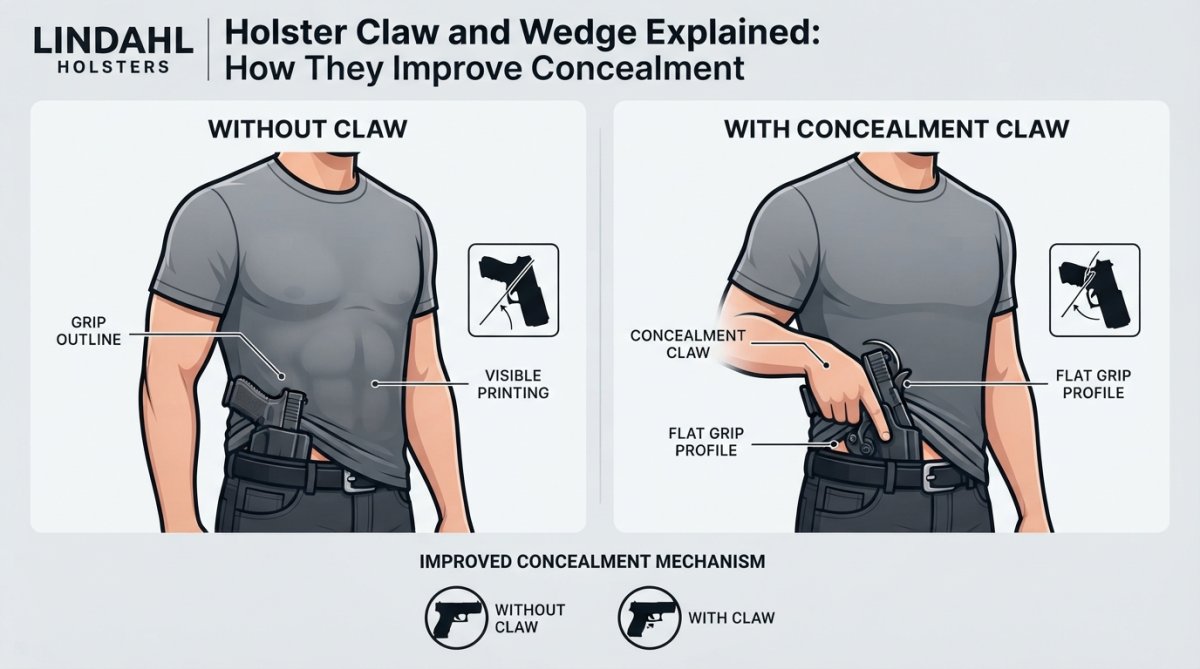
The combination of a claw and a wedge together produces the best concealability results for most appendix carry setups.
IWB vs OWB Kydex Holster Comfort: Choosing the Right Carry Style
The IWB vs OWB Kydex holster comfort question doesn't have a universal answer. It depends on your body type, clothing, and use case.
IWB (inside the waistband) positions the holster between your body and pants. The firearm rides closer to your body, improving concealability significantly. The tradeoff is that the gun and holster add bulk inside your waistband, typically requiring sizing up one waist size or choosing looser-fitting clothing. For everyday concealed carry, IWB is the dominant choice.
OWB (outside the waistband) positions the holster on the outside of the pants, attached directly to the belt. This is more comfortable for extended wear, easier to draw from, and better suited to open carry or range use. Concealing an OWB holster requires a cover garment, limiting its utility for deep concealment.
As noted in concealed carry research from the Crime Prevention Research Center, the carry method a person will actually use consistently is the right carry method for them. Comfort drives compliance.
Cant Adjustment and Ride Height for Your Body Type
Cant is the angle at which the holster positions the firearm relative to vertical. A zero-cant holster holds the gun straight up and down. A positive cant (FBI cant) tilts the muzzle forward. Negative cant tilts the muzzle rearward, common for appendix carry.
Ride height determines how high or low the grip sits relative to your belt line. A higher ride height keeps the grip accessible but may print more. A lower ride height hides the grip below the belt line but can make the draw more difficult. Carriers with longer torsos generally tolerate a higher ride height without printing. Carriers with shorter torsos or wider hips often need a lower ride height and a more aggressive claw.
Belt Attachment Options and Hardware Quality
The belt clip is the single point of contact between your holster and your body. It deserves careful attention.
Standard polymer belt clips are functional and inexpensive but can develop play over time with repeated on/off cycles. For serious daily carry, upgraded hardware makes a measurable difference in holster stability.
Belt clip options worth knowing:
- Standard polymer clip: The Lindahl Holsters IWB Standard Belt Clip is purpose-built for IWB setups and designed for secure belt retention throughout daily movement.
-
DCC Monoblock: The DCC Monoblock IWB Belt Clip uses high-strength spring steel with dual mounting slots that distribute weight evenly and reduce holster movement during draw and re-holstering.

-
Ulticlip UltiTuck: The Ulticlip UltiTuck converts a standard IWB holster into a tuckable, beltless carry system. Built from C-1075 spring steel heat-treated to RC 42-49, it attaches directly to clothing without a belt.

Soft loops are another belt attachment option worth considering. They thread through the belt rather than clipping over it, distributing the holster's weight across a wider surface and reducing rocking motion.
Hardware quality extends beyond the clip itself. Screws and posts holding retention hardware, clips, and accessories are subject to constant vibration. According to general fastener maintenance guidelines from the Machinery's Handbook, thread-locking compounds on small fasteners under vibration loads significantly reduce self-loosening. For holster hardware, medium-strength blue threadlocker applied to retention screws and clip mounting hardware prevents backing-out without making future adjustments impossible.
The Lindahl Holsters Blue Threadlocker is formulated specifically for holster hardware, strong enough to prevent loosening during carry and training, removable when you need to adjust retention or replace a component.
Maintaining Your Custom Kydex Holster for Long-Term Performance
Kydex is one of the most durable holster materials available. It doesn't absorb moisture, doesn't rot, and holds its shape under normal temperature ranges. However, a holster that sees daily use for years needs periodic attention to stay in peak condition.
Regular maintenance checklist:
- Check retention screw tension monthly; vibration from daily carry can loosen screws
- Inspect belt clip for cracks, deformation, or play; replace if the clip rocks on the belt
- Wipe the interior of the holster with a dry cloth to remove debris and lint
- Check all mounting hardware for looseness; apply threadlocker if screws have backed out
- Inspect the Kydex shell for cracks, particularly around mounting holes and retention points
- Test the audible click on re-holstering; a change in retention feel indicates a screw has moved
The most common long-term failure point is the hardware, not the Kydex itself. Keeping a spare hardware kit on hand eliminates downtime when a component fails. The Lindahl Holsters IWB Hardware Replacement Kit includes the screws, posts, and mounting hardware used in standard IWB configurations.
Kydex doesn't require lubrication, and applying gun oil to the interior is counterproductive. Oil softens the material over time and can reduce retention consistency. Keep the interior clean and dry. Sustained high heat will damage Kydex. Leaving a holster on a car dashboard in direct summer sun can cause the material to soften and deform slightly. Store holsters away from direct heat sources when not in use.
Conclusion
Choosing a holster that ends up in a drawer is an expensive way to learn what you actually need. The best custom kydex holster features, precise thermoform molding, full trigger guard coverage, adjustable retention, a quality concealment claw, and hardware built for daily use, aren't marketing language. They're engineering decisions that determine whether your holster performs when it matters.
Lindahl Holsters builds IWB, OWB, and Level 2 duty holsters to these standards, with a 1-3 business day lead time and a Military, Law Enforcement, and First Responder discount program. Find your gun model and get a holster that actually stays on your belt.
Frequently Asked Questions
Q: What makes a Kydex holster high-quality?
A: A high-quality custom Kydex holster starts with precision thermoforming that creates a bespoke fit for your exact firearm model. From there, look for full trigger guard coverage with an audible click on re-holstering, adjustable retention screws, a full sweat guard, and durable hardware. The polymer thickness matters too — .08-inch Kydex is the standard for everyday carry, offering the right balance of rigidity and slim profile.
Q: Why choose a custom Kydex holster over a mass-produced option?
A: Mass-produced holsters are built to fit a category of guns, not your specific pistol with its specific optic, light, or grip module. A custom Kydex holster is molded to your exact firearm configuration, which means consistent passive retention, a smooth draw every time, and no wobble. If you carry a light-bearing setup like a Glock 19 with a TLR-7A, a custom mold is the only way to guarantee a proper fit.
Q: What is the importance of adjustable retention in a holster?
A: Adjustable retention lets you dial in exactly how much friction holds your firearm in place. Too loose and the gun shifts during movement. Too tight and a fast draw under stress becomes a struggle. A quality custom Kydex holster uses a retention screw at the trigger guard that you can tighten or loosen with a hex key, giving you a friction fit tuned to your draw speed and carry conditions without changing the holster itself.
Q: Are sweat guards necessary on Kydex holsters?
A: A full sweat guard runs along the top edge of the holster body between the slide and your skin. For IWB and appendix carry, it serves two purposes: it protects your firearm's finish from moisture and body oils, and it keeps the sharp rear sight from digging into your side. For daily carry in any climate, a full sweat guard is a practical feature rather than an optional upgrade.
Q: How does holster cant and ride height affect concealment?
A: Cant is the forward or backward angle of the holster, and ride height is how deep the gun sits below your beltline. A forward cant of around 15 degrees works well for appendix carry, keeping the grip tucked close to the body. Higher ride height exposes more of the grip and increases printing risk. Dialing in both settings for your body type and clothing is one of the fastest ways to improve everyday concealment without switching holsters.

