


6 Best Concealed Carry Handguns for Beginners in 2026
Last Updated: November 1, 2026
Quick Summary
The best concealed carry handguns for beginners are the SIG Sauer P365 for overall balance, the Smith & Wesson Shield Plus for the softest recoil, and the Glock 43X for simple controls. Each of these six picks is a proven 9mm or .380 pistol that is small enough to conceal and easy enough to train with.
- We weighted shootability and ease of operation highest because beginners quit carrying when a pistol is punishing or hard to run.
- The Shield Plus is slightly larger than the P365 and Hellcat, making it a touch harder to hide in a t-shirt.
- The Hellcat is among the smallest 9mm pistols on this list, which is its main appeal for deep carry.
- The Ruger LCP MAX is the lightest, flattest option here, and its 10+1 capacity is unusually high for a .380 this size.
- The Shield EZ removes the biggest barrier to training for beginners with hand strength issues.
Table of Contents
- Quick Comparison: 6 Best Concealed Carry Handguns for Beginners
- How We Evaluated These Beginner Concealed Carry Handguns
- 1. SIG Sauer P365: Best Overall for Most Beginners
- 2. Smith & Wesson Shield Plus: Best Runner-Up and Softest Shooter
- 3. Glock 43X: Best for Glock Familiarity and Simple Controls
- 4. Springfield Hellcat: Best Micro-Compact for Deep Carry
- 5. Ruger LCP MAX: Best .380 for Pocket and Minimal Printing
- 6. Smith & Wesson Shield EZ: Easiest Slide to Rack for New Shooters
- How to Choose a Concealed Carry Pistol That Fits Your Hand
- Why the Best 9mm Handgun for Beginners Is Usually a Compact
- Frequently Asked Questions
Quick Comparison: 6 Best Concealed Carry Handguns for Beginners
The best concealed carry handguns for beginners are the ones you will actually carry, shoot well, and train with consistently. New carriers often cycle through pistols that look perfect on paper and then sit in a safe because the trigger is awkward or the slide is too stiff to run. This guide ranks six proven options and explains exactly why each one earns its place.
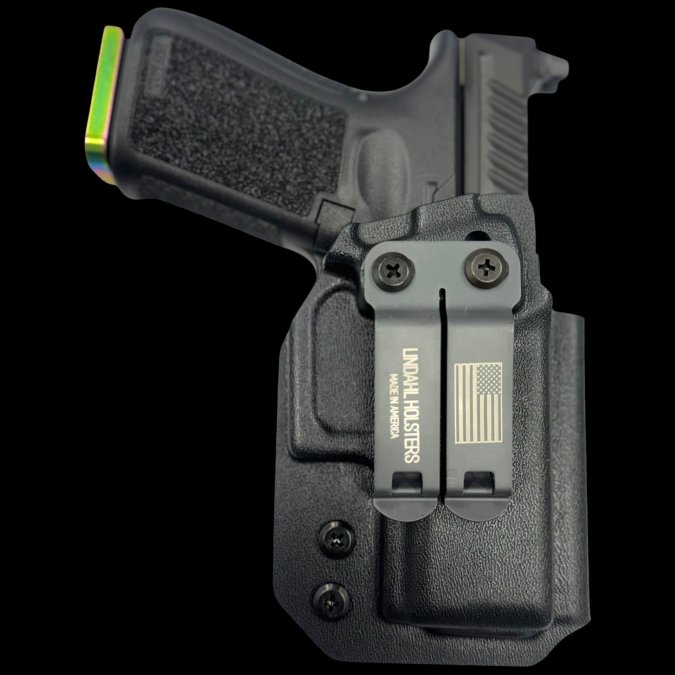
Below, we break down what matters most: fit, recoil, controls, capacity, and how each pistol pairs with a proper inside-the-waistband holster. Each of the six picks below has a clear use case for a first-time carrier.
Quick Picks:
- Best Overall: SIG Sauer P365, the balance of capacity, size, and shootability most beginners need
- Best Runner-Up: Smith & Wesson Shield Plus, softest shooting of the group
- Best for Glock Fans: Glock 43X, simple controls and familiar manual of arms
- Best Deep Carry: Springfield Hellcat, smallest 9mm here that still holds a real magazine
- Best Pocket Option: Ruger LCP MAX, lightest and flattest for minimal printing
- Easiest to Rack: Smith & Wesson Shield EZ, built for weaker hands and new shooters
| Pistol | Capacity | Best For | Key Feature |
|---|---|---|---|
| SIG Sauer P365 | 10+1 | Best overall | Optics-ready, compact grip |
| S&W Shield Plus | 10+1 | Softest shooter | Low recoil, good trigger |
| Glock 43X | 10+1 | Glock familiarity | Simple controls |
| Springfield Hellcat | 11+1 | Deep carry | Micro-compact, optics-ready |
| Ruger LCP MAX | 10+1 | Pocket carry | Lightest, flattest |
| S&W Shield EZ | 8+1 | Easy racking | Light slide, easy mags |
How We Evaluated These Beginner Concealed Carry Handguns
We ranked these pistols on five criteria that matter to a first-time carrier: shootability, ease of operation, concealability, reliability reputation, and holster support. Shootability covers recoil and trigger feel. Ease of operation covers slide racking, controls, and takedown. Concealability covers size and printing. We weighted shootability and ease of operation highest because most beginners quit carrying when a pistol is punishing or hard to run.
A pistol that holds more rounds but hurts to shoot is a worse beginner choice than one with a softer recoil impulse. Reliability matters too, and all six platforms are widely carried when fed quality ammunition and maintained properly.
One honest limitation: fit is personal. A pistol that suits a large hand may feel wrong in a small one, so treat this ranking as a starting shortlist, not a final answer.
1. SIG Sauer P365: Best Overall for Most Beginners
The P365 is our top pick because it does the hardest thing well: it stays small enough to conceal every day while still shooting like a larger pistol. The 9mm chambering keeps ammunition common and affordable, and the 10+1 capacity means you are not trading round count for size.
That said, the P365 is not the softest shooter in this group; the Shield Plus edges it out on recoil. If you have very small hands, test the grip before committing.
For carry, a dedicated IWB holster makes the difference between a pistol you carry and one you leave at home. Our SIG Sauer P365 compatible IWB holster is molded to the pistol's contours with adjustable retention, a full sweat guard, and an audible click so you know the pistol is seated.
Pros: Great size-to-capacity ratio, clean trigger, optics-ready options, huge holster support. Cons: Snappier recoil than the Shield Plus, premium price. Best for: Most beginners who want one pistol to carry and train with. Skip if: You have very small hands or want the softest possible recoil.
2. Smith & Wesson Shield Plus: Best Runner-Up and Softest Shooter
If recoil is your main concern, the Shield Plus is the answer. The 9mm Shield platform is generally regarded as manageable to shoot, and the Plus version adds capacity without making the pistol much harder to conceal.
The Shield Plus is slightly larger than the P365 and Hellcat, which makes it a touch harder to hide in a t-shirt. For a beginner building confidence, that matters more than a few tenths of an inch.
Our S&W Shield 3.1-inch and Shield Plus IWB holster is a closed-end Kydex design with a mid-rise sweat guard and fully enclosed trigger guard, built for appendix or strong-side carry.

Pros: Softest recoil here, good trigger, proven reliability, affordable. Cons: Slightly larger than the micro-compacts, not optics-ready on every model. Best for: Beginners who want the easiest pistol to shoot well. Skip if: You need the smallest possible footprint for deep carry.
3. Glock 43X: Best for Glock Familiarity and Simple Controls
The Glock 43X is simple to operate. It has no manual safety, minimal controls, and shares the manual of arms of other Glock pistols, which matters if you already train on one or plan to. The 10+1 capacity in a slim frame is a strong balance.
But for a beginner who values a simple, no-frills pistol, the 43X is a straightforward choice.
Pair it with a molded holster that covers the trigger guard completely. Our Glock 43X MOS IWB holster offers adjustable retention and cant with a slim Kydex profile.

Pros: Simple controls, proven reliability, huge aftermarket, familiar manual of arms. Cons: Mediocre factory trigger, basic sights, not optics-ready on the standard model. Best for: Beginners who already know Glock or want the simplest controls. Skip if: You want the best factory trigger or optics-ready out of the box.
4. Springfield Hellcat: Best Micro-Compact for Deep Carry
The Hellcat is among the smallest 9mm pistols on this list, which is its main appeal for deep carry. The OSP version is optics-ready, and it offers good capacity for its size.
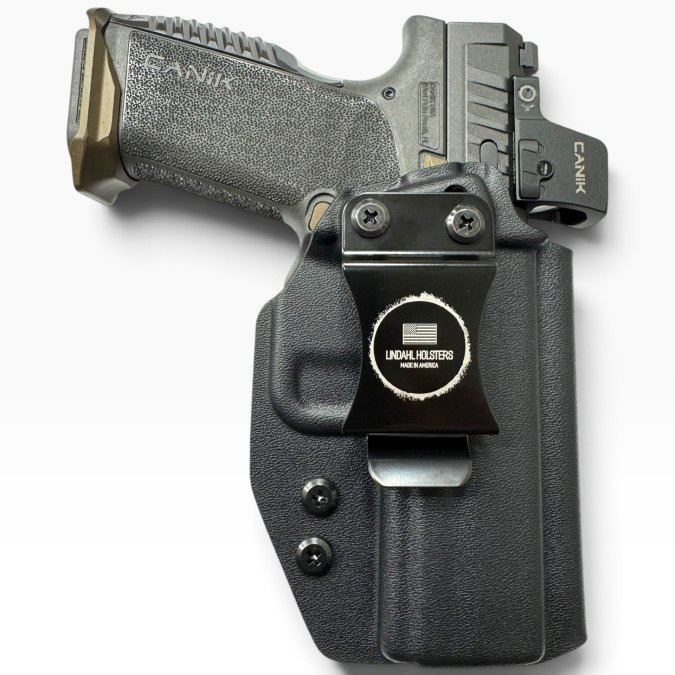
The tradeoff is recoil, and beginners should expect to train more to shoot a micro-compact 9mm well.
For deep carry, holster fit is critical. Our Hellcat OSP IWB holster is vacuum-formed to the OSP's slide and optics cut with a closed-end muzzle and full sweatshield. Our Hellcat OSP IWB holster is vacuum-formed to the OSP's slide and optics cut with a closed-end muzzle and full sweatshield.

Pros: Excellent deep carry, high capacity for size, optics-ready OSP version. Cons: Snappy recoil, less pleasant to train with, smaller grip. Best for: Beginners who prioritize concealment above all else. Skip if: You are recoil-sensitive or plan to shoot high round counts.
5. Ruger LCP MAX: Best .380 for Pocket and Minimal Printing
The LCP MAX is the lightest, flattest option here, and for some carriers that is the deciding factor. The .380 chambering produces less recoil than 9mm, and the pistol is small enough for pocket carry in the right holster. The 10+1 capacity is unusually high for a .380 this size, which fixes the main complaint about older pocket pistols.
The honest limitations: .380 ammunition is generally more expensive than 9mm, and the small grip may be harder to hold for large hands. It is a specialized tool for deep concealment, not a do-everything pistol.
Springfield Hellcat OSP 9mm IWB Holster – Closed-End Kydex Holster →
Our Ruger LCP MAX IWB holster is built around the LCP MAX's frame with a closed-end muzzle and fully enclosed trigger guard.
Pros: Lightest and flattest, low recoil, high capacity for a .380. Cons: .380 ammo costs more, less powerful, small grip. Best for: Pocket carry and carriers who want the smallest possible pistol. Skip if: You want one caliber for training and carry, or have large hands.
6. Smith & Wesson Shield EZ: Easiest Slide to Rack for New Shooters
The Shield EZ is designed with new shooters in mind, including those who find a stiff slide or magazine difficult. In 9mm, it keeps ammunition common while being gentler to run than most compact pistols.
The capacity is lower than the other 9mm picks, and the pistol is larger than the micro-compacts, so it is not the best deep-carry choice. But for a beginner with hand strength issues, or an older shooter, the EZ removes the biggest barrier to training.
Our S&W M&P 9 Shield EZ IWB holster is molded to the EZ 9 profile with adjustable retention and a closed-end muzzle.
Pros: Easiest to rack, easy magazine loading, gentle recoil, good for weak hands. Cons: Lower capacity, larger than micro-compacts, not optics-ready. Best for: New shooters with hand strength concerns. Skip if: You want maximum capacity or the smallest footprint.
How to Choose a Concealed Carry Pistol That Fits Your Hand
Choosing a concealed carry pistol starts with your hand, not the spec sheet. A pistol that does not fit your hand is hard to shoot accurately and unpleasant to train with, no matter how good its reputation. The goal is a pistol you can run safely under stress, not one that wins a spec-sheet comparison.
The three-point fit check
Before you buy, handle the pistol in person, dry-fire it if the shop allows, and run this sequence:
- Trigger reach. With a proper firing grip, can the pad of your index finger reach the trigger without shifting your hand? If you have to stretch or rotate your wrist, the grip is too long or too wide for you.
- Control reach. Can you drop the magazine and work the slide stop or release without breaking your grip? On micro-compacts, the slide stop is often the first control a small-handed shooter cannot reach.
- Slide rack. Can you rack the slide with a firm overhand grip, not just a pinch? If not, look at the Shield EZ or plan for a training regimen that builds the motion.
A common pattern is that beginners buy the smallest pistol they can find, then discover the short grip and stiff recoil spring make it the hardest one to shoot. Fit beats footprint.
Try before you buy
Where lawful and available, rent or borrow the models on your shortlist at a range before committing. A single range session with three pistols tells you more about recoil, trigger feel, and control reach than any spec sheet. Many ranges rent by the hour and let you swap models, which is the cheapest way to avoid buying the wrong pistol.
Carry position changes the fit equation
Appendix carry demands a shorter grip and a holster that covers the trigger guard completely. Strong-side carry is more forgiving on size. Whatever you choose, budget for a quality holster and training, not just the pistol. A proper IWB holster with full trigger coverage and adjustable retention is not optional; it is part of the safety system.
Know the law where you live
Concealed carry rules vary by state and change over time. Before you carry, check your state's official requirements for permits or permitless carry, reciprocity with other states, prohibited locations, and transport rules. A local instructor is the fastest way to get current, accurate guidance, and a state attorney general or state police website is the authoritative source for the text of the law. Do not treat any national guide, including this one, as legal advice.
Safe storage and handling from day one
A new carrier's setup is not complete without a secure storage plan. A locked case or safe for the pistol when it is not on your person, and a consistent routine for loading and unloading, prevent the most common accidents. Practice the four rules of firearm safety until they are automatic: treat every firearm as loaded, keep your finger off the trigger until you are ready to shoot, know your target and what is beyond it, and never point a firearm at anything you are not willing to destroy (4 Primary Rules of Firearm Safety • NSSF).
If you are still narrowing down a first holster, our guide on how to choose a holster for beginners without wasting money walks through the fit and retention checks that save you from a drawer full of mistakes.
Why the Best 9mm Handgun for Beginners Is Usually a Compact
The best 9mm handgun for beginners is usually a compact or micro-compact, not a full-size duty pistol. Compacts hit the sweet spot: small enough to conceal, large enough to shoot well, and chambered in the most common, affordable defensive caliber. Full-size pistols are easier to shoot but hard to hide. Subcompact .380s are easy to hide but harder to shoot well and cost more to feed.
Four of the six picks are 9mm compacts or micro-compacts, which let a beginner train with affordable ammunition and build skill on a pistol they can carry.
The mechanics behind the tradeoff
A shorter barrel and a lighter slide reduce the pistol's mass, so the same 9mm cartridge produces more felt recoil and more muzzle rise. A shorter grip gives less surface for your support hand, which compounds the effect. That is why a micro-compact 9mm snaps more than a compact, and why a compact is easier to learn on than a subcompact.
How we evaluated these pistols
Our ranking weighs five criteria: shootability (recoil and trigger feel), ease of operation (slide racking, controls, takedown), concealability (size and printing), reliability reputation, and holster support. We weighted shootability and ease of operation highest because most beginners quit carrying when a pistol is punishing or hard to run. We did not rank on hype or spec-sheet bragging rights. A pistol that holds more rounds but hurts to shoot is a worse beginner choice than one with a softer recoil impulse.
Total ownership cost, not just purchase price
The purchase price is only part of what a beginner spends. Ammunition for practice, a quality holster, a secure storage case or safe, and training classes all add to the real budget. Factor those costs in before you commit to a caliber.
The most common beginner mistake
Buying a pistol before you have handled it, or before you have a holster that fits it properly, is the most common beginner mistake we see. Fit the pistol to your hand, then fit the holster to the pistol. A pistol without a proper holster is a pistol you will not carry.
At Lindahl Holsters, we build custom Kydex holsters with complete trigger-guard coverage and adjustable retention. Explore compatible holsters at Lindahl Holsters and carry with confidence.
Frequently Asked Questions
What is a good first handgun for concealed carry?
A compact 9mm with a 3- to 3.5-inch barrel is the usual starting point. It is large enough to grip with both hands and control recoil, small enough to hide under a shirt, and cheap to practice with. The SIG Sauer P365 and Smith & Wesson Shield Plus are the two most common answers because they balance capacity, size, and shootability. Handle several before buying, and pick the one your hand wraps around naturally.
Is a compact or subcompact handgun easier for beginners to shoot?
Compact pistols are easier to shoot. A longer grip gives you more surface for your support hand, extra weight softens recoil, and the sight radius is longer. Subcompacts hide better but punish sloppy grip technique. Many beginners buy the smallest gun they can find, struggle at the range, and stop practicing. Start with a compact, learn the fundamentals, then add a smaller gun for deep carry once your grip is solid.
What caliber is best for a beginner concealed carry handgun?
9mm is the practical default. Ammunition is widely available, practice costs less than most other defensive calibers, and modern defensive loads perform well. Recoil in a compact 9mm is manageable for most adults. .380 ACP is worth considering if hand strength or recoil sensitivity is a concern, and the Ruger LCP MAX makes it a viable deep-carry option. Avoid starting with calibers you cannot afford to shoot often.
How should a concealed carry holster fit a handgun?
The handgun should seat with an audible click, with no wiggle or rattle, and the trigger guard must be fully enclosed. Retention should hold the gun upside down without releasing it, yet allow a clean draw with a firm pull. The muzzle should be covered to keep debris out. Lindahl Holsters molds each Kydex shell to a specific model, so a P365 holster will not fit a Hellcat, and a Hellcat holster will not fit a Hellcat Pro.
What training should I take before carrying a handgun?
Start with a basic handgun safety course that covers the fundamentals of safe handling, loading, unloading, and storage. Then take a concealed carry class that addresses your state's permit requirements and the legal rules for use of force. Live-fire practice should follow, at least monthly at first. Dry-fire practice at home builds trigger control cheaply. Confirm the current requirements with your state's licensing authority before you apply.


