


Is a Light Bearing Holster Good for Appendix Carry?
Table of Contents
- What Makes a Light Bearing Holster Different for AIWB
- The Real Concealed Carry Weapon Light Benefits
- Does a Light Make the Holster Bulkier? Biomechanics and Bulk
- AIWB Holster Concealment: Managing Printing With a Light
- Appendix Carry Comfort Tips for Light-Bearing Setups
- Safety Considerations: Retention, Trigger Guard, and Muzzle Discipline
- Holster Fitment and Compatibility With Different Light Models
- Maintenance and Dry-Fire Training for Light-Bearing AIWB
- Conclusion
- Frequently Asked Questions
Last Updated: September 29, 2026
What Makes a Light Bearing Holster Different for AIWB
A light bearing holster is a holster molded specifically around a pistol with a weapon-mounted light attached, rather than around the pistol alone. That single design difference changes retention geometry, shell dimensions, and how the whole package sits against your body. At Lindahl Holsters, we build every light-bearing shell on a dedicated mold for the exact firearm and light combination, because a generic fit is where most appendix carry problems start.
The question of whether a light bearing holster is good for appendix carry has a short answer: yes, with conditions. A properly molded light-bearing AIWB holster gives you a consistent draw stroke, full trigger guard coverage, and the same concealment you would get from a non-light holster. A poorly molded one adds bulk, prints through a t-shirt, and digs into your pelvic bone.
The difference between those two outcomes is fitment, not the light itself.
The Real Concealed Carry Weapon Light Benefits
The main concealed carry weapon light benefits come down to target identification and control. A weapon-mounted light keeps your support hand free, gives you a single-handed lighting option, and puts the light source on the same axis as your muzzle. For appendix carriers who spend most of their waking hours in low-light environments like parking structures, stairwells, and unlit entryways, that matters.
There is a real trade-off, though. A handheld light lets you illuminate a space without pointing a firearm at it. Some instructors argue that alone makes handheld the better default for civilian carry. The honest position is that both tools solve different problems, and a light-bearing setup makes more sense if you already train with it consistently.
What most guides miss is that a light on the gun does not replace a handheld. It complements one. Carriers who treat the weapon-mounted light as their only illumination tool often end up using the pistol as a flashlight, which is exactly the habit you do not want to build.
Does a Light Make the Holster Bulkier? Biomechanics and Bulk
Holster bulk increases, but the amount depends almost entirely on which light you mount. The shell has to wrap the light body, so the added material tracks the light's dimensions rather than the pistol's. A compact light like the Streamlight TLR-7 family adds roughly 1.1 to 1.2 inches of width at the light body, while a full-size light like the SureFire X300U adds closer to 1.4 inches and extends the shell forward by another inch or more. Those fractions of an inch are what separate a setup that disappears under a t-shirt from one that prints at the belt line.
The biomechanics are where light-bearing AIWB differs most from a plain holster, and most guides skip this entirely. Adding a light shifts the pistol's center of mass forward and down. In the appendix position, that shift changes how the grip sits relative to your belt line and moves the pressure point against your body. On a non-light holster, the primary contact is the flat back of the slide against the lower abdomen. On a light-bearing shell, the extra width forward of the trigger guard creates a second contact patch against the pelvic bone and the crease of the thigh. That second patch is where hot spots form.
A holster with a neutral cant and an adjustable ride height lets you correct for the center-of-mass shift. Without those adjustments, the grip tends to rotate outward and print. A slight forward cant can rotate the light body away from the pelvic crease, which reduces the hot spot but can change your draw index. There is no universal setting, the right cant depends on your torso length and where the light body lands against your pelvis.
The other factor is the closed-end versus open-end muzzle design. A closed-end shell fully encloses the barrel and keeps debris out, but it adds a small amount of length. An open-end design trims that length at the cost of exposed muzzle. Neither is universally better. It depends on whether you prioritize protection or the shortest possible footprint.
AIWB Holster Concealment: Managing Printing With a Light
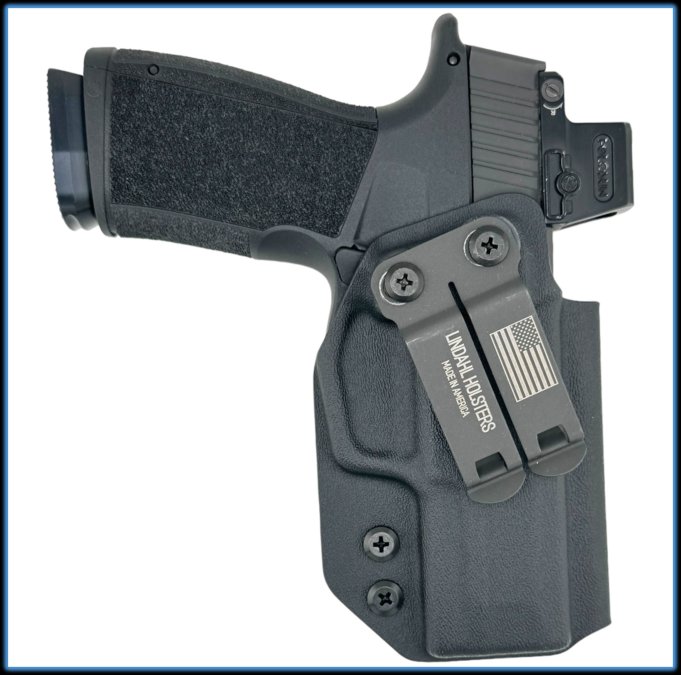
AIWB holster concealment with a light comes down to three variables: ride height, cant, and the concealment wing. Get those right and a light-bearing setup disappears under a fitted t-shirt. Get them wrong and you get a visible bulge at the belt line.
Best IWB Holster for Light Bearing: 2026 Guide
Ride height controls how much of the grip sits above the belt. Lower is more concealable but slower to draw. A concealment claw, sometimes called a concealment wing, pushes the grip back toward your body by applying pressure against the inside of the belt. That single piece of hardware does more for printing than almost anything else on the holster.
Body type changes the math. A carrier with a longer torso can run a lower ride height and still get a full grip. A shorter torso often needs a higher ride with a stronger wing to keep the grip tucked. This is why a holster that conceals perfectly on one person can print badly on another with the same pistol and light.
Appendix Carry Comfort Tips for Light-Bearing Setups
Appendix carry comfort tips for light-bearing setups start with the belt, not the holster. A stiff gun belt distributes the weight of the pistol, light, and holster across a wider area, which reduces the pressure point against your pelvic bone. A floppy belt concentrates that load in one spot, and no amount of holster padding fixes it.
Next, look at the back of the holster. A full sweatshield running the length of the slide keeps the pistol and light body off your skin and reduces moisture exposure. On a light-bearing shell, the shield also covers the extra material forward of the trigger guard, which is exactly where a bare Kydex edge would otherwise dig in.
Ride height and cant adjustments matter here too. A slight forward cant on an appendix holster can move the muzzle away from the crease of your leg. Some carriers find a straight-drop neutral cant more comfortable. There is no universal answer, which is why adjustable hardware is worth prioritizing over a fixed design.
- Loosen the retention screw a quarter turn at a time until the draw is smooth
- Move the clip one position and re-test for a full day before changing anything else
- Wear the setup around the house before committing to a full carry day
Safety Considerations: Retention, Trigger Guard, and Muzzle Discipline
Safety in a light-bearing appendix setup rests on three things: retention, trigger guard coverage, and muzzle discipline during the draw stroke. A holster that passes all three checks is safe to carry. One that fails any of them is not, regardless of how comfortable it feels.
Passive retention comes from the molded shell gripping the pistol and light at specific contact points. Active retention adds a mechanical device, like a thumb break or hood, that you must release before the draw. For appendix carry, passive retention set correctly is usually enough. For duty use, active retention is the standard.
Hellcat Pro w/ TLR-7 Sub 1913 IWB →
Trigger guard coverage is non-negotiable. The shell must fully enclose the trigger guard so nothing can reach the trigger while the pistol is holstered. On a light-bearing holster, that coverage extends around the light body as well, since the light sits forward of the trigger guard and changes the shell's internal geometry.
Muzzle discipline during the draw is the part you control. Because the muzzle points at your body during an appendix draw, the draw stroke must be clean and consistent, with the finger off the trigger until the pistol is clear of the holster and rotated toward the target. This is a training issue, not a holster issue, but the holster's fitment determines whether a clean draw is even possible.
Holster Fitment and Compatibility With Different Light Models
Fitment is where light-bearing holsters live or die. A holster molded for a Streamlight TLR-7 Sub in the 1913 configuration will not fit the same light in the SA configuration, because the rail key and body geometry differ. The same goes for full-size versus sub-compact light bodies. They are not interchangeable.

Hellcat Pro w/ TLR-7 Sub 1913 IWB Holster – Closed-End Kydex
This is why the specific light model matters more than the brand. Two lights from the same manufacturer can have completely different footprints. Before ordering, confirm three things: the exact light model, the mounting configuration, and the rail key you are using.
Setup |
Holster Fitment Requirement |
Common Mistake |
|---|---|---|
Compact pistol with sub-compact light |
Mold built for the specific light body |
Assuming all sub-compact lights share geometry |
Full-size pistol with full-size light |
Shell sized for the larger light footprint |
Ordering a sub-compact shell and forcing the fit |
Light with multiple rail keys |
Correct key installed before molding |
Using the wrong key, which misaligns the light |
Pistol with compensator plus light |
Shell with proper muzzle clearance |
Standard shell that binds on the compensator |
A holster like the Hellcat Pro with TLR-7 Sub 1913 IWB holster is built on a light-specific mold for that exact configuration, which is why it locks up consistently. The same principle applies across the lineup, including the Canik Prime Radian TLR-7 Sub 1913 IWB holster and the Glock 17 with TLR-7/7A/7X IWB holster.


Maintenance and Dry-Fire Training for Light-Bearing AIWB
Maintenance on a light-bearing holster is mostly about the lens, the emitter, and the shell interior. The light lens collects lint and dust from clothing, which degrades output over time. Wipe it with a microfiber cloth and check that the holster's closed-end design is not trapping debris against the lens. The emitter window is the more fragile surface, a scratched emitter scatters the beam and reduces throw. Avoid abrasive cloths and never use solvents on the lens or emitter. Keeping the holster clear of debris is essential for reliability, just as selecting appropriate tactical clothing options ensures that your daily carry setup remains both comfortable and discreet.
The shell interior needs attention too. Grit that works its way inside can scratch the light body and the slide finish. A dry brush and a wipe-down every few weeks keeps the contact points clean and preserves the molded fit. Do not use solvents on Kydex. Warm soapy water and a soft cloth are enough. On light-bearing shells, pay extra attention to the area around the light body and the retention screw. That screw controls how tightly the shell grips the light, and it can walk loose over weeks of carry. Check it monthly and re-torque to the manufacturer's spec.
Retention mechanisms on light-bearing holsters are often more complex than on plain shells because the shell has to index off both the pistol and the light. Some designs use a single adjustable screw; others use a combination of molded contact points and a tension screw. If your holster has a thumb break or hood, inspect the release for wear and confirm it still engages fully with the pistol seated. A worn active-retention device is a safety problem, not just a performance one.
Dry-fire training specific to light-bearing AIWB should focus on the draw stroke, grip acquisition, and light activation. The added bulk of the light changes where your hand meets the grip and how the pistol clears the shell. Practice drawing to a consistent index, then activating the light only after the pistol is on target. Building the habit of activating the light during the draw, before the muzzle is oriented, is a mistake worth avoiding.
- Confirm the pistol is unloaded and all ammunition is in another room
- Draw to a consistent index, ten repetitions at a slow pace
- Practice light activation after the pistol is on target, not during the draw
- Check retention after every session by inverting the holster
- Re-torque the retention screw monthly and inspect the lens and emitter for debris
Conclusion
The honest answer to whether a light bearing holster is good for appendix carry is that it depends entirely on fitment. A shell molded around your exact pistol and light combination gives you consistent retention, full trigger guard coverage, and concealment that holds up under a t-shirt. A shell that "mostly fits" gives you none of that.
That is the whole reason Lindahl Holsters builds every light-bearing holster on a dedicated mold for the specific firearm and light. Add adjustable retention, a full sweatshield, and a slim Kydex profile, and you get a setup that carries comfortably all day without printing.
National Shooting Sports Foundation
Most appendix carry problems trace back to a holster that was never molded for the specific pistol and light combination. Lindahl Holsters builds custom Kydex holsters on dedicated light-bearing molds, with adjustable retention, a full sweatshield, and a slim profile designed for low-print daily carry. Military, law enforcement, and first responders get 15% off, orders ship free over $125, and most custom orders ship in 1-3 business days. Find your gun model and get a holster that actually fits your setup.
Frequently Asked Questions
Does a weapon-mounted light make a holster bulkier for appendix carry?
Yes, a light adds material to the holster shell, which increases overall bulk. The additional Kydex needed to cover the light extends the holster's footprint, especially around the muzzle and trigger guard area. This extra material can push the holster further away from the body, affecting both concealment and comfort. However, a properly molded light bearing holster designed for appendix carry minimizes this bulk by keeping the profile as slim as possible while still fully enclosing the light and trigger guard.
What are the safety considerations for appendix carry with a light?
The main safety concern with appendix carry is muzzle direction, since the holster sits near the femoral artery and pelvis. A light-bearing holster must have a fully enclosed trigger guard that covers both the firearm and the light area. Retention should be tested by inserting the loaded firearm into the holster and turning it upside down to confirm it does not fall out. Also check that the light is securely mounted and that the holster does not allow the trigger to be accessed while the firearm is holstered.
How does a light-bearing holster affect concealment?
Concealment depends on the holster's design and how it sits on your body. A light adds length and width to the holster, which can create a visible bulge under clothing if the holster is not positioned correctly. Using a holster with a concealment wing or wedge pushes the grip closer to your body, reducing printing. Adjusting ride height and cant so the light sits below the belt line also helps. A well-designed AIWB holster for a light-bearing setup can conceal as effectively as a standard holster with the right adjustments.
Is it necessary to have a light on an appendix carry firearm?
It is not necessary, but many carriers choose a weapon-mounted light for low-light visibility and target identification. A light lets you see what you are aiming at without holding a separate flashlight, which keeps one hand free. The trade-off is added holster bulk and the need for a light-specific holster. If you rarely find yourself in low-light environments or prefer a separate handheld light, a standard holster may be a better fit. The decision comes down to your daily carry conditions and training.

